Prospective students imagine a life at Antioch College

Unsure if she wanted to attend college, Jennifer Carlson took a year off after high school to work in an orphanage and school in India. But upon being accepted to Antioch College’s first new class, she is now re-considering college because of Antioch’s co-op opportunity.

“I don’t want to sign away four years of my life to go to school,” she said on a tour of the campus last week. “I’m interested in working and having experience in the world.” If she enrolls at the newly re-opened college this fall, Carlson, of Austin, Texas, hopes to study human rights and media.

“I’m ready for an adventure,” said accepted student Forrest Humphrey, who attended a youth initiative high school in southwest Wisconsin. “The most attractive thing to me [about Antioch] is this idea of community governance, of taking control of my education.”

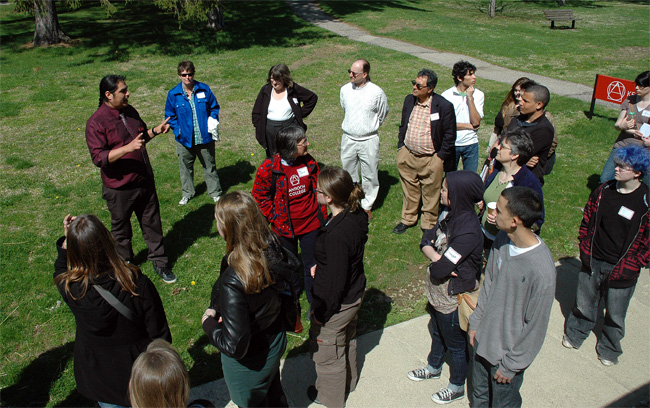
Carlson and Humphrey were two of 24 admitted students who visited the college last Sunday ahead of a May 1 deadline to enroll.

“It was a really good cross-section of our pool,” said Kristen Pett, special assistant to the president for enrollment, in discussing the campus visitors. “In this group I see a really talented, adventurous, bright, diverse group of students with strong leadership skills.”

The prospective students toured the campus buildings in which they would spend most of their time beginning this fall — McGregor Hall for classes and Birch Hall for living and eating — and heard from Antioch alumnus and MacArthur Genius Award winner Timothy Barrett and recent graduates of the college.

“I think what came through is we have things to offer that other schools don’t,” said President Mark Roosevelt of the presentations. “For the right students, Antioch is well worth thinking about.”

Forty-five students have been accepted into the college as Horace Mann Fellows. If they enroll, they will have their full four-year tuition paid for by the college, while they would cover room and board expenses and fees. Before last weekend, six students had already committed to the college with a $450 deposit, and about twice as many have said they are definitely coming, according to Director of Communications Gariot Louima. An additional 30 prospective students are on a waiting list, he said. After the open house, more may commit to the college.

“We got overwhelmingly positive feedback from parents and students,” Pett said after the open house. “We actually had a number of students that came undecided and left decided — in a positive way.”

Students were most curious about student life, which is hard to imagine on a campus that currently has no students. And Pett was most impressed by the co-op experiences of alumni who spoke, she said.

“You could go to a school that has a football team … or where you’re going to actually grow as a person and have a résumé of actual experience,” said alumna Fela Pierre-Louis on a panel of 2008 graduates.

For Diana Lopez, it was the co-op opportunities, plus the free tuition and the chance to study abroad that attracted her to the college.

“When you apply for a job, the one thing they look for is experience,” said Lopez, who hails from Chihuahua, Mexico and hopes to study forensic psychology.

Sam Senzek, who wants to learn Japanese and pursue East Asian studies, is excited that she may be able to do so through Antioch. Senzek, of Lisbon Falls, Maine, looks forward to working closely with her fellow students.

“What interests me is the fact that it’s kids of a pioneering group starting a college over again — there’s going to be a unique group,” Senzek said.

Sam Franco of Oakland, Calif. said he looks forward to helping shape the college.

“While they’re trying to re-build the program they will be incorporating everyone’s ideas,” Franco said. He was additionally attracted by the amount of attention he will receive as a student, the school’s history and the peaceful campus.

Nargees Jumahan said Antioch would give her the educational experiences she wants in a beautiful, natural setting.

“I can sit and meditate here,” she said. “This is how the earth’s supposed to be — to me it’s beautiful to explore and look at it.”

Jumahan said that if she weren’t accepted at Antioch, she would have joined the military. Jumahan now plans to work for women’s rights in Afghanistan, where she was born and raised, on one of her co-ops.

Greylyn Burk, of Shelbyville, Ky. said she appreciates how the curriculum’s global seminars will expand her thinking.

“It’s not just an education, it will make me into a better person,” said Burk. “It will be tough, but it’s something I want to do.”

Burk learned about Antioch from her mother, a self-described hippie who participated in student activities and protests on campus in the early 1970s. Because she is interested in film studies, Burk was excited to learn about the Little Art Theatre and the many local filmmakers she might be able to work with.

Twenty four-year-old Adam Abraham appreciates that the college treats its students more like adults and empowers them to take initiative, rather than being more like a factory that gives out diplomas. Abraham’s aunt attended Antioch in the 1960s, leaving the college after three years to stay on a co-op job helping at-risk youth.

“It really touched me to visit here and hear from all the alumni about their passions” said Abraham, adding he will definitely be among the first class that starts school on Oct. 4, with plans to study psychology, anthropology and history.

On a tour of campus, Admission Ambassador Shane Creepingbear told students to envision high-tech greenhouses and orchards on the golf course and a student lounge and café at the Olive Kettering Library. But bigger priorities for the college are upgrading the heating and cooling systems of Birch and McGregor, while these other campus renovations will depend upon fundraising, Louima said.

“The campus is in various states of disrepair, but it’s kind of romantic to think about all the people that have been here,” Abraham said.

Also visiting campus were seven high school underclassmen considering enrolling at Antioch in the next few years. Among them was 15-year-old Kyle Brennan from Carmel, Ind.

“I’m attracted by how much diversity and how accepting people are here,” Brennan said. “You’re accepted here no matter who you are — that’s a big thing for me.”

If he chooses Antioch, and the college is successful in its revival efforts, Brennan would enter in the fall of 2013.

Finances a challenge, but college confidently advances

At Antioch College a new class of 45 students has been accepted, three of the six initial faculty positions have been filled and work to renovate the campus continues. While optimism is high, finances are tight, and as the college moves closer to re-opening this fall, its reliance on donations will continue to grow.

“We are in the interesting position of not expecting significant revenue from students until 2013, so we are more dependent on philanthropy until then,” said President Mark Roosevelt in an interview last week, pointing out that the re-opened college will pay the full four-year tuition for the first class of students who enroll.

Currently, the college has just two months of operating cash on hand even while it counts as assets a $25-million endowment in addition to $5.5 million in outstanding pledges.

“I can’t deny that having two months of money in the bank is a challenge,” Roosevelt said. “But we will end this year with a surplus, because we will raise more than we spend.”

By the end of the college’s fiscal year in June, Roosevelt expects to raise additional money from this year’s outstanding pledges and alumni at this summer’s reunion, especially as the college takes major steps towards re-opening.

Antioch’s annual expenses of $6.5 million will increase to about $8 million in the fall to pay for faculty, staff and facilities. But some of the endowment’s restricted funds for scholarships will be available then, though the college is only allowed to use 5 percent of its endowment each year to operate.

To pay for expenses next fiscal year, Roosevelt estimates about $2 million will come from donors giving to Antioch’s annual fund, $1.4 million from the endowment and the remaining, about $4.6 million, from major gifts.

“There are some people of means deeply committed to seeing this enterprise succeed and many of these same people will have to fill the gap,” he said.“My job is to be able to create an institution that is attractive to other folks not in this core group and cultivate a large group of caring alums.”

Roosevelt said he hopes the alumni who have been “true believers,” supporting the college when it wasn’t clear if it would succeed, will pass the baton to those who have been hesitant to donate in an uncertain time or because of contentious issues such as the role of former faculty. Before then, more healing needs to take place in the Antioch community, Roosevelt said.

“Not that everyone is happy, but there is progress on reducing the loud tensions,” Roosevelt said, citing the hiring of former professor Hassan Rahmanian as dean of curriculum, assessment, planning and interdisciplinary learning, and continued conversations with former faculty to see how they might fit into the new college.

“[The tensions] need to be dealt with to create the atmosphere that giving will take place in,” he added. Roosevelt is also beginning to meet with large foundations to diversify the college’s donation sources.

“Technically we’re completely dependent upon alumni and other philanthropists right now,” echoed Antioch Pro Tempore Board Chair Lee Morgan. “But we have a relatively healthy balance sheet compared to many schools that have a lot of debt.”

The 45 admitted students and their families have been invited to campus on Sunday, April 17, for a campus tour and presentations by alumni. Alumnus Timothy Barrett, a MacArthur Genius Award winner, will speak, recent graduates will share their co-op experiences and prospective students will tour the Birch Residence Hall, where they will live and eat if they enroll.

By the end of April, the next three full-time faculty positions, in Spanish, literature and 3-D art, will be announced, Roosevelt said. And nearly $3 million has been spent on building renovations and maintenance since independence, which Roosevelt hopes to accelerate before the school year begins.

“Our goal is to be the greenest campus known to man,” Roosevelt said, citing his hope to raise money from large donors for energy-efficiency upgrades. In the meantime, conversations with local groups about partnering to renovate and operate a gym and performance space continue.

As the college moves closer to re-opening, Roosevelt said he believes the money will follow.

“They’ve raised $22 million in the last few years with no students, a campus and only a hope,” he said. “So there is urgency, there is need, but there are also resources and commitments.”

Admitted Antioch students visit campus

Twenty-four of the 45 students who have been admitted to Antioch College attended an open house at the college on Sunday. As Horace Mann Fellows, they will have their full four-year tuition paid for by the college if they choose to enroll. The deadline is May 1.

The prospective students toured the campus buildings in which they would spend most of their time beginning this fall — McGregor Hall for classes and Birch Hall for living and eating — and heard from Antioch alumnus and MacArthur Genius Award winner Timothy Barrett and recent graduates of the college.

For interviews with the new students, see the April 21 issue of the News.

A panel of 2008 graduates discussed their co-op experiences and answered questions from prospective students.

A panel of 2008 graduates discussed their co-op experiences and answered questions from prospective students.


Admission Ambassador Shane Creepingbear told students the library would host a cafe.

Admission Ambassador Shane Creepingbear told students the library would host a student lounge and cafe.

Antioch College— Contemplating mindfulness

Stop. Close your eyes. Now envision an Antioch College where students are challenged to contemplate as well as analyze — to understand the outer world and reflect on the inner.

Imagine that classes might start with a 10-minute meditation, that students experiment with contemplative practices from spiritual traditions around the world, and that they bring mindfulness to bear on math and physics equations as well as to works of art and literature.

If this sounds Antiochian, it’s because it is. A group consisting largely of former Antioch faculty and students is promoting contemplative education as the fourth “C,” and one which would enhance the existing principles of classroom, co-op and community.

And if the group is successful in its efforts, beginning with a groundbreaking symposium this weekend, the college’s future students may have better attention, empathy, tolerance, equanimity and less stress, anxiety and distractions than other college students, organizers said.

At “Green Space for the Mind,” on Saturday, April 9, at Antioch’s Herndon Gallery, leading scholars will report on their efforts to incorporate contemplative practices into higher education. A Christian monk, a University of California neuroscientist, a professor of Buddhism and a Brown University institute director will offer advice on how the revived college could lead in this emerging field. The event, which runs from 10 a.m. to 4 p.m., is free and open to the public.

“The college would be at the forefront of something that is a big part of where higher education is heading,” said organizer Amy Maruyama, a 1996 Antioch graduate.

Contemplative practices would help students think more deeply about subjects and integrate new perspectives, according to organizer Robert Pryor, founder and director of Antioch Education Abroad’s Buddhist Studies Program.

“It’s not an alternative to rational thinking, it’s an enhancement,” said Pryor, also the symposium moderator. “We don’t have a different goal about liberal arts — these methods help achieve the traditional goals of education.”

Harold Roth, director of the Contemplative Studies Initiative at Brown University and a panelist at Saturday’s symposium, said he sees contemplative practices as a way to foster academic learning as well as to help students deal with emotional stresses and get along with one another.

“They are less judgmental about themselves and have more compassion for themselves and others,” Roth said of students employing such practices.

Sponsored by the Southwest Ohio Council for Higher Education, or SOCHE, the symposium is the first of four events over the next few years introducing the Antioch and greater academic community to the benefits of contemplative practices and how to use them on campuses and in classrooms. SOCHE has given $10,000 to the initiative, with half going to its first event.

Daniel Goleman, best-selling author of Emotional Intelligence, will speak via Webcast at 10 a.m. on environmentally-conscious consumerism, the topic of his latest book, Ecological Intelligence. Goleman’s son, Hanuman, is an Antioch alumnus.

Following Goleman’s address and a lunch break, a panel discussion will begin at 1 p.m. among Roth, Linda-Susan Beard, a Bryn Mawr College associate professor of literature; John Makransky, professor of Buddhism and comparative theology at Boston College, and Clifford Saron, associate research scientist at the Center for Mind and Brain at the University of California at Davis.

Beard will offer contemplative practices from a Western spiritual perspective and Makransky brings an Eastern one, while Antioch’s model would be secular.

“It’s not only a spiritual practice or a wellness practice,” added Maruyama. “It can contribute to scientific innovation by opening new pathways in the brain to allow thoughts to expand and grow.”

While the traditions date back millennia, scientific research into their effect on the brain only go back several decades. Saron will share the results of his groundbreaking research on the long-term neurological changes resulting from meditation and mindfulness practices.

Learning meditation, mindfulness and relaxation techniques could particularly be valuable to Antioch students, who may have more stress from the community process and their co-op experiences, organizers said. Plus today’s generation, they said, needs to learn how to quiet and focus their minds now more than ever as the rise of digital media has shortened attention spans and increased distractions.

Like an Antioch education, contemplative practice may be hard to quantify. But the organizing team of Maruyama, Pryor, Egart, Denman and Dianeah Wanicek stress the value of contemplation, and its importance for the college.

“Antioch has an opportunity to build contemplative practices into the curriculum from the ground up,” Roth said. “Places already established don’t have the flexibility.”

Contemplative education at Antioch

At “Green Space for the Mind,” on Saturday, April 9, at Antioch South Hall’s Herndon Gallery, leading scholars will report on their efforts to incorporate contemplative practices into higher education. A Christian monk, a University of California neuroscientist, a professor of Buddhism and a Brown University institute director will offer advice on how the revived college could lead in this emerging field. The event, which runs from 10 a.m. to 4 p.m., is free and open to the public.

“Antioch educates the whole person, so if we only develop the objective mind, we’re missing the person inside,” said Katie Egart, an organizer and former co-op faculty at the college. “It’s about turning critical inquiry inside to examine what’s going on in your mind.”

Daniel Goleman, best-selling author of Emotional Intelligence will speak via webcast at 10 a.m. on environmentally-conscious consumerism, the topic of his latest book, Ecological Intelligence. Goleman’s son, Hanuman, is an Antioch alumnus.

Following Goleman’s address and a lunch break, a panel discussion will begin at 1 p.m. among Harold Roth, director of the Contemplative Studies Initiative at Brown University; Linda-Susan Beard, a Bryn Mawr College associate professor of literature; John Makransky, professor of Buddhism and comparative theology at Boston College, and Clifford Saron, associate research scientist at the Center for Mind and Brain at the University of California at Davis.

Learning meditation, mindfulness and relaxation techniques could particularly be valuable to Antioch students, who may have more stress from the community process and their co-op experiences, organizers said. Plus today’s generation, they said, needs to learn how to quiet and focus their minds now more than ever as the rise of digital media has shortened attention spans and increased distractions.

“All college students are under a lot of pressure, but Antioch students even more because they’re asked to change environments, and because of the emphasis on community,” Pryor said.

Antioch hires first faculty, gains on accreditation

Antioch College continues its forward motion toward admitting new students next fall, announcing this week that the college has hired its first three tenure-track faculty members. And last week, the revived college received notice that it successfully jumped the first hurdle on the road to gaining accreditation.

“This is very good news,” said consultant Len Clark, regarding the Ohio Board of Regents, or OBR, peer review team’s recommendation that the college be granted provisional approval as a degree-granting institution, pending the OBR chancellor’s official authorization.

“While our application to the Ohio Board of Regents still requires the approval of the chancellor, this is the first formal indication that our planning team has been successful in creating a liberal arts curriculum that is sound and distinct,” said Antioch College Communications Director Gariot Louima this week.

The review team’s recommendation followed a January daylong visit to the college, during which team members met with college leaders, the Morgan Fellows, student support staff and reviewed the school’s finances and curriculum plans.

The OBR provisional approval allows the college to operate in the state, according to OBR Director of Program Approval Shane DeGarmo in an interview last week. And the action clears the way for the college to take the next step in the multi-year process of becoming accredited, by applying for candidacy to the North Central Association, or NCA, the regional accreditation agency.

Clark, who is retired after 26 years as provost and academic dean of Earlham College, is leading Antioch’s effort to gain accreditation following the college’s achieving independence in 2009 from Antioch University.

The review team’s recommendation was good news because the team could have required significant changes to Antioch’s proposed curriculum that might have compromised the college’s ability to welcome its first students next fall, Clark said. However, the team did not request any curriculum changes, and asked only for clarifications regarding some unusual aspects of the college’s program, he said.

This successful first step toward accreditation “is the result of the hard work by a lot of people, including alumni, the board, the Morgan Fellows, the new president and Matthew,” Clark said, referring to former Antioch Interim President Matthew Derr, who led the college between its 2009 revival and the arrival of new President Mark Roosevelt in January.

First hires announced

This week the college announced that tenure-track positions in cultural anthropology, philosophy and chemistry have been filled. The three positions not yet filled, in Spanish, literature and 3-D art, are expected to be announced in May, according to Louima. Appointments are effective July 18.

The new assistant professor of cultural anthropology will be Kristen Adler, a PhD candidate at the University of New Mexico who will receive her doctorate in May. Adler received her masters in anthropology from the University of Denver and bachelors from Colorado State University, where she graduated cum laude. She’s currently a part-time teaching associate at the University of New Mexico. Her areas of interest include globalization, neoliberalism and the politics of ethnicity, and her doctoral project was a study of indigenous communities in Chiapas, Mexico.

Adler’s expertise on Latin America was one reason she was chosen, because the revived Antioch will include a focus on Latin American issues, according to retired Antioch anthropology professor Victor Ayoub, who sat with two others on the selection committee. The college received about 140 applications for the position, he said.

Adler also has significant teaching experience, and made a strong impression when she visited campus and gave a presentation.

“She answered questions clearly and intelligently, and I was impressed with how she reacted with former students,” Ayoub said.

Lewis Trelawny-Cassity will be the college’s new assistant professor of philosophy. Trelawny-Cassity, who is a PhD candidate in philosophy at Binghamton University of the State University of New York, received a masters in philosophy from Binghamton, a masters in political science from Boston College and a bachelors in environmental policy from Warren Wilson College. He will also finish his doctorate in May.

In an e-mail this week, Cassity wrote that, “I was drawn to Antioch because of the College’s distinctive educational model that emphasizes the classroom, community and co-op. Antioch College offers the unique opportunity to both teach a rigorous liberal arts curriculum and to work closely with students who are committed to making the world a better place, so there is no place I’d rather be.”

Lewis, his wife and two sons plan to move to the village in June. While he was interested in Antioch before coming to Yellow Springs, he was especially excited about the job after visiting here, Cassity wrote, citing Glen Helen as a place he looks forward to exploring with his sons.

Cassity’s areas of interest include the history of philosophy, political philosophy and environmental ethics, according to Louima, and at Binghamton he received university-wide awards for excellence in both teaching and research. At Binghamton, he also participated in community efforts to increase public awareness of the risks involved in unregulated drilling for natural gas.

The new associate professor of chemistry will be David Kammler, who was assistant professor of chemistry at Antioch College for five years before it closed in 2008. At that point, he accepted a professorship at Wilberforce University, where he taught chemistry and biochemistry. Kammler received his PhD in organic chamistry from Indiana University and his bachelors from Harvard University, where he graduated cum laude.

On faculty selections, President Roosevelt deferred to the recommendations of the selection committees, according to Louima. Committee members, whose names have not been made public, included retired Antioch College faculty, former faculty, alumni who are experts in the field and professors from Great Lakes College Association member colleges.

Candidates were judged on their subject matter expertise; ability to teach; ability to interact with students, faculty, colleagues and community members; ability to collaborate effectively; knowledge of and comfort with the three C’s of the Antioch College educational model, co-op, classroom and community; and their interpersonal style and ability to engage in effective discussion, according to Louima.

Good news from OBR

The OBR review team that visited campus in January included national experts on assessment tools and libraries, along with representatives from other liberal arts programs, including those of Dartmouth and Duke University, according to consultant Clark.

“I was impressed by the quality and credentials of the team,” he said.

Having read “an extensive bundle of information” about the college before their visit, team members met with college administrative and academic leaders, along with student support staff.

The review team’s recommendations included requests for clarification regarding the pace of some faculty hiring and “some things that are unusual,” Clark said.

For instance, the team sought clarification on the college’s proposed policy on faculty rank, which runs counter to the norm in higher education, although is similar to that used at Earlham, he said.

What’s unusual is that, “We have developed a rank policy that doesn’t make much of rank,” Clark said, because college leaders believe that, “Antioch does not want to artificially create classes among faculty. They are all members of the same team.”

If the OBR chancellor approves the review team’s recommendation, the college will immediately submit the extensive materials necessary to be considered a candidate for accreditation to an NCA committee, which will determine if the college is a worthy candidate. If that approval is given, an NCA site visit will take place on campus next fall, according to Clark, beginning the multi-year process of obtaining accreditation.

A critical aspect of being approved as a candidate for accreditation is that Antioch will then be able to offer federal financial aid to its students, Clark said. While the college is planning to offer its first class of 25 students free tuition, that federal financial aid would ease the college’s financial responsibility, he said.