New Antioch College class, smaller than hoped

A few weeks ago, incoming Antioch students participated in welcome-week activities across campus. Among other options, students were able to roll balls of dirt and compost in wildflower seeds to create seed balls, which can be thrown in fertile spots to grow wildflowers. Whether the activity was intended to be symbolic or not — planting the seeds that will grow into something beautiful — the students were able to get to know one another and become a little more acclimated to the campus that will be their home away from home for the better part of the next four years.

The new class represents a moment of both promise and peril for the college. Antioch’s incoming class, the class of 2020, is a small group. At just 44 students, it is a number well below the 75 to 80 students the college had hoped to attract, according to a figure cited by Antioch President Tom Manley in his September state of the college address to alumni.

The size of the incoming class is a “number the college can work with, but that is not ideal,” said Lori Collins-Hall, Antioch’s provost, in a recent interview.

The small class size reflects nationwide trends, but it also reflects Antioch-specific factors, such as last year’s lower level of Horace Mann funding and turnover in the admissions department. And news of  the college’s accreditation, which was a great boon to the college, came too late in the recruitment cycle to make a difference this year.

However, college officials expect next year’s enrollment to meet the college’s projections, Collins-Hall said. Antioch’s newly accredited status will open up new opportunities for both students and the college, while some new recruitment strategies aim to address the drop in attendance and the changing ways students are approaching higher education.

Who is the class of 2020?

The class of 2020, while lower in number than anticipated, is notably accomplished and diverse, said Collins-Hall.

Antioch’s incoming class hails from 15 far-flung states, including California, Minnesota and Michigan, with 22 students attending from Ohio. The students chose Antioch for diverse reasons. Carlos Mendez, a freshman coming from Oberlin, said he was drawn to Antioch because of its small student-to-teacher ratio. Eva Westermeyer, from Centerville, has always been drawn to Yellow Springs and was intrigued by the school’s closing-reopening saga, while Oliver Garrott from New Mexico was drawn to the co-op program and plans to use that opportunity to explore the intersection of mental healthcare and civil rights. Interviewed during their first week on campus, the students were at the same time shy and cheerful, excited for the college experience but at the earliest stages of figuring out what that experience would be.

The students represent a broad range of interests and experience, Collins-Hall said, including cosplayers, members of political campaigns, high school gay-straight club participants and Pokémon Go fanatics. Thirty-nine percent of the incoming class are students of color. Thirty-nine percent of the class is female, 51 percent male, seven percent transgendered and two percent gender queer. According to surveys conducted by the college, significant percentages of the students said they chose Antioch for its “hands-on learning,” and that the physical campus and the surrounding community made Antioch even more appealing. Incoming students all rank in the top third of ACT scores, while their average high school GPA is a B and transfer GPA is a B+. Forty-six percent of the class of 2020 are the first in their family to attend college.

“They are a mighty group in what they bring to the college,” Collins-Hall said. “While the class is small, they represent a continuing legacy of recruiting a body of bright, talented and diverse students who want to do good in the world.”

Factors affecting class size

According to the Sept. 8 issue of The Antioch Record, the college newspaper, the college met or exceeded its enrollment goals each year from 2015-2018 (with 75–85 students each year), but recruited only 66 of its anticipated 85 students in the class that entered last fall, and 44 of 85 students for this year’s entering class. The decreased attendance over the past two years coincides with decreasing financial aid in the form of half-tuition scholarships, a combination that Collins-Hall said is directly responsible for this year’s low class number.

Previously, a big draw to Antioch was the Horace Mann Fellowship, which awarded students 100 percent tuition, regardless of a student’s financial need, starting with the revived college’s first class, which entered in 2011. The school relied heavily on the promise of tuition paid in full to draw students to Antioch for the first four years after it reopened, according to Collins-Hall.

For the last two years, however, the Horace Mann Fellowship has covered only 50 percent of the cost of tuition. Despite the promise of significant financial aid, parents and prospective students were wary of paying for a degree from an unaccredited college, Collins-Hall said. In other words, robust scholarships helped make up for the lack of accreditation. The admissions office found it more challenging to recruit with half tuition. Without the full tuition offer, the college didn’t have the same “market pop and visibility,” she said, and admissions numbers dropped over the two years that the scholarship has been reduced.

“We didn’t sell the college — we sold free tuition,” Collins-Hall said. “You can’t underestimate the challenge of recruiting students to an unaccredited college. That’s why they were offered such hefty financial aid packages.”

Other factors contributing to the low incoming class numbers include decreasing college attendance nationwide. According to the National Center for Education Statistics, U.S. college enrollment fell four percent from 2010 to 2014. Lower attendance at traditional four-year institutions also reflects the changing nature of what students are looking for, Collins-Hall said. More students are choosing two-year career programs or attending community colleges before transitioning to other universities or programs. Antioch has not been immune to either of these trends.

Moreover, the admissions department at Antioch also experienced significant turnover and restructuring over the past year. Previous Dean of Admissions Micah Canal left in September of last year, after which Harold Wingood, an interim dean of admissions, took over in November, and worked for six months before Collins-Hall assumed the job in June. Two other admissions staff members left the college over the summer. Resources were stretched further when the recruitment and admissions process for this year’s class and the next overlapped, owing to the scramble of a department in flux and a college recruitment process that has moved steadily later in the year, as students themselves hold their spot in several schools and defer final decisions into the summer.

However, the fact that Antioch has received accreditation and has developed strong strategies for recruitment and retention bodes well for future classes, Collins-Hall said. The college also hired Bill Carter as a dean of admissions last week, who is coming to the school with a long background in higher education, most recently as the director of admissions at the University of Tennessee Health Science Center.

New funding, new strategies

Thanks to its new accreditation, which was awarded in July, the college will be able to tap into a variety of funding options for its students, such as the GI Bill, federal student loans and parent plus loans. The school will be able to take advantage of federal work-study programs and VA benefits, which are unavailable to unaccredited institutions. Accreditation also makes the college eligible for CFUS funding, which allows the college to enroll international students. Increasing the number of international students would be beneficial to the college on many fronts, Collins-Hall said.

While the Horace Mann Fellowship will never be awarded in the same way again, she said, new financial aid options and scholarships will be available in the future. Collins-Hall couldn’t comment on the specifics of upcoming financial aid, as the college is still putting together the financial aid packages it will offer students next year, but she said she expects that information to be available in November.

Other changes will allow Antioch to recruit more effectively, Collins-Hall believes. As an accredited college, Antioch can participate in the Common Application for colleges, which allows students to fill out one application and send it to a number of schools simultaneously. The process makes applying for colleges very simple, she said, and has quickly proven to be helpful to the recruitment process. The college has already received 10 applications for next year’s class through Common App.

Going forward, college leaders have decided to institute rolling admissions, admitting students as they apply instead of adhering to strict deadlines that often run late in the school year.

Another change that will likely increase next year’s class stems from changes to the FAFSA application. (FAFSA is the Free Application for Federal Student Aid.) Previously, applicants were required to include a copy of the current year’s tax return to determine aid eligibility, meaning that FAFSA forms couldn’t be turned in until taxes were filed. However, applicants are now able to use the previous year’s tax returns, meaning that the application process can begin much earlier, and thus lead to earlier decision making about which school a student will attend.

Focus on marketing

Beyond these changes, college leaders are crafting strategies to increase future enrollment while preserving and enlarging student body diversity. The college is working on a marketing message that highlights the great things at Antioch, and why they are worth paying for, Collins-Hall said.

“In addition to the fact that we are now an accredited institution, we’ve been working on strategy, marketing, and addressing the gaps in telling the Antioch story,” she said. “We’re focusing on why you want to invest in an Antioch education, and why that will put you ahead.”

For example, class of 2020 students cited Antioch’s emphasis on social justice and its status as a gender progressive school as key factors in their decision to attend the college, Collins-Hall said. Highlighting the college’s strengths, such as sustainability and farm-to-table organic farming practices, will continue to be a part of the recruitment approach, with recruitment teams focusing specifically on those aspects.

And once students have been accepted, officials want to keep them engaged with Antioch. Students will be able to take pre-enrollment classes and online seminars, and will be more easily able to transfer community college credits, she said. In fact, 25 percent of the class of 2020 are transfer students.

Another strategy entails reaching out to “affinity schools,” such as high schools with educational approaches similar to that of Antioch. Recruitment hasn’t been attempted in this way before, said Collins-Hall. The perspective of freshman Adam Green, from Columbus, seems to validate this approach. He was drawn to Antioch because of its similarity to his high school’s emphasis on experiential learning, which he maintains is a much better teacher than a textbook.

At the welcome-week events, students seemed happy to be on campus. After all, it was their first week at college, one of the foremost American rites of passage. Freshman Mendez said he felt like he’d been on the Antioch campus for 15 days, when it had only been three. Garrott was a few thousand miles away from his home in New Mexico, but he said “it’s not too big a deal” to be on the other side of the country, given his excitement at being at Antioch. And Green said that he already feels part of the Antioch community.

“I’ve met people I can tell are going to become my best friends,” he said. “It feels cool to be surrounded by that feeling.”

This year’s incoming class reflects the diversity Antioch has always valued in its students, Collins-Hall said, and she is equally optimistic about future classes. With accreditation, new sources of financial aid and the settling down of the admissions department, officials hope to maintain that diversity in coming years, but in proportionally larger numbers.

“We are actively planning to successfully hit our targets for next year,” she said. “And there’s no reason to believe we won’t hit that mark.”
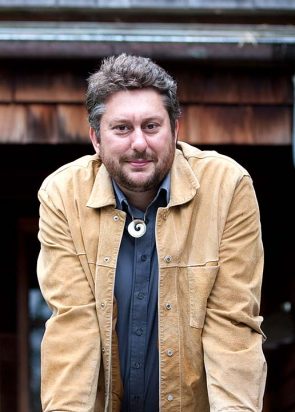
‘Deep green’ architect to talk at Antioch College

Architect Jason McLennan, a pioneer of sustainable design and creator of the Living Building Challenge, will speak this Saturday, Aug. 13, at 7 p.m. in the Antioch South Gym. (Submitted Photo by Paul Dunn)

Architect Jason McLennan, a pioneer of sustainable design and creator of the Living Building Challenge, will speak this Saturday, Aug. 13, at 7 p.m. in the Antioch South Gym. (Submitted Photo by Paul Dunn)

A “deep green” architect is coming to Yellow Springs. Jason McLennan, recent winner of two major architectural awards and a pioneer of green building design, will give a public talk on Saturday, Aug. 13, from 7 to 8 p.m. at the Wellness Center South Gym at Antioch College. McLennan has designed dozens of innovative green projects around the world, and was recently announced as the designer for Antioch College Village’s cohousing pilot. Seattle-based McLennan and his team will be on campus during the weekend for a series of sessions with college leaders and prospective cohousing community members to kick off the cohousing project. His Saturday evening talk, however, is open to all villagers interested in green design and the ways in which buildings, people and the natural environment interrelate.

“Jason is a very talented designer, somebody in the vanguard of thinking about what it means to develop the built environment in a truly sustainable way,” said Sandy Wiggins, a green building expert and a consultant to Antioch College on the College Village project. Wiggins brought McLennan and the college together; the architect and his team are providing some pro bono services to get the cohousing pilot off the ground this fall.

McLennan is known worldwide as the creator of the Living Building Challenge, a framework that moves far beyond traditional sustainability measures and requires that buildings play a positive, regenerative role in local ecosystems. According to the website of the nonprofit International Living Future Institute, which manages the programs and conducts related advocacy work, buildings that meet all or even some of the Living Building criteria can claim to be the “greenest in the world.”

Talk on Green Design
“Deep green” architect Jason McLennan, a pioneer in sustainability and green design, will give a public talk on Saturday, Aug. 13, from 7 to 8 p.m. in the South Gym of Antioch College’s Wellness Center. The college has engaged McLennan to design the cohousing pilot project for Antioch College Village. McLennan’s talk will focus on connections between that project and worldwide trends in environmental design.

“The Living Building Challenge goes beyond the idea of minimizing harm … to create buildings and projects that are good for people and the planet,” McLennan explained in a recent interview. “It’s a very holistic framework for all the ways [buildings] impact on the world and in turn impact on people’s lives.”

That program led, in 2014, to the creation of the Living Community Challenge, which uses the principles of the Living Building Challenge to set sustainability standards for groups of buildings.

The Living Building Challenge and Living Community Challenge are “the standard bearers,” affirmed Wiggins. “They’re the “tip of the spear,” both in terms of what’s being called for and what’s possible in green design.”

ACV first ‘Living Community’?

At Wiggins’ recommendation, Antioch College adopted the Living Community Challenge as the framework for Antioch College Village, or ACV, in 2014. The college’s embrace of the Living Community standards was one reason he was attracted to the cohousing pilot, McLennan said. “There’s a tight synergy in values and ideals,” he explained.

Though the originator of the Living Building Challenge and founder of the International Living Future Institute, McLennan is no longer an employee of the Institute and is not involved in the assessment of projects.

The Living Community Challenge “scales up” the earlier Living Building Challenge. “Philosophically, they’re siblings,” McLennan said. “But they have different scales and different issues arise.” Rather than assessing a single building, Living Community standards measure the sustainability of a collection of buildings, such as a neighborhood, campus or city block.

There are currently no certified communities, though projects are underway in a variety of cities, McLennan said. The process takes time; the Living Community Challenge includes an upfront masterplan review, so the standards actually help guide the design framework for a project, as well as measure the outcome.

If certified under the Living Community Challenge standards, Antioch College Village could be the first such project in the world, both Wiggins and McLennan emphasized.

In his public talk, McLennan will not only describe the principles and philosophy of the Living Building Challenge and Living Community Challenge, but also provide case studies that he hopes will illuminate “what’s possible in green design,” he said.

One such case study is the Bullitt Center in Seattle, which was billed as the “world’s greenest office building” when it opened on Earth Day in 2013. According to a report aired by Northwest Public Radio on April 18, 2013, the Bullitt Center’s unique attributes include its use of 100 percent sustainably harvested lumber, the world’s only six-story composting toilet system and 575 rooftop solar panels that supply all of the building’s energy. The panels also collect rainwater, which is funneled to a 56,000-gallon cistern in the basement that provides all the building’s water.

The Bullitt Center meets the highest level of Living Building standards. First put forward in 2006, these standards are used to evaluate projects across seven performance categories: place, water, energy, health and happiness, materials, equity and beauty. Each of these has smaller, specific subcategories. Energy, for example, is measured in terms of “net positive energy,” which mandates that 100 percent of a building’s energy needs are self-generated using no combustion-based sources.

While certain metrics, such as for building materials and energy, may overlap with other green certifications such as LEED and Forest Stewardship Council, they are far more stringent than all other existing measures, according to the International Living Future Institute website. And many of the Living Building Challenge criteria bring an utterly novel focus on human well-being, according to McLennan.

“The training of architecture is really about how the built environment impacts the mental and emotional and physical well-being of people,” he said. Under the terms of the Living Building Challenge, these impacts are extended to the health of the ecosystem and the lives of plants and non-human animals within it, he added.

There are currently about 100 Living Building-certified buildings around the world, according to Wiggins, and many more in the process of development. Unlike other certification programs, Living Building projects are assessed based on actual, not projected performance. This means that projects must be operational for at least 12 consecutive months before they are evaluated, adding another layer of rigor to the process, McLennan said.

Cohousing kick-off

Beyond his public talk, McLennan and his team will spend the weekend on the Antioch College campus gathering information for the first iteration of the cohousing design. One key decision is the location of the cohousing project, selected from several potential sites on campus, according to Wiggins. McLennan will also engage college leaders and prospective cohousing residents — specifically, members of the local cohousing group, the Antioch Eco-Village Pioneers — in a programming exercise to elicit basic design criteria for the project, including the design of individual units, the organization of units in relation to each other and the design and amenities of the common house that is a focal point of cohousing communities.

McLennan said he’ll be doing a lot of listening that weekend. “We take a very patient period of listening and learning. We view our project as having two clients: the people and the community writ large, which includes other species and future generations.” So he’ll be making a careful study of place, climate, culture and people, he said.

Though he’s designed many different types of projects around the world, Antioch College Village’s cohousing pilot will be his first cohousing project. And this will be his first time in Yellow Springs and Ohio. But all projects are, in a sense, new to him, he said.

“I don’t like to come into a design project with a predetermined aesthetic. I don’t know what it will look like, and that’s the point. But it will be beautiful,” he promised, with a laugh.

With this weekend’s kick-off session, Wiggins said that the college is on track to complete the cohousing pilot’s conceptual design phase by the end of the year. He is currently raising funds for the pilot, previously estimated to cost $2.2 million for design and planning (an amount that includes some costs of the overall ACV project) and $6.5 million for construction. He is also working with the Village on zoning and planning.

“We’re hoping to begin building this time next year,” Wiggins said.

Antioch College film students learn their craft at RNC

Last week’s Republican National Convention (RNC) in Cleveland, Ohio, drew thousands of visitors, delegates, demonstrators and members of the media. Given the contentious and untraditional nature of the 2016 presidential race and the tense social climate, the RNC was more than just a political forum — it was a reflection of a pivotal point in American politics, and therefore American history. And this is exactly why Professor Charles Fairbanks, a media arts instructor at Antioch College, wanted his students to experience such a monumental event.

Inspired by “Four More Years,” a documentary about the 1972 RNC, Fairbanks took a number of students to the convention in order to document it. The Antioch film crew, comprised of Fairbanks, adjunct professor and studio arts coordinator Forest Bright and media arts students Lillian Burke, Charlotte Norman, David Blakeslee, Odette Chavez-Mayo and Ellie Burck spent two days interviewing, filming and trying to understand the event.

“I wanted to do something memorable for this [media arts] class,” Fairbanks said. “It’s a really great opportunity to practice media arts and engage with the political process.”

Although the documentarians were excited about the project, they were unsure what they were getting themselves into. Burck said she wasn’t sure if it was going to be dangerous or banal or both, while Chavez-Mayo wasn’t sure if she would be able to relate to anyone there because she doesn’t share their political leanings.

Upon arrival, the sheer scope of the convention both underscored and challenged the ways students were thinking about it before they arrived

The public square, where many attendees gathered, was cordoned off from protestors, Blakeslee said. There was a place for speakers, and further away were groups of protestors representing all sides of the political spectrum. Demonstrators ran the gamut from armed open carry activists to people wearing Trump masks to a group of doctors protesting the ill-treatment of their Muslim colleagues, Burck said.

Monitoring it all were police from all over the country, Burck said, noting that she saw badges from Georgia, Virginia and California. However, Chavez-Mayo thought the police were remarkably nice and engaged with attendees, going so far as to check on people’s wellbeing and asking if they were staying hydrated.

But one group seemed to outnumber everyone else there — the media, Fairbanks said. There were lots of people yelling and demonstrating, Blakeslee said, and each time even one person was making a lot of noise, even if it was just someone yelling into a bullhorn, “15 or 20 cameras would be focused on that person within 30 seconds,” to make sure they weren’t missing some kind of spectacle.

But the Antioch students weren’t there to document spectacles or highlight the troublemakers. Inspired by the 1972 documentary, the idea was to focus on the average person at the convention and the “everyday” environment of political activism, Fairbanks said. The students spoke with everyone from people carrying flags to the children of demonstrators.

The students made a point to simply listen to the people they were talking to, Chavez-Mayo said. The idea was to get at the personal reasons for supporting their respective candidates instead of engaging them in debate. To do this, the students worked in teams of two, interviewing people for an average 30 minutes per person.

“Being in a position of listening versus arguing is a different approach,” said Chavez-Mayo. “You get to hear more.”

The excitement of being there and the fervor of being among like-minded people, on either side, inspired an effusiveness among interviewees that the film students weren’t expecting. Most people were very willing to talk, said Blakeslee.

Spending so much one-on-one time with Trump supporters, for example, made her change her perspective on who they are, said Chavez-Mayo. Although she found some of their views illogical, she said she could understand why Trump’s rhetoric could be appealing. They were real people attempting to make sense of the world, and they found someone who resonates with their experience, she came to believe.

Bright and Burck, however, were a little less forgiving of what they perceived to be gaps in logic or lack of genuine analysis. So many people believed in odd conspiracy theories, Bright said.

“Everyone was just spitting out something someone else said,” Burck added. “There was no real human connection to their beliefs.”

Blakeslee said what he saw at the convention didn’t bode well for the nature of the two-party system, as the country is stuck with whomever the Republicans and Democrats pick as their nominees, even if members of that party don’t have much in common with their chosen candidate. Noting the intra-party squabbling over an outsider like Trump, lifelong Republicans are nonetheless going to support the Republican candidate no matter what, he said.

As the students spent more time at the convention, they grew more comfortable speaking with people, said Burke. She wasn’t sure if she’d be able to go up and engage with total strangers, but the project gave her a sense of confidence and purpose in approaching the people she wanted to talk to.

“I want to do this all the time now,” Chavez-Mayo said.

Exploring the convention on such a personal and in-depth level exposed the group to some very powerful scenes.

Bright described the prompt and incredibly efficient police response to a scuffle. The police ran into the crowd, immediately created a circle around the subjects in the middle, and expanded outward to push people away. They brought in bikes to continue expanding the perimeter. There was also a Muslim man who had a prayer rug set up and was praying all day in the middle of the crowd, Chavez-Mayo said. He had video cameras attached to his body in order to film his own reactions, so he could show how politely Muslims conduct themselves in the face of snickering or misunderstanding. Burke described how another group had explained that Cleveland hosting the RNC was a second sign that a curse over Cleveland had been lifted, before handing out Christian tracts. The first sign was Cleveland winning the NBA championship.

“There was a lot of Cleveland pride,” Fairbanks said.

The raw emotion on display was incredibly moving to several students. One family had pictures of people killed by “illegal aliens” to inspire support for restrictive immigration policies. While the argument made little logical sense, Fairbanks said, learning that one of the demonstrator’s children had been killed by someone from another country gave a little more perspective to their anger. Another man, there with his young son, was advocating for justice for Tamir Rice, a 12-year-old who was killed by Cleveland police for holding a pellet gun. The man prostrated himself in front of police, yelling at them, his voice choking with emotion.

“He was giving all he could,” Fairbanks said. “It was the only way to express the extreme emotions he felt.”

However, the outright displays of emotion from both sides left a few of the students questioning the efficacy of such vociferous protests and the motivations of the people behind them. “[The protestors] aren’t interested in building a bridge,” Burck said. “They’re just there.” She noted that she didn’t feel any connection with Trump supporters, but she also felt alienated from the liberals there as well. It’s like a real life Internet comments section, she said.

“Does this change anything?” she asked. “Does anyone really shift?”

The approach makes for a “savage democracy,” Bright said.

But Chavez-Mayo disagreed, noting that she was willing to listen to more opposing views than she thought she would before going to the convention.

After spending all day immersed in such powerful emotions and arguments, the students had to unwind as a way to process the intensity of their surroundings, Blakeslee said. Whenever they got back together, they got pretty silly, he said.

“I had to go sing and dance with the street performers,” Burke said. “It just didn’t feel real.”

All in all, the group filled up well over a dozen 32-gigabyte memory cards, Blakeslee said. There is a ton of video and audio to go through.

The class will be editing for much of the next quarter, Fairbanks said, though the form their footage will take isn’t quite decided upon yet. Possible options include a feature-length documentary, a series, podcasts or some combination of all of these. Whatever format their project takes, Fairbanks said that crossing the political divide and talking to people has the potential to inspire empathy and understanding.

After a few days’ reflection about what they saw and how they will present it, the members of the group all agreed that it was an incredibly worthwhile experience.

“It really, really changed my outlook on protests, politics and filmmaking,” Blakeslee said.

Antioch College receives accreditation

Antioch College President Tom Manley got the word around 1 p.m. this past Monday. An email showed up in his inbox from the Higher Learning Commission, or HLC. It contained the biggest of big news.

After an arduous, five-year process, Antioch College had received accreditation.

For Manley and other senior administrators at the college, a “touchdown dance” commenced, he said on Tuesday.

The news was not entirely unexpected, according to Manley and Provost Lori Collins-Hall, formerly vice president of academic affairs. In June 2014, after three years of required steps including an extended “self-study,” the HLC granted the college candidacy for accreditation on a two-year “fast track,” rather than the standard four years. Antioch had pressed for the shorter timeline, and HLC had agreed to grant the college the accelerated track. A site visit by an HLC team last November seemed to be a success, college leaders said at the time, and subsequent communications with HLC officials seemed to suggest that accreditation was on a good course.

“We had the sense that we’d done everything we could,” Collins-Hall said. “But it’s never done until it’s done,” she added.

Now it’s done.

This is the “best news we could have gotten,” said Manley. It’s not just that the college was granted accreditation on a two-year track, he said. Accreditation from the HLC is not a onetime event, but rather a status that must be maintained in an ongoing way, with defined time frames for renewal. Going forward, the HLC has granted Antioch a “standard” or 10-year accreditation track, Manley said, meaning that the college is slated to reapply for accreditation in 10 years, with a check-in during 2019–20.

“This is the best possible result,” Manley said. “Not only did we get over the finish line, but we did it in a powerful way.”

Immediate impact

For the class of 2016, accreditation will have an immediate impact. The college’s accreditation date will be aligned with that class’s graduation date, meaning June’s graduates will hold degrees from an accredited Antioch. This is not the case for the class of 2015, however.

“It can’t be done for the class of 2015,” Manley said. But he and Collins-Hall downplayed concerns that the earlier class — often referred to as “the pioneers” — will face skepticism from prospective employers or graduate schools. “No one will really care about [the unaccredited degrees] any longer” in light of the positive accreditation decision, Manley said.

Antioch College as a whole will benefit in many ways, some immediate, some with a longer timeline.

Fundraising is one key way, said college leaders. With its new accredited status, Antioch will be able to seek funding from a full array of foundations, as well as funding from federal government programs, such as Title IV financial aid, only available to accredited institutions. And though the college has benefited hugely from alumni spirit and support, said Manley, many alumni have told the college they’re “waiting for accreditation” before they commit to financial support.

Student recruitment efforts will also get a boost, said Collins-Hall. “Students and their parents are in tune to issues of standards and accountability,” she explained. Not only will the college be able to offer students a degree from an accredited institution, but accreditation “clearly demonstrates the college’s high standard of rigor,” which remains on par with what Antioch has always been, she said. The college will also be able to recruit international students, a door that was closed when the college lacked accreditation.

Many of these benefits will require time and strategy to communicate to the college’s constituencies, as well as time and hard work to come to fruition.

“These are multi-year, ongoing challenges — but now we have a fantastic story to tell,” Manley said.

Change and continuity

Asked if the newly accredited Antioch was the same or different from the “old” Antioch that existed prior to the college’s 2008 closing, Manley emphasized both change and continuity.

“It moves on, but it’s the same river,” he said. Progressive values and academic rigor remain areas of continuity, as does a commitment to experimentation and meaningful real-world experiences for students. But Antioch’s closing gave it a rare opportunity to reinvent the college, and “help reimagine what college can be,” he said.

Manley noted that HLC accreditation required that Antioch enter into the process as a “novice institution,” offering proof of its present-day excellence “not drawn from the history of the institution.” Yet at the same time, HLC President Barbara Gellman-Danley acknowledged the college’s history in her recent determination letter.

“Let me commend you for the passion of your alumni, the Yellow Springs community, board and institutional leadership, students and other stakehoders. Your efforts clearly reflect Horace Mann’s greatest quote, and you have indeed won ‘some victory’ today,” she wrote.

End of a long road

Accreditation is the end of a long road that began in 2009, when the college reopened as an independent institution. College leaders began working toward accreditation immediately upon that reopening, building toward an initial submission, in 2011, of the first round of materials to the HLC.

That organization is the regional accrediting body for institutions of higher education in the central U.S.; accreditation is considered essential for legitimizing a college or university’s programs. Criteria for accreditation include an institution’s finances, structure, board and governance, curriculum and curriculum delivery, student success, shared governance and, on top of all that, proof that the institution is “engaging in continuous improvement,” said Collins-Hall.

Antioch’s first submission of initial materials was rejected, and the college reapplied in 2012. At that point, the process seemed to get on track. The HLC approved the next step, a 14-month self-study that began in 2012. That led to a site visit in November 2013, followed by the HLC’s momentous decision, in June 2014, to approve the college as fast-track candidate for -accreditation. More self-study and another site visit ensued.

Then-President Mark Roosevelt, celebrating that earlier milestone, described accreditation as the “whole shebang.”

And so it is, current college leaders said.

Associate Director of Communications Kateri Kosta said on Tuesday that the college community would be informed by phone and email later that day. A campus celebration (not geared to the public) is planned for next Tuesday, July 19. A banner will be hung on the horseshoe side of Main Building, Kosta said.

It will read, “New and better ways of living and learning since 1850.”

Antioch College receives accreditation

The big news came in a small way. Antioch College President Tom Manley received an email at 1 p.m. on Monday, July 11, informing him that the Higher Learning Commission, or HLC, had granted Antioch accreditation.

“This is the best possible news we could have gotten,” Manley said on Tuesday, clearly exuberant.

Antioch has been accredited on the “standard track,” meaning it will be up for reaccreditation in 10 years, with a check-in in 2019–2020. Accreditation by the HLC or other authorized body is considered essential for legitimizing an academic institution’s programs in the U.S. It’s proof of a “high standard of rigor,” Provost Lori Collins-Hall said on Tuesday.

But accreditation also means that the college will be able to tap funding sources not previously available, and it will give Antioch a boost in student recruitment, college leaders added. And because accreditation dates will be aligned with 2016 graduation dates, the just-graduated class of 2016 will receive degrees from an accredited Antioch.

Antioch has been on the road to accreditation since the independent college reopened in 2009. Accreditation is a multi-step, multi-year process involving a combination of self-study, site visits and extensive documentation of everything from an institution’s finances and governance to its curriculum and student success.

Read a more detailed story in the July 14 issue of the News.

Below, Antioch College President Tom Manley shares the positive accreditation news in a video announcement (courtesy of Antioch College).

Thomas Manley arrives on Antioch campus

New Antioch College President Thomas Manley began his position earlier this week and is now on campus. He is eager to get to work, according to a college press release.

“In my view, nothing is more imperative than the continued success of Antioch College at this time, and I am deeply committed to becoming part of this community and helping the College grow,” he said in the press statement. “The determined work of alumni, trustees, faculty, staff and students has been nothing less than inspirational since the decision to reopen. I am very much looking forward to contributing to this ongoing effort.”

Manley and his wife, Susanne Hashim, and their young daughter, Chedin, will be moving into the Folkmanis House on campus, which has formerly housed college presidents. Chedin will be attending Mills Lawn School.

Manley brings to the job more than 35 years of experience in education, most recently as president of Pacific Northwest College of Art in Portland, Ore., since 2003. During his tenure there, he was credited with helping that college turn around and emerge as “Portland’s most well-rounded, diverse and established arts institution,” according to the release.

Manley is only the second president of the reborn Antioch College, succeeding Mark Roosevelt, who left at the end of December. Roosevelt is now president of St. John’s College in Santa Fe, N.M.

The college’s path since it reopened in 2009 has been “distinctive and brave,” Manley said in the release.

“No college I know of has been braver and more steadfast over time in delivering a liberal arts education aimed so squarely at making a difference in the world,” he said.

See Manley’s letter on page 4. An extended interview with Manley will be published in the March 17 News.