|
A transition time for Nonstop
Yellow Springs News Since its launch after the shut-down of Antioch College, the educators and artists of Nonstop Institute have been nothing if not flexible and creative. And their flexibility is being called upon once again, as Nonstop members adapt … |
Category: news
New college dines responsibly
Traditional cafeterias are designed to be about choice. But what’s the difference between institutional chicken fingers and institutional mac and cheese? Not much, according to the folks at Antioch College, who are out to create a campus dining model that exchanges the anonymous din of feeding from the trough for a more intimate and participatory, socially and environmentally responsible way of eating.
The college’s innovative approach to food was born partly of the need to recognize the ecological demands of food service and also to honor the experience of eating in community. According to Louise Smith, dean of community life at the college, “It’s how we live in community together — we break bread together, meditate together, cook together, in addition to doing governance together…it’s part of the larger coversation of what’s our responsibility to the planet? To the local community? To our bodies?”
The unusually small size of the current college community provided the other justification for a decentralized dining system. With 35 students living on campus and about that many faculty and staff there during the week days, economies of scale would have been difficult to realize in the kind of cafeteria setting the college formerly operated in the Union building, Smith said.
The plan drafted in August, when Smith started her job full-time, was to utilize the kitchen on the ground floor of Birch Hall, where all the students currently live. The college’s Renewal Commission had it remodeled for student use in 2005, and this year’s dining committee of Smith, Joyce Morrissey, Tom Brookey, Reggie Stratton and Nick Boutis believed it to be an inviting, well-proportioned space to upgrade, utilizing much of the good commercial equipment from the Union’s kitchen.
“It’s a beautiful space with lots of windows that we thought would foster a sense of belonging to a dorm and to the core community for first-year students,” said Smith, who had memories of baking cookies there to deliver to students one Christmas.
Although students have been on campus for almost two months, they only recently got the chance to eat in their own dining hall. After many frustrating weeks renovating the campus kitchen, the Greene County Health Department finally signed off on the new dining hall, and students had their first meal there on Wednesday, Nov. 9. On Tuesday this week, head chef Isaac DeLematre was serving split pea soup, black beans and rice, roasted root vegetables from area farms and braised greens from the college farm.
“I’m taking input from students and working with what we have coming from the farms,” DeLamatre said. “It’s going great.”
While the campus is well fed now, making the new dining plan operational was slower and more costly than college leaders had hoped, largely due to the complicated county health and building codes that regulate commercial kitchens. While the Union building kitchen satisfies many of the regulations, the building isn’t heated, it’s not ADA compliant, and aside from the cafeteria, the remainder of the large building would be vacant. But installing a new kitchen at Birch was complicated.
The county code is very fussy about the specifications of a commercial kitchen, which, it says, shall have cooking stations lit at 50 candles and dishwashing at 20 candles, stainless steel countertops, a separate sanitizing sink and a handwashing station not more or less than 18 feet from where food is being served. Fire safety, temperature control, food storage, plumbing and electric must all conform to code, which Smith has all but memorized by now.
So Stratton, the college facilities manager, had his crew upgrade the Birch kitchen by reusing the dish room, three refrigerators, two ovens and other cooking equipment from the Union kitchen and buying only a freezer, one dishwasher and a prep sink and countertop.
Students were scheduled to arrive on Sept. 24, before the renovation would be complete. In a survey, a large majority of them had already indicated interest in doing some amount of cooperative dining. So the college asked Current Cuisine to help cater some meals temporarily, believing that the students could take care of many of their own meals as well until the kitchen was up and running.
However, it turned out that Greene County not only prohibits the students from preparing meals together outside of an approved kitchen, it also required that the catering be done in a space with servers, sneeze guards, and both hot and cold service stations, Smith said.
So for the first six weeks, Current Cuisine served lunches and dinners at the Corretta Scott King Center during the week, and students started the cooperative system by helping to set up and clean up after their meals, with the help of community life student worker Sara Brooks and residence life manager Randle Charles. The college also held a weekly Wednesday potluck with the Yellow Springs community at the First Presbyterian Church. And several community members invited the student body to dine in their homes, Smith said. While the dining challenge was costly and stressful for both the college and the small local caterer, it also created unexpected opportunities for community building, according to Smith.
“The potlucks have been great, and there’s been a lot of support in town for us,” she said. “It’s been one of the ways we’ve taken lemons and made lemonade.”
The situation brightened significantly when Chef DeLamatre started work full-time last month. Most recently the sous chef at Sunrise Café, DeLamatre attended Antioch College in 2003–04 and then worked for several years on organic farms, including Orion Organics in Yellow Springs. He helped run a food co-op in Hillsboro, S.C., where he also started a CSA, before deciding to go to cooking school. He is thrilled to be connected to the college’s own farm, which welcomed its first eggs last week and is expecting to harvest its first chickens this fall.
“It’s like a dream come true for a chef — having such a close relationship to a farm,” he said. “Students can go to the farm and bring up whatever they want to eat. That’s as good as it gets.”
DeLamatre also supports the cooperative dining scene. He recalls being less than enthusiastic about his college dining experiece, and feels excited about being able to help students get the kind of organic, local, fresh food they want. He has met with them a few times already, and found them to be “conscientious about the food and food systems they support, and how it affects the world around them. They make dietary choices that reflect that,” he said.
“The students are excited, they kind of arrived that way,” he said. “They’re excited to be able to choose what they eat, which is something immediate [they] can do — establish their values and make it happen immediately — it’s gratifying and empowering.”
The cooperative model Antioch is establishing isn’t new. Boutis, who is part of the committee and also managing sustainability on campus, started out in a dining cooperative at Oberlin College in the 1980s. The group, part of the National Association of Student Cooperatives, had 90 members who were all involved in creating their menus, purchasing the food, cooking it and serving it themselves. Cooperatives can be less expensive than traditional dining plans, partly due to a reduction in waste on trays, which encourage people to take more than they can eat, Smith said. The co-op food plan at Oberlin, according to Boutis, cost about half as much as the traditional dining plan.
“Our ability to charge less for dining services will increase our ability to focus on our academic model,” Boutis said. “It plays in the context of making practical decisions with not just ecological sustainability but economic sustainability.”
Dining on campus has been one of the biggest challenges the community life group has faced, mostly because “food is so fundamental,” Smith said. But with the kitchen now fully operational, it won’t be long for students to be “serve-safe” trained to be an integral part of the community dining and food service program. Smith feels the ultimate plan is solid and responsible on many levels.
“It’s in keeping with our vision, and it will be a vital part of what makes community life here good,” Smith said. “And I’m confident that when we’re up and running, we’ll be cost effective.”
Gegner legacy strong after 50 years
Fifty years ago this month, African-American villager Paul Graham walked into Lewis Gegner’s barbershop on Xenia Avenue, sat down in his barber chair and asked for a haircut.
“I can’t cut your hair,” the white barbershop owner replied, according to Graham’s account. “I don’t know how. That’s all there is to it.”
That day Graham filed a complaint against Gegner’s discriminatory practices with the Ohio Civil Rights Commission in a case that reached the Ohio Supreme Court.
The historic moment was part of a 20-year effort to desegregate Yellow Springs, which escalated to the dramatic 1964 confrontation between police and protesters picketing Gegner’s shop — an event that landed 100 people in jail and thrust Yellow Springs into the national spotlight during the height of the civil rights movement.
Soon after the confrontation, Gegner sold his shop and moved out of town, and the Supreme Court refused to hear Graham’s case. Gegner had never consented to cut a black man’s hair when pressured.
Today, the villagers and Antioch College students who participated in the Gegner actions look back on the incident with a mixture of pride and disappointment, and draw lessons from a struggle which both defined and divided the community.
“It became apparent that Yellow Springs wasn’t the type of community we thought it was,” Graham said.
See the Nov. 24 issue of the YS News for the full story.

Hundreds of local and area students, residents and law enforcement officials jammed downtown Yellow Springs on Xenia Avenue during a chaotic demonstration against Gegner's Barber Shop on March 14, 1964. (Photo courtesy of Antiochiana)

From left, Arthur Morgan, Paul Graham, an unidentified man, Walter Anderson and Hardy Trolander (partially hidden) led a march through Yellow Springs in May 1963 to protest discrimination at Gegner's Barbershop. More than 550 people participated in the march. (Photo courtesy of Antiochiana)
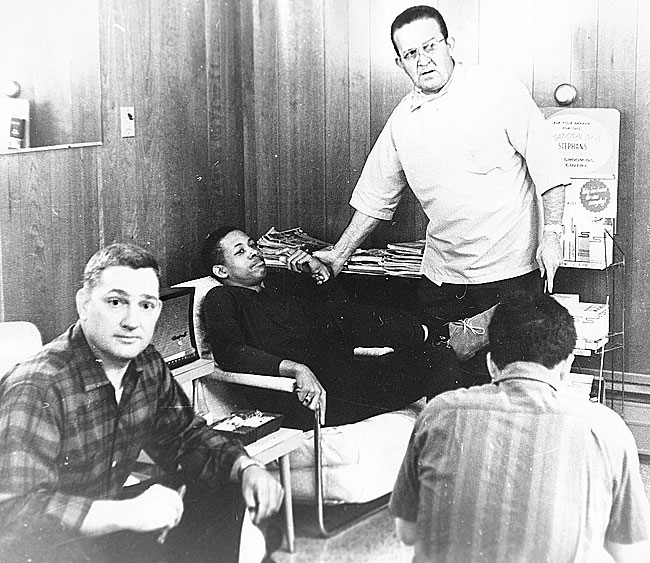
Lewis Gegner, right, tried to remove Antioch student Jim Fearn from his shop in 1964. (Photo courtesy of Antiochiana)
Jon B. Lovelace, friend of Antioch College and a mutual fund innovator
 LOS ANGELES – November 19, 2011 – (PRNewswire) Jon B. Lovelace, spouse of Antiochian Lilian Lovelace ’51 and a mutual fund innovator who guided The Capital Group Companies Inc. as it grew to become one of the largest investment management firms in the United States, died Nov. 16 after a long illness, his family announced. He was 84.
Under his guidance The Capital Group, which had been started by his father, Jonathan Bell Lovelace, and which he joined in 1951, became a pioneer in international and global investing and initiated the multiple portfolio system of asset management.
"For many of us Jon Lovelace represents Capital," said James Rothenberg, non-executive chairman of The Capital Group Companies who worked with Lovelace for almost 40 years. "His legacy is an organization of incredibly talented people, great integrity, a unique approach to the investment challenge, and a culture that is broadly admired. He touched so many lives in so many positive ways."
Lovelace helped initiate one of his most influential innovations, the Multiple Portfolio Counselor System, in the 1950s. Built on the insight that there are many ways to invest successfully, it is the cornerstone of the way the Capital Group manages assets today. Under the system, the assets of each fund are divided among multiple investment professionals who invest according to their strongest conviction and are compensated by the returns they generate for investors and clients as well as how well the fund does. Blending individual responsibility and collaboration, the system was a radical departure from the single-manager system and is increasingly emulated in the mutual fund industry.
Throughout his tenure, Lovelace helped Capital resist fads and trendy investment ideas such as Internet funds that blossomed in the late 1990s and eventually hurt investors. Instead, he emphasized investing for the long term and helped establish practices that reinforced his beliefs. Under his guidance, the firm adjusted its compensation for investment professionals, putting emphasis on longer rolling periods instead of the single-year results that are common in the industry.
Former U.S. Senator Bill Bradley remarked on Lovelace's quiet style. "I met Jon in 1978 — a quiet visionary who led by example. I was fortunate in countless ways to call him a dear friend. His modest selflessness and clear thinking always amazed me. More than building one of the world's great financial institutions, he was one of the most admirable human beings that I have ever known."
Lovelace was born in Detroit in 1927. His family moved to Los Angeles in 1929. He attended Beverly Hills High School and the Hotchkiss School, then left to join the Navy during World War II. After the war, he attended Princeton University and graduated cum laude with a degree in economics. He and Lillian Pierson were married in 1950 and have four grown children and six grandchildren.
Lovelace joined the Capital Group as a statistician and became a portfolio manager in 1953. During his tenure at The Capital Group, the mutual fund industry underwent profound change. In 1964, when Lovelace became Chairman of Capital Research and Management Company, the investment adviser to the American Funds family of mutual funds, few American families even knew about mutual funds. Today more than 44% of American households have mutual fund investments. Over that same time span, the organization grew from managing about $740 million to managing more than $1 trillion today. In 1964 the firm had 80 employees and four funds. Today, the organization employs more than 7,500 people worldwide, offers 33 mutual funds, a college savings program, target date retirement funds and manages institutional mandates.
His first choice of a career was not investment management, however. After graduating from Princeton University, where he studied economics and psychology, he went to work for Pacific Finance Company in the personnel department. He was convinced to join Capital in 1951, when the firm was undergoing re-organization.
His profound skills in managing people first became manifest in 1964, when he became president of Capital Research and Management. His insights helped create Capital's unique culture, its egalitarianism that shuns corner offices, and with a fluid system of collegial organization that encouraged creativity and collegiality.
Described as brilliant and humble, he and his consensus-building approach and deferential style of leadership are credited by colleagues as the reason for the firm's low-key culture. Probably Lovelace's greatest talents were his organizational skills. Although he may not have been directly responsible for many of the innovations that happened under his stewardship, such as the firm's early entry into international investing and emerging markets, he created a climate of innovation in which they could occur.
His egalitarian approach to management and the fluid system of organization that he inspired encouraged creativity and laid the foundation for the success of some of the firm's most innovative ideas.
Lovelace was an important philanthropist who gave time, effort and money to support the arts, education, health, science, and the environment. He held key positions at many of Southern California's most important civic, cultural and education institutions. He was Chairman of the J. Paul Getty Trust from 1988 to 1993 the period during which the new J. Paul Getty Center was being built. He was Chairman of the Board of Trustees of Claremont McKenna College from 1973 to 1976. He was a founding trustee and later served as Chairman of the Board of Trustees of the California Institute of the Arts, a school based on an idea by Walt Disney to develop a multi-arts degree-granting institution.
Despite his very active role in shaping the mutual fund industry as it is today, and his contribution to the community, Lovelace was not well known by the public. He shunned the spotlight.
Television and movie producer Norman Lear, a friend of more than 20 years, said, "You never read about Jon Lovelace but he probably has done more good in the world that can be imagined. Any number of times I joined an organization that I was attracted to and found that Jon and Lillian Lovelace were at the very foundation of the cause."
Although Capital was very successful under his leadership, Lovelace's colleagues say their strongest memory of him are his humanity, his desire to contribute to the community and his willingness to share his time and mentor to younger associates. "He was an extraordinary and understated gentleman," said David Fisher, Chairman Emeritus of Capital International Inc. who worked with Lovelace for nearly four decades. "His values have been the cornerstone of Capital and I hope they will continue to permeate the company in the future."
Lovelace himself encouraged his colleagues to continue striving for excellence. In 1996, celebrating the firm's 75th anniversary, Lovelace said, "It's very satisfying to see how far Capital has come, but it's a continuing challenge to maintain it. There's a phrase I've always loved. 'Nothing wilts faster than laurels rested upon' And the key is not to rest on our laurels, but to keep achieving."
"He was always fascinated by numbers," his daughter, Carey Lovelace said. "He always kept score at baseball games and if you gave him a date in history, he could figure out what day of the week it was. 'It isn't as hard as it looks,' he told my brother Jeff, once. 'I figured out an algorithm to do it.'"
An aficionado of Dixieland jazz, Lovelace wrote song lyrics in college ("No One Who Knew You Will Know the New You.") and was interested in folk music from the early 1950s and was a fan of Pete Seeger and the Weavers.
A dedicated environmentalist and avid hiker, Lovelace was instrumental in helping The Yosemite Fund build and maintain hiking trails such as the Red Peak Path Trial and the John Muir Trail and restoring degraded areas to their natural beauty.
Lovelace was a major supporter of Public Radio International and the Idyllwild Arts Foundation. He helped fund the Ahmanson-Lovelace Brain Mapping Center at UCLA and, in a departure from his desire to donate anonymously, he allowed the institution to use his name. In 1997 in recognition of his international philanthropy, Queen Elizabeth II made him an Honorary Commander of the Order of the British Empire
Asked once what his secret of success was, Lovelace quoted his own father and said, "Don't be greedy."
He is survived by his wife Lillian, his daughter Carey Lovelace and three sons, Jeffrey, Jim and Rob, and six grandchildren.
In lieu of flowers, the family requests that donations be made to the Sansum Clinic, attn: Philanthropy Department, P.O. Box 1200 Santa Barbara CA 93102, or pray for the Dodgers.
Antioch College to host exhibition and workshop by famed papercut artist Nikki McClure
YELLOW SPRINGS, Ohio – November 17, 2011 – Antioch College will host a solo exhibition by paper crafter Nikki McClure beginning Friday, December 2, in the College’s Herndon Gallery. An opening reception featuring an artist talk will be held from 6 p.m. to 9 p.m. Friday evening. An artist workshop will follow on Saturday from 10 a.m. to 1 p.m. Workshop seating is limited and participants are required to register in advance by e-mailing Sara Black at sblack@antiochcollege.org.
The exhibition, Nikki McClure: Cutting Her Own Path, 1996-2011, premiered this fall at the Museum of Contemporary Craft in Portland, Oregon. Cutting Her Own Path showcases McClure’s unique papercut artwork alongside her popular and better-known calendars, books, and other recent projects.
Based in Olympia, Washington, McClure has spent fifteen years creating compelling narratives by cutting into black paper with an X-Acto knife. Her delicate and sculptural “carved paintings” connect personal experiences to collective memory through a celebration of current and traditional models of self-sufficiency, resourcefulness and participation in community.
McClure describes her work process as the creation of an image through the removal of paper. “What is left is all connected,” she explains, “fragile, yet strong, like the world I am depicting.”
She created her first papercut for a self-published book, Apple (1996), and produced her first hand-bound calendar in 1998. Her iconic style of papercut has resonated with a diverse audience and has been featured on snowboards, Patagonia t-shirts, record covers, magazine illustrations, greeting cards, movies, tote bags, Microsoft advertisements, non-profit logos, strangers’ tattoos and even the storm drains in Olympia, Washington.
In addition to a calendar print run of 17,000, McClure’s books have been published by Sasquatch Books and Chronicle Books. She also is the writer/illustrator of four children’s books published by Abrams Books, including The New York Times bestseller All in a Day (2009) by Cynthia Rylant.
Nikki McClure: Cutting Her Own Path, 1996-2011 can be viewed 1 p.m. to 4 p.m. Tuesday-Saturday through February 15 in the Herndon Gallery on the Antioch College campus.
For more information about the exhibition, contact Sara Black at sblack@antiochollege.org.
About Antioch College
Antioch College is a private, independent nonprofit liberal arts college in Yellow Springs, Ohio. The College curriculum puts equal emphasis on rigorous liberal arts learning, work (cooperative education), and community engagement. Students will complete individualized majors based on one or more of 11 concentrations, a language minor, and six full-time work experiences off campus. The institution, originally founded in 1850, is authorized by the Ohio Board of Regents to grant Bachelor of Arts and Bachelor of Science degrees.
MEDIA CONTACT:
Jennifer Jolls
Assistant Director of Communications
phone: 937-768-3343
jjolls@antiochcollege.org
Antioch College to host exhibition and workshop by famed papercut artist Nikki McClure

YELLOW SPRINGS, Ohio – November 17, 2011 – Antioch College will host a solo exhibition by paper crafter Nikki McClure beginning Friday, December 2, in the College’s Herndon Gallery. An opening reception featuring an artist talk will be held from 6:00 – 9:00 p.m. An artist workshop, presented in collaboration with the Writing Institute, will follow on Saturday, December 3, from 10:00 a.m. to 1:00 p.m. Workshop seating is limited and participants are required to register in advance by e-mailing Sara Black at sblack@antiochcollege.org.
The exhibition, Nikki McClure: Cutting Her Own Path, 1996-2011, premiered this fall at the Museum of Contemporary Craft in Portland, Oregon. Cutting Her Own Path showcases McClure’s unique papercut artwork alongside her popular and better-known calendars, books, and other recent projects.
Based in Olympia, Washington, McClure has spent fifteen years creating compelling narratives by cutting into black paper with an X-Acto knife. Her delicate and sculptural “carved paintings” connect personal experiences to collective memory through a celebration of current and traditional models of self-sufficiency, resourcefulness and participation in community.
McClure describes her work process as the creation of an image through the removal of paper. “What is left is all connected,” she explains, “fragile, yet strong, like the world I am depicting.”
She created her first papercut for a self-published book, Apple (1996), and produced her first hand-bound calendar in 1998. Her iconic style of papercut has resonated with a diverse audience and has been featured on snowboards, Patagonia t-shirts, record covers, magazine illustrations, greeting cards, movies, tote bags, Microsoft advertisements, non-profit logos, strangers’ tattoos and even the storm drains in Olympia, Washington.
In addition to a calendar print run of 17,000, McClure’s books have been published by Sasquatch Books and Chronicle Books. She also is the writer/illustrator of four children’s books published by Abrams Books, including The New York Times bestseller All in a Day (2009) by Cynthia Rylant.
Nikki McClure: Cutting Her Own Path, 1996-2011 can be viewed 1 p.m. to 4 p.m. Tuesday-Saturday through February 15 in the Herndon Gallery on the Antioch College campus.
For more information about the exhibition, contact Sara Black at sblack@antiochollege.org.
About Antioch College
Antioch College is a private, independent nonprofit liberal arts college in Yellow Springs, Ohio. The College curriculum puts equal emphasis on rigorous liberal arts learning, work (cooperative education), and community engagement. Students will complete individualized majors based on one or more of 11 concentrations, a language minor, and six full-time work experiences off campus. The institution, originally founded in 1850, is authorized by the Ohio Board of Regents to grant Bachelor of Arts and Bachelor of Science degrees.
MEDIA CONTACT:
Jennifer Jolls
Assistant Director of Communications
phone: 937-768-3343
jjolls@antiochcollege.org