Risa Grimes Announces Her Departure from Antioch College

YELLOW SPRINGS, Ohio – April 21, 2011 – Risa Grimes, the chief fund-raiser for Antioch College as it worked toward independence, has announced she is leaving the College, effective May 4.

“The work I’ve done for Antioch College is some of the most rewarding work I’ve ever done,” Grimes said. “I am moved and amazed by all the alumni and friends who saved this audacious little college.”

“Risa led a team that, together, accomplished something extraordinary for Antioch College. Her work was instrumental in the establishment of an independent Antioch. We owe her a debt of gratitude and wish her nothing but the best in her future professional and personal
endeavors,” Antioch College President Mark Roosevelt said.

During the last five years, Grimes has worked in every facet of
Antioch College’s advancement operation.

She was hired in 2005 as a major gifts officer. At the closing of the
College, she emerged as the institution’s chief fund-raiser, working
with the alumni to secure the funds to purchase the College and its
assets from Antioch University.

She led a team of eight that secured $10 million to obtain the college
and wrote grants totaling $4.5 million. As executive director of the
College Revival Fund, she worked intimately with the Alumni
Association Board of Directors and wrote the 501(c)3 application to
establish the Antioch College Continuation Corporation.

“I am especially proud of the Advancement Team,” Grimes added.
“Against all odds, they never gave up on the fight to reclaim Antioch
College … They are the unsung heroes of the Save Antioch movement and
they are, without a doubt, the finest advancement professionals I have
ever encountered. I will miss each and every one of them.”

Grimes came to Antioch College from Clemson University, where she
served as the director of development for the College of Architecture,
Arts and Humanities from 2002-2005. There, she raised millions of
dollars for a wide variety of projects, including a Pre Law Society
and a Creative Arts Center.

She was also the chief executive officer for Dayton’s Center for
Nonprofit Resources (1998 to 2002), where she raised more than
$500,000 annually, and Life Essentials (1988-1998), where she raised
nearly $600,000 annually.

Grimes holds a bachelor’s in marketing education from Memphis State
University and a master’s in counseling from Troy State University.

MEDIA CONTACT:
Gariot P. Louima ?
Director of Communications
Office: 937-319-6131
Mobile: 937-581-8201
glouima@antiochcollege.org

Duffy Returns to the O.K. Library

YELLOW SPRINGS, Ohio – April 21, 2011 – Steven D. Duffy ’77, who is known by most Antiochians as “Duffy” and by some as “Buffalo,” has returned to the Olive Kettering Library as a library circulation specialist and special assistant to alumni relations. Duffy’s return to the library, where he worked for three decades, is a move that gives the library necessary staff support in these critical months as the College prepares to welcome its first students since 2008.
For much of the last two years, Duffy worked in the Office of Advancement as an assistant director of alumni relations. He was the staff liaison to the Alumni of Courage for Diversity affinity group (formerly Alumni of Color), as well as the campus contact to the Chapters Committee of the Alumni Board.

Duffy will develop electronic and print course reserves for supplemental readings, process requests for library materials from local patrons using an automated circulation system, and manage the ongoing search process for missing materials and ongoing stack maintenance needs. When students arrive in the fall, he may train and oversee the work of the student assistant.

An integral member of the College’s advancement team, Duffy will continue to support chapter development and maintenance; serve as the primary college liaison to the Alumni of Courage for Diversity, and contribute to The Antiochian by soliciting and compiling “Class Notes” for publication in each edition. He will also work with the Communications office to develop a bi-weekly column that will be published in The Independent electronic newsletter.

From July of 1977 to June 30, 2008, Duffy managed the circulation desk at the Olive Kettering Library. He has trained hundreds of Antiochians to be library assistants. Additionally, he was the union representative in the College’s white-collar union, UE 767, and helped to negotiate amicable contracts for all but four years between 1979-2008. He also served two terms on the Alumni Board, and served on Comcil, AdCil, and the Sexual Offense Hearing Board.

MEDIA CONTACT:
Gariot P. Louima ?
Director of Communications
Office: 937-319-6131
Mobile: 937-581-8201
glouima@antiochcollege.org

Finances a challenge, but college confidently advances

At Antioch College a new class of 45 students has been accepted, three of the six initial faculty positions have been filled and work to renovate the campus continues. While optimism is high, finances are tight, and as the college moves closer to re-opening this fall, its reliance on donations will continue to grow.

“We are in the interesting position of not expecting significant revenue from students until 2013, so we are more dependent on philanthropy until then,” said President Mark Roosevelt in an interview last week, pointing out that the re-opened college will pay the full four-year tuition for the first class of students who enroll.

Currently, the college has just two months of operating cash on hand even while it counts as assets a $25-million endowment in addition to $5.5 million in outstanding pledges.

“I can’t deny that having two months of money in the bank is a challenge,” Roosevelt said. “But we will end this year with a surplus, because we will raise more than we spend.”

By the end of the college’s fiscal year in June, Roosevelt expects to raise additional money from this year’s outstanding pledges and alumni at this summer’s reunion, especially as the college takes major steps towards re-opening.

Antioch’s annual expenses of $6.5 million will increase to about $8 million in the fall to pay for faculty, staff and facilities. But some of the endowment’s restricted funds for scholarships will be available then, though the college is only allowed to use 5 percent of its endowment each year to operate.

To pay for expenses next fiscal year, Roosevelt estimates about $2 million will come from donors giving to Antioch’s annual fund, $1.4 million from the endowment and the remaining, about $4.6 million, from major gifts.

“There are some people of means deeply committed to seeing this enterprise succeed and many of these same people will have to fill the gap,” he said.“My job is to be able to create an institution that is attractive to other folks not in this core group and cultivate a large group of caring alums.”

Roosevelt said he hopes the alumni who have been “true believers,” supporting the college when it wasn’t clear if it would succeed, will pass the baton to those who have been hesitant to donate in an uncertain time or because of contentious issues such as the role of former faculty. Before then, more healing needs to take place in the Antioch community, Roosevelt said.

“Not that everyone is happy, but there is progress on reducing the loud tensions,” Roosevelt said, citing the hiring of former professor Hassan Rahmanian as dean of curriculum, assessment, planning and interdisciplinary learning, and continued conversations with former faculty to see how they might fit into the new college.

“[The tensions] need to be dealt with to create the atmosphere that giving will take place in,” he added. Roosevelt is also beginning to meet with large foundations to diversify the college’s donation sources.

“Technically we’re completely dependent upon alumni and other philanthropists right now,” echoed Antioch Pro Tempore Board Chair Lee Morgan. “But we have a relatively healthy balance sheet compared to many schools that have a lot of debt.”

The 45 admitted students and their families have been invited to campus on Sunday, April 17, for a campus tour and presentations by alumni. Alumnus Timothy Barrett, a MacArthur Genius Award winner, will speak, recent graduates will share their co-op experiences and prospective students will tour the Birch Residence Hall, where they will live and eat if they enroll.

By the end of April, the next three full-time faculty positions, in Spanish, literature and 3-D art, will be announced, Roosevelt said. And nearly $3 million has been spent on building renovations and maintenance since independence, which Roosevelt hopes to accelerate before the school year begins.

“Our goal is to be the greenest campus known to man,” Roosevelt said, citing his hope to raise money from large donors for energy-efficiency upgrades. In the meantime, conversations with local groups about partnering to renovate and operate a gym and performance space continue.

As the college moves closer to re-opening, Roosevelt said he believes the money will follow.

“They’ve raised $22 million in the last few years with no students, a campus and only a hope,” he said. “So there is urgency, there is need, but there are also resources and commitments.”

Admitted Antioch students visit campus

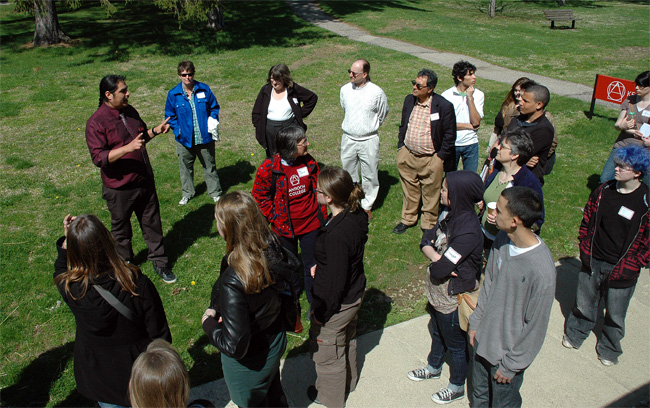
Twenty-four of the 45 students who have been admitted to Antioch College attended an open house at the college on Sunday. As Horace Mann Fellows, they will have their full four-year tuition paid for by the college if they choose to enroll. The deadline is May 1.

The prospective students toured the campus buildings in which they would spend most of their time beginning this fall — McGregor Hall for classes and Birch Hall for living and eating — and heard from Antioch alumnus and MacArthur Genius Award winner Timothy Barrett and recent graduates of the college.

For interviews with the new students, see the April 21 issue of the News.

A panel of 2008 graduates discussed their co-op experiences and answered questions from prospective students.

A panel of 2008 graduates discussed their co-op experiences and answered questions from prospective students.


Admission Ambassador Shane Creepingbear told students the library would host a cafe.

Admission Ambassador Shane Creepingbear told students the library would host a student lounge and cafe.

Antioch College— Contemplating mindfulness

Stop. Close your eyes. Now envision an Antioch College where students are challenged to contemplate as well as analyze — to understand the outer world and reflect on the inner.

Imagine that classes might start with a 10-minute meditation, that students experiment with contemplative practices from spiritual traditions around the world, and that they bring mindfulness to bear on math and physics equations as well as to works of art and literature.

If this sounds Antiochian, it’s because it is. A group consisting largely of former Antioch faculty and students is promoting contemplative education as the fourth “C,” and one which would enhance the existing principles of classroom, co-op and community.

And if the group is successful in its efforts, beginning with a groundbreaking symposium this weekend, the college’s future students may have better attention, empathy, tolerance, equanimity and less stress, anxiety and distractions than other college students, organizers said.

At “Green Space for the Mind,” on Saturday, April 9, at Antioch’s Herndon Gallery, leading scholars will report on their efforts to incorporate contemplative practices into higher education. A Christian monk, a University of California neuroscientist, a professor of Buddhism and a Brown University institute director will offer advice on how the revived college could lead in this emerging field. The event, which runs from 10 a.m. to 4 p.m., is free and open to the public.

“The college would be at the forefront of something that is a big part of where higher education is heading,” said organizer Amy Maruyama, a 1996 Antioch graduate.

Contemplative practices would help students think more deeply about subjects and integrate new perspectives, according to organizer Robert Pryor, founder and director of Antioch Education Abroad’s Buddhist Studies Program.

“It’s not an alternative to rational thinking, it’s an enhancement,” said Pryor, also the symposium moderator. “We don’t have a different goal about liberal arts — these methods help achieve the traditional goals of education.”

Harold Roth, director of the Contemplative Studies Initiative at Brown University and a panelist at Saturday’s symposium, said he sees contemplative practices as a way to foster academic learning as well as to help students deal with emotional stresses and get along with one another.

“They are less judgmental about themselves and have more compassion for themselves and others,” Roth said of students employing such practices.

Sponsored by the Southwest Ohio Council for Higher Education, or SOCHE, the symposium is the first of four events over the next few years introducing the Antioch and greater academic community to the benefits of contemplative practices and how to use them on campuses and in classrooms. SOCHE has given $10,000 to the initiative, with half going to its first event.

Daniel Goleman, best-selling author of Emotional Intelligence, will speak via Webcast at 10 a.m. on environmentally-conscious consumerism, the topic of his latest book, Ecological Intelligence. Goleman’s son, Hanuman, is an Antioch alumnus.

Following Goleman’s address and a lunch break, a panel discussion will begin at 1 p.m. among Roth, Linda-Susan Beard, a Bryn Mawr College associate professor of literature; John Makransky, professor of Buddhism and comparative theology at Boston College, and Clifford Saron, associate research scientist at the Center for Mind and Brain at the University of California at Davis.

Beard will offer contemplative practices from a Western spiritual perspective and Makransky brings an Eastern one, while Antioch’s model would be secular.

“It’s not only a spiritual practice or a wellness practice,” added Maruyama. “It can contribute to scientific innovation by opening new pathways in the brain to allow thoughts to expand and grow.”

While the traditions date back millennia, scientific research into their effect on the brain only go back several decades. Saron will share the results of his groundbreaking research on the long-term neurological changes resulting from meditation and mindfulness practices.

Learning meditation, mindfulness and relaxation techniques could particularly be valuable to Antioch students, who may have more stress from the community process and their co-op experiences, organizers said. Plus today’s generation, they said, needs to learn how to quiet and focus their minds now more than ever as the rise of digital media has shortened attention spans and increased distractions.

Like an Antioch education, contemplative practice may be hard to quantify. But the organizing team of Maruyama, Pryor, Egart, Denman and Dianeah Wanicek stress the value of contemplation, and its importance for the college.

“Antioch has an opportunity to build contemplative practices into the curriculum from the ground up,” Roth said. “Places already established don’t have the flexibility.”

Antioch College to Celebrate the Life and Work of Alumna Coretta Scott King


Coretta Scott King


Rev. Dr. Barbara A. Reynolds 

YELLOW SPRINGS, Ohio – April 11, 2010 – The public is invited to an event celebrating the life and work of Antioch College alumna Coretta Scott King on her birthday, April 27, at the College’s Coretta Scott King Center for Cultural and Intellectual Freedom. The Rev. Dr. Barbara A. Reynolds, an award-winning journalist, activist, author, spiritual leader and educator, will deliver a public address on King’s legacy at 7:00 p.m.

Presented jointly by the College and the African American Cross-Cultural Works, the event will also feature live music performances and readings from King’s speeches and interviews. A reception will follow the scheduled program.

One of the most celebrated champions of human and civil rights, Coretta Scott King, in partnership with her husband, Dr. Martin Luther King Jr., ignited democracy movements worldwide. For more than forty years, she traveled extensively as a messenger of peace, justice and social action. Notably, in 1974, she formed and co-chaired the National Committee for Full Employment, formed the Coalition of Conscience (1983), and co-convened the Soviet-American Women’s Summit (1990). In 1969, she became the founding president, chair and chief executive officer of The King Center, the first institution built in memory of an African American leader. As a lifelong advocate for non-violence and coalition building, King’s legacy will continue to serve as an example for years to come.

King enrolled at Antioch College in 1945 as part of the college’s Interracial Education Scholarship program, which had recruited her sister, Edythe, two years earlier. Though she left the College in 1949, she remained connected to her alma mater, returning in 1965 when her husband delivered the commencement address, and again in 1967 to receive the baccalaureate degree that she should have received in 1951. She delivered the commencement address in 1982 and in 2004 accepted the Horace Mann Award from the Alumni Association for her determination to promote nonviolent social change. In 2005, she honored the College by allowing it to use her name on a Center for Cultural and Intellectual and Freedom. The Coretta Scott King Center opened on March 27, 2007.

Reynolds has more than 30 years of experience as a journalist/writer with some of the major media institutions in America, including Ebony, Essence, and The Chicago Tribune. She was also a founding editor at USA Today, where she served on the editorial board and wrote a column for more than 13 years. Today she is a religion columnist for the National Newspaper Publishers Association and is president of Women’s Christian Action Network (WCAN), a new multi-media TV channel that will be launched this year. Her television appearances include guest spots on The Oprah Winfrey Show and Politically Incorrect.

Her books include: Jesse Jackson: America’s David, an unauthorized biography; And Still We Rise: Interviews with 50 African-American Role Models; No I Won’t Shut-Up! 30 Years of Telling It Like It Is; Out of Hell & Living Well: Healing From the Inside Out. In August 2007, she released her fifth book, Doing Good in the Hood: The Life, Leadership & Legacy of Bishop Alfred A. Owens, Jr.

Born in Columbus, Ohio, Reynolds earned a bachelor’s in journalism at The Ohio State University, master’s in divinity at Howard University, and doctorate in ministry at the United Theological Seminary in Dayton. She received honorary doctorates in humane letters from both Shenandoah University and Ohio State. Bishop Alfred A. Owens Jr. ordained her an elder at the Greater Mt. Calvary Holy Church in 1995. For more information contact Morgan Fellow, Anne Bohlen, at 937286-8455 or abohlen@antiochcollege.org.

About Antioch College
A private, independent nonprofit liberal arts college in Yellow Springs, Ohio, Antioch College will offer a four-year, undergraduate residential experience to a new class of students beginning in the fall of 2011. The College curriculum puts equal emphasis on rigorous liberal arts learning, work (cooperative education), and community engagement. Students will complete individualized majors based on one of 11 concentrations, a language minor, and six full-time work experiences. The institution, originally founded in 1850, is now completely independent of Antioch University, the multi-campus system it created.

MEDIA CONTACT:
Gariot P. Louima ?
Director of Communications
Office: 937-319-6131
Mobile: 937-581-8201
glouima@antiochcollege.org