Antioch College begins renovation to theater and gym

Last week about 100 Antioch College alumni returned to campus to engage in the ongoing work, both creative and backbreaking, of rebuilding their school. This summer’s alumni work week focused especially on the demolition jobs needed to be done before the college can start this year’s slate of renovation planned for the Health and Wellness Center, the Theater building and the campus’s central geothermal heating and cooling plant. The chain-link fence that went up around Curl gym a few weeks ago is indicative of where the initial thrust lies.

According to Antioch Facilities Manager Reggie Stratton, the Wellness Center, to be located in Curl gym, is the biggest capital project to get under way this year. With plans for a new fitness center, lounge, locker rooms, two racketball courts and a new pool, the 44,000-square-foot center is expected to cost $7.2 million.

Along with the fitness amenities, the original Curl gym, built in 1928, will get its former windows restored along the upper perimeter of both the “east gym” and “west gym” — this time with double-paned insulated glass. The back wall of the natatorium will be constructed entirely of glass, with access to an outdoor patio to the south. The west gym will be refurbished, and the south gym will continue to be used as a multi-purpose performance and assembly space.

Also with new roofing, insulation and energy efficient lighting, the Wellness center aims to achieve some level of LEED certification, the second facility on campus (after North Hall) to do so, Stratton said.

The new Wellness Center is expected to be complete by June of next year.

A little ways east of the gym, the theater building is also getting some attention this year. The construction is happening ahead of schedule thanks to private donations of $350,000 and a commitment from the Yellow Springs Community Foundation. Though he couldn’t specify the amount of the grant which isn’t yet official, YSCF President Sterling Wiggins expressed enthusiasm for supporting the college.

“I believe the stronger the college is, the stronger the village is,” he said this week.

The theater, 16,000 square feet in total, is ready for an infrastructure overhaul, with new electric, plumbing and HVAC, as well as a partial roof repair on the north side. On the cosmetic end, the theater will also get new and expanded restrooms, new paint in the front hall, an LED theater lighting system, and all new seating on the existing risers in both the main theater and the smaller black box to the south. The theater seats a total of about 250 people, Stratton said. In addition, the college is rebuilding the theater’s dance floor using the wood from the floor of west gym. About a half a dozen alumni spent last week tearing out the old floor and meticulously removing the nails from each plank for the recycling effort.

All told, this phase of the theater building renovation is expected to cost $1.2 million, Stratton said. It is scheduled to start in earnest in July and be completed by Oct. 1, in time for the arrival of Antioch’s third class of students. Phase II for the theater will depend on financing and is projected to include the rest of the roof, all new windows, and a new set workshop, he said.

Both the gym and the theater, as well as the science building (currently in partial use for both the science and art programs) are to be heated and cooled by the central and primary geothermal plant, another major construction/renovation project slated for this year. The geothermal wellfield consists of 150 wells each 300 feet deep and will be located on the campus golf course. The system uses the steady temperature of the ground to heat and cool water whose energy is then converted to either the heating or cooling needs of campus facilities. The converters, including heat pumps, chillers and heat exchangers, will be located in the maintenance and engineering building just south of the library.

When the geothermal project starts in September, maintenance staff will relocate to an existing structure south of the Kettering building, as the maintenance building itself will also benefit from a new roof, windows and restrooms.

The cost of the geothermal system and trenching to the first three buildings is expected to cost around $4.2 million. That phase should be completed by April 2014. (In the meantime, the theater building, which will be up and running this fall, will be heated with a rented gas-fire unit until it can be connected to the central plant.) Phase II of the geothermal system, again dependent on the availability of funds, will include serving the heating and cooling needs of South Hall, McGregor and possibly the library, Stratton said, by trenching and laying pipeline from the central plant to those buildings.

The Wellness Center and the theater building constitute the third and fourth renovation projects since the college reopened in 2011. Last year the college put $3.6 million into reburbishing some of the science building laboratories and classrooms, and $5.7 million into a complete renovation of North Hall dorm and cafeteria, with a secondary geothermal heating system. Phase II of the science building is projected to cost an estimated $7.4 million and will accommodate both the science and the art departments for the foreseeable future, Stratton said.

“We want to get that done in the next few years in order to allow the arts program to grow,” he said.

In terms of dorm space on campus, Antioch anticipates that Birch Hall and North Hall have enough space for the first four classes, with Case Commons (behind the Coretta Scott King Center) available for additional needs. By 2017, the college expects to have one more dorm online, perhaps either a renovated Spalt dorm or a new building on the horseshoe where Spalt now stands.
Roosevelt envisions ‘Antioch village’

Of the thousands of institutions of higher learning represented at a recent accreditation meeting, only five were looking to be newly accredited — two tribal schools, a bible school, a cosmetology school and Antioch College.

As the only liberal arts college in the country in the process of starting up, Antioch must find new and better ways of operating, and the village of Yellow Springs could play a pivotal role. That was the message of Antioch President Mark Roosevelt during a presentation to college trustees last weekend.

“There are significant ways we can break new ground in relationship with the village we call home,” Roosevelt said.

The new Wellness Center breaking ground this year is projected to strengthen town-gown ties and bring in revenue to the college, but is just the beginning, Roosevelt told the trustees. Antioch’s assets also include Glen Helen, WYSO Public Radio, Antioch Review, Herndon Gallery, Coretta Scott King Center, Riding Centre, Rockford Chapel, a renovated theater building and more.

“We’re not either a simple enterprise or simply a residential small liberal arts enterprise,” Roosevelt said. “How do we think about integrating all of these [assets] to enrich student education opportunities and to enrich the community we live in?”

Collaboration with Yellow Springs is described as the “Antioch Village” concept and is still in its nascent phase, according to Antioch chief communications officer Gariot Louima. It may also include opportunities for seniors to live and learn on the Antioch campus, but there are no immediate plans for senior housing, he said.

Accreditation, meanwhile, remains an important board goal, according to Louima, who said the college can’t conjecture about an achievement date.

During his talk, Roosevelt shared plenty of good news with trustees. It will be a banner fundraising year for the college, with $20 million expected by the end of its fiscal year in June, while annual operating expenses are around $12 million. Far more students enrolled than expected for the fall incoming class — the college’s third class since reopening in 2011. Already 104 deposits have been received. When planned renovations are complete, Antioch will have a $5.7 million dorm, $11 million science building, $8 million wellness center, a central geothermal plant and, potentially, a two-acre solar farm.

But Roosevelt said he doesn’t take much satisfaction in the college’s past fundraising and enrollment success because Antioch still needs reliable revenue sources. Even when students begin paying tuition in a few years, the college will remain reliant on donations, he said.

“When I first came here, I described it as daunting but doable,” Roosevelt said. “Then it was all-in, in order to accomplish it. We’re somewhere past that. We’re well on our way. We are past some of the major hurdles…but it’s unfortunately not safe territory.”

Roosevelt also suggested a new model for admissions. Currently Antioch is “playing the same game” as other colleges by sending out mass mail appeals and email blasts and bragging about its selectivity, Roosevelt said. But, he asked, is that how Antioch College wants to be judged?

With 158 students accepted this year out of 875 applications, Antioch remains highly selective compared to other colleges. Last year, because of a viral Internet article about the college, more than 3,000 applications were received. But with as many as 200 incoming freshman projected in a few years, selectivity might diminish, Roosevelt said. And Antioch might want to find new ways to reach its target student, who in the past has had a combination of academic prowess, grit and positivity.

“We want a particular kind of student,” Roosevelt said. “We don’t admit them just based upon test scores and GPA.”

Roosevelt proposed that Antioch could instead stake out relationships with 30 to 50 high schools in the country from which to draw a diverse student body. School counselors would be educated on the Antioch model. But that would mean ending the pursuit to be more selective.

A related matter is how the college judges its own educational experience, which Roosevelt said remains a major issue with accreditors. While Antioch students are reportedly satisfied with courses, rating them highly for everything from the attentiveness of instructors to the rigor, it’s harder to assess student learning, Roosevelt said. Co-op is notoriously difficult to evaluate, he added. Antioch could look at employability after college, job satisfaction, graduate school admissions or other ways, he said.

“People will judge us by terms they set if we don’t set our own,” Roosevelt said.

According to chief admissions officer Micah Canal, students enrolled in the incoming freshman class have an average ACT score of 26, SAT of 1160 and a GPA of 3.62. There are 33 states and three countries represented, with many students hailing from the top five states of Ohio (22), Texas (11), Pennsylvania (6), California (6) and Wisconsin (5).

Campus renovations

While the board has supported a host of capital projects in recent years, the funds allocated for them has been used up, Roosevelt said. New fundraising must begin for a third dormitory, expected to cost $10 million, which may be needed in a few years if enrollment continues as projected.

Moving ahead this year are renovations to the former Curl Gymnasium, now the Antioch College Health and Wellness Center, and to the theater building. The college may also see ground break this year on a behind-the-meter 550-kilowatt solar array on two acres along Corry Street. That project would be erected not with Antioch funds, but through a power purchase agreement with a solar development company, and is expected to provide for about one-quarter of the college’s electricity needs.

The wellness center will break ground in late spring or early summer, according to a news release last week. Once rehabbed, the 44,000-square-foot facility will have a fully-equipped fitness center, racquetball courts, multi-purpose studio spaces, and a regulation-size indoor swimming pool. The East Gym’s indoor basketball courts will be refurbished, while South Gym will continue to serve as a multi-use space. There will also be a snack bar, locker rooms and outdoor patio, according to floor plans.

The original gymnasium was erected in 1928 and the swimming pool addition built in 1964. Much of the building was in poor condition, according to a recent inspection. There was no insulation in the walls or roof, the floor in the West Gym was buckled due to flooding and the walls in the natatorium were corroded because of chlorine. In addition to fixing these problems, the renovation will be up to Leadership in Energy and Environmental Design, or LEED, standards thanks to an anonymous donation from a villager. The wellness center is expected to be competitive in fees to area YMCAs.

First Education Conference— AUM, college collaborate on kids

An upcoming educational conference at Antioch University Midwest and Antioch College seeks to address topics of concern to many local parents and educators: how technology affects children, and how best to create safe, healthy schools. The series of events features an international expert on school climate and an area expert on the effects of technology on children.

The “Safe School Climate: Making the Invisible Visible” education conference will take place May 8 and 9. Featured are author and educator Kim John Payne, the author of Simplicity Parenting and founder of the Center for Social Sustainability, along with Wittenberg educator Lowell Monke.
The conference includes several events, beginning with a pre-conference four-hour session with Payne on May 8, which takes place at Antioch College, and a free lecture by Payne that night. It continues on May 9 with a day-long session with Payne at Antioch Midwest. Cost for the workshop is $125 for both days, and $75 for only one, with student rates available.

A related event on the effects of technology on children, featuring Monke, will take place Thursday, April 18, at 7 p.m. at the AU Midwest PNC Auditorium. That event is free to the community.

“The topic of school climate is connecting parents, teachers, students, higher education faculty and nonprofits in organizing an event that offers something to everyone,” said AUM School of Education Director Marian Glancy in a press release.

Co-organizers of the conference are Sarah Wallis, the assessment coordinator for the School of Education at AUM, and Antioch College community liaison Jennifer Berman. As well as having a timely topic, the event is significant as a collaboration between Antioch College and Antioch University, the first since the college gained its independence from the university in 2009.
“People are excited about it both inside and outside the institutions,” Wallis said. “This is showing that it [collaboration] can be done and will be done. This is the first of many.”

It’s also noteworthy that Yellow Springs public schools are providing support, along with the Yellow Springs Community Foundation, Project Trust and Think Tank, Inc., according to Wallis.
“It’s a community event where we’ve all come together to do this,” she said.

The collaboration between Wallis and Berman began when Wallis volunteered to help the college train students in mediation techniques for resolving difficult situations.

“We’re trying to figure out a new way to deal with conflict,” Berman said.

Of interest to both Berman and Wallis is the strategy of “restorative justice,” in which the offender in a difficult situation is not banned from the community, as often happens in traditional strategies, but rather is included in the solution.

“The process is more inclusive, with an emphasis on keeping the person in the community, getting everyone involved in a dispute working together to figure out a way to make the community whole,” Berman said.

Payne, an educator for 27 years, is a leading advocate for restorative justice who has spoken on the school climate issue on television networks ABC, NBC and CBS, among other places. He also writes a blog for Huffington Post on issues related to parenting and school climate, and has been featured in Time magazine, the Chicago Tribune and the L.A.Times.

“I’m am thrilled to be a part of this conference. I feel the approach of connecting social inclusion of marginalized student populations to overall school climate is timely and essential to creating an effective learning and compassionate community,” Payne said in the press release.

The May 8 pre-conference sessions will include The Cost of Poverty and Other Issues of Diversity; Project Trust: Building Inclusive Communities and Breaking Down Barriers Between Student Cliques; and Overcoming Social Overwhelm: Building our Kids’ Resilience to Bullying, Teasing and Subtle Non-Inclusion.

Workshop topics on May 9 include Assessing School Climate; Signs and Symptoms of Student Mental Health Issues; School Climate Initiatives by the Ohio Department of Education; and student panels on topics such as GLBT issues and resources.

“I am extremely excited at the opportunity to host a conference that facilitates the exchange of skills and resources to create safe and inclusive environments for learning,” AUM School of Education Director Glancy said in the press statement.

And while how to address bullying is in the limelight in many school communities, the effects of technology on children is also high on parents’ lists of concerns, Berman said.

“Screen time is a huge source of conversation and strife” among local parents, according to Berman, the mother of two elementary-age children. “People feel these things are getting away from them, like we’re on a runaway train with all on board, but we’re not happy about the ride.”
Dr. Monke will address this topic on April 18 in his talk, “Unplugging Narcissus: Why a High Tech Society Needs a High Touch Childhood.”

Monke, who has focused his work on the effects of technology on children for the past 15 years, believes that some of  the concerns receiving publicity on the topic, such as “sexting,” may be focusing on the wrong issues.

“Those things may be important but don’t get at the fundamental problems,” he said in an interview last week.

Those fundamentals are how technology changes the way that children relate to the world.
“What we’ve seen in the last 60 years is a fundamental shift in the way that children engage in the world first hand,” he said. While until recent history most children’s experience of the world was first-hand, now “the vast majority of what children engage with are symbolic representations of the world rather than the real world,” he said.

It’s not clear what the effects of this shift are, but one may be that children care less about learning, since they don’t bring as much real-world experience to the table, Monke said. And he has also looked at how the average 7½ to 8 hours a day that children spend engaged with technology has affected their social skills.

“My students to a person admit that when they come to class they fake texting rather than talk to the strange person sitting beside them,” he said. “What does this mean about their capacity to have good social skills?”

At Antioch College, staff is aware of the challenges of communication issues among young people, according to Berman.

“At Antioch, we’re all about community, and the value of face-to-face conversations,” she said. Most Antioch College students grew up texting and on Facebook, and “We’re all figuring out how to talk to each other.”

And while many Antioch College students have excellent social skills, “this generation has new issues,” she said.

For more information on the Lowell Monke lecture, contact Berman at jberman {at} antiochcollege(.)org. To register for the Kim Payne events, go to http://midwest.antioch.edu/education-conference.

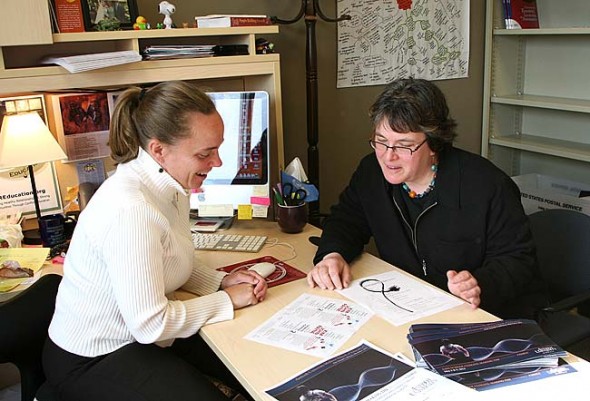
041113_MonkePayne01

Curl Gym next on college’s renovation list

Antioch College is unveiling this week a preliminary design for its new Health and Wellness Center on campus. The center will be located in Curl Gym, which is scheduled for major renovation beginning late spring. College leaders view the wellness center as much a resource for the Yellow Springs community as it will be for the campus, Project Lead Dorothy Roosevelt said this week.

“We’re really excited about it — I think it will be great for the community.”

The college will host a dinner to announce further updates on the plans for Curl Gym tonight. The seating for the event is full.

According to the facilities master plan, Curl gym is next on the list of campus buildings to be renovated, after North Hall was completed last summer and a portion of the science building laboratories were reopened in the fall. Along with the rehabbing of the wellness center, the college expects to start the construction of another geothermal heating and cooling system (second to the one that serves North Hall and the Vernet Ecological Center) that will serve the gym and the science building.

“Everything is being done in a sequenced, thoughtful way with environmental and economic sustainability in mind,” Roosevelt said.

Roosevelt, who is the wife of Antioch College President Mark Roosevelt, came on as Project Lead in February to research best practices and manage a local survey about the wellness needs on campus and in the wider community. Formerly a child development researcher at Harvard Project Zero, Roosevelt owned a yoga studio in Pittsburgh and taught rehabilitative yoga to those with cancer and heart disease. Her interest in the wellness center stems from her experience and connection to a village community she has heard clearly say that it would like a wellness/fitness/recreation facility in the village.

“In my conversations with people, everyone, the first thing they say is, ‘Is the pool going to be back?’” Roosevelt said.

The survey the college conducted reflected that sentiment. Since February, the college has received about 500 survey responses, including 135 from campus and over 350 from the community. Close to 95 percent said they were very likely or likely to join the center, which is expected to be competitive in fees to area YMCAs. Most said they wanted the cardio/strength building equipmement and fitness aspects of a gym. And many people said they wanted the pool back.

So the plan that architects MacLachlan, Cornelius and Filoni are creating for the college wellness center includes everything the community said it wanted. According to Roosevelt, the front doors will open into an open lounge area with comfortable chairs, where people can gather, have a juice and plan a bike ride or coordinate a club team.

To the left, will be east gym’s basketball court, and to the right will be west gym’s fitness center/weight room. The college plans to keep two of the racketball courts behind west gym and turn two more into multi-purpose studios for things like dance, tai chi or martial arts. South gym, which was in fairly good shape, will remain a multi-purpose room able to accommodate both a campus dinner as well as a sporting competition or dance performance, Roosevelt said.

And at the heart of the gym, the pool will be completely rebuilt, at official competition length of 25 yards. The current pool is seven inches short of that, which Roosevelt suspects may be related to Antioch Archivist Scott Sanders’ story that the pool was planned and built at least in part by former Antioch students.

In a future facilities renovation phase, the second floor could accommodate a partnership with a physical therapy rehabilitation/massage practice.

In all, the 44,000 square foot fitness building will maintain its current footprint but be better integrated on the inside and get all new HVAC, electrical and plumbing infrastructure, as well as roofing, concrete patching, windows and doors. The renovation is expected to be completed sometime in the fall.

For the total cost of the project, the College is currently working with a rough “conceptual estimate” of $8 million, according to Antioch College Finance Director Valerie Webster. The number can vary due to a variety of alternate scenarios being considered in the bidding, which is expected to be finalized in a few weeks, Webster said.

While the renovation of the gym is part of Antioch’s master plan budget, the college is still in need of funds for the current year’s capital projects, Roosevelt said. With the second class of students finishing their first year, and a new crop of students applying for the fall, all tuition-free, the college is still dependent on ongoing fundraising. But Antioch’s leaders are taking a carefully planned course toward remaking the school into one that is sustainable for the long-term, Roosevelt said.

“Going forward, we’re doing things well and right, without being extravagant,” she said. “A fitness center is a real need — all colleges have some kind of fitness center, and if we want to attract students down the road, it’s something we’ll need.”

Mary Lee Boles

Mary Boles

Mary Boles

Mary Lee Boles of Yellow Springs passed away unexpectedly on Sunday, March 10 at Greene Memorial Hospital. She was 78.

Mary was born on Feb. 1, 1935 in Blaze, Ky., the daughter of the late Leslie and Lenia (Lewis) Peyton. Mary was preceded in death by her husband, Earl “Don” Boles; brothers Roy, Clyde, Onyx and Clay Peyton and sister, Nola Johnson. She is survived by her daughter, Donna (Jerry) Huckleba of Clifton; son, Gary (Ronda) Boles of Fairborn; grandchildren, Caleb (Jessica) Boles and Joshua Boles; sister-in-law, Reva Abner of Fairborn and sister-in-law and brother-in-law, Anna Mae and Charlie Boles of Mechanicsburg. She is also survived by several nieces and nephews and close friend and neighbor, Eileen Babineau.

Mary worked as a waitress for most of her life before retirement. She owned and operated, with her late husband, the former Village Coffee Shop in Yellow Springs. Mary loved collecting beautiful antique dishes, but most of all, she loved spending time with her grandchildren.

Viewing will be held on Friday, March 15, 5–7 p.m. at Jackson, Lytle and Lewis Funeral Home in Yellow Springs, where a funeral service will be held on Saturday, March 16, 2013 at 10 a.m. Pastor Stuart Snow will officiate, and burial will follow at Clifton Cemetery. Condolences may be expressed to the family at www.jacksonlytle.com.

Paul F. Ihrig

Paul F. Ihrig, aged 99 years and 8 months, died Saturday, March 2, at Friends Care Community.

Paul was born July 18, 1913 in Marion, Ind. He was the child of Fred H. and Callista C. Ihrig. Paul had one brother, Henry, and one sister, Barbara. Paul’s father died when he and his siblings were young, so the family moved to Springfield to be near family.

Paul’s first job was delivering the Springfield Sun News. He moved to Yellow Springs in the 1940s after his sister, Barbara, was hired by Ernest Morgan to assist with the development of the Antioch Bookplate, and where Paul met Horace Champney, who had a great influence on Paul. He became employed at Antioch Bookplate for a short period. He moved to radio engineering and worked at WHIO when Don Wayne first began in his career. Paul was fired by WHIO because he refused to play commercials. He loved the Yellow Springs News and, later in life, had a newspaper route in Yellow Springs, carefully delivering the news to homes. Also, he loved WYSO when it finally came on the air, but was deeply disappointed when classical music was removed from the airwaves.

Paul met and married Lou, and out of that marriage, two children were born. His daughter, Beth, was killed in a motor vehicle accident in the 1970s. His son, Glen, Glen’s wife and his grandson, Arlo, reside in California. An ex-daughter-in-law and mother of Arlo, Selwa Whitesell of Yellow Springs, also survives him, as well as many friends in the Yellow Springs community.

Paul was the oldest living member of the Yellow Springs Friends Meeting. He was quite a character in town, and was often found Dumpster-diving, trying to recycle food to give to everyone. He lived with many people in town throughout the years, but most of his time was spent in the Vale community or on the Antioch College campus. He was one of the original members of the south Glen community. He was also a member of the 100 Chew Club: “Chew every spoonful 100 times and you will live to 100.”

Within the past 18 years, Paul lived on Jackson Road with Neal Crandall and Pam Davis and their children. Two days before Hanna Northway died, she summoned the Crandalls to her home to discuss the care and oversight Paul would need and made Pam promise her that Paul would be cared for. Many others assisted in the care of Paul. Much appreciation and thanks to Vicky Deady for her compassion and daily excellent care for Paul so he could remain in a home, the staff at Friends Care and especially the STNAs who work diligently to care for those in Friends.

Paul is the only person to make a negative impact on a landfill. Troubled by the consumption of our culture and the impact on future generations, he lived his life accordingly.

Paul donated his body to Wright State University. Memorial contributions can be made to Friends Care Center or the Yellow Springs Food Pantry. A memorial service is being planned by the Friends Meeting.