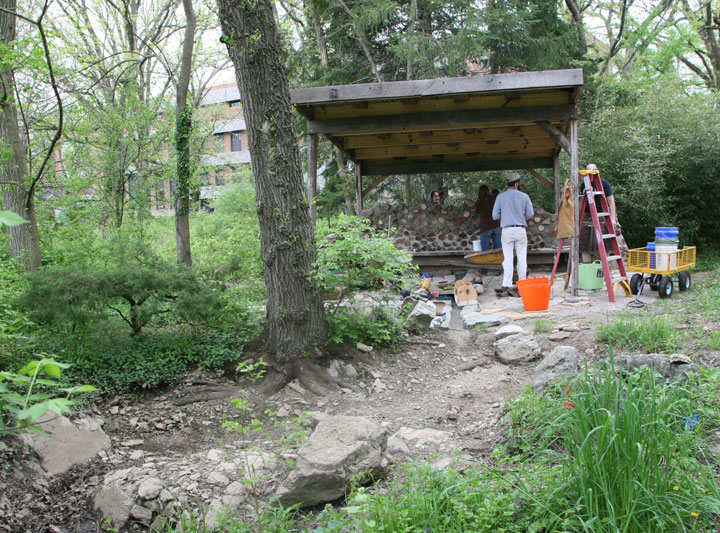
Tea pavilion construction continues

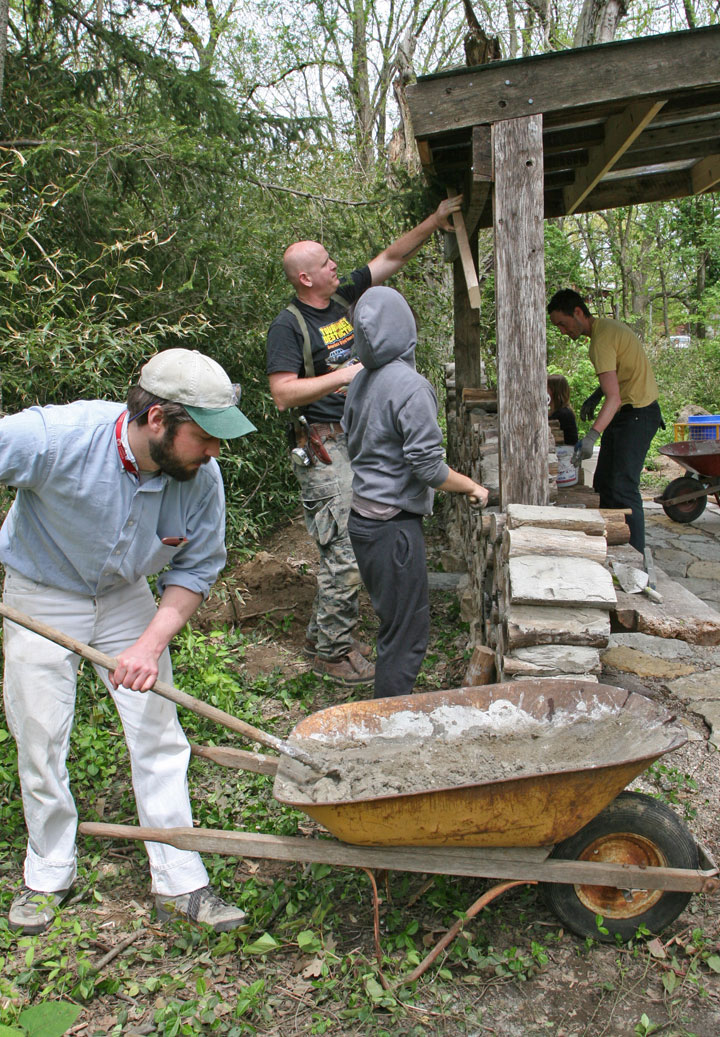
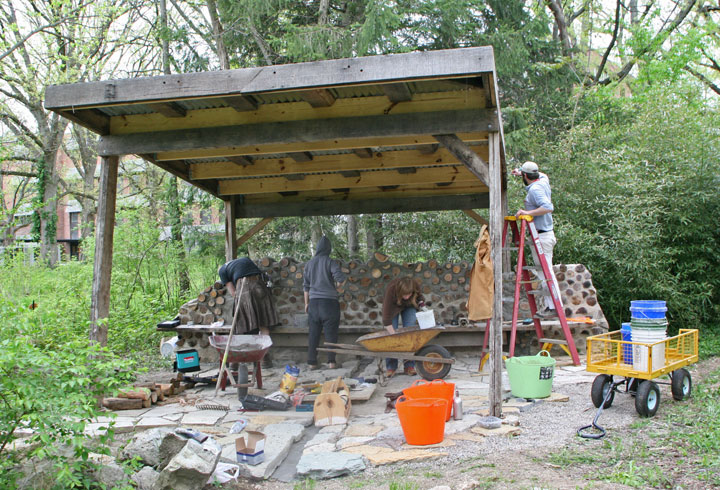
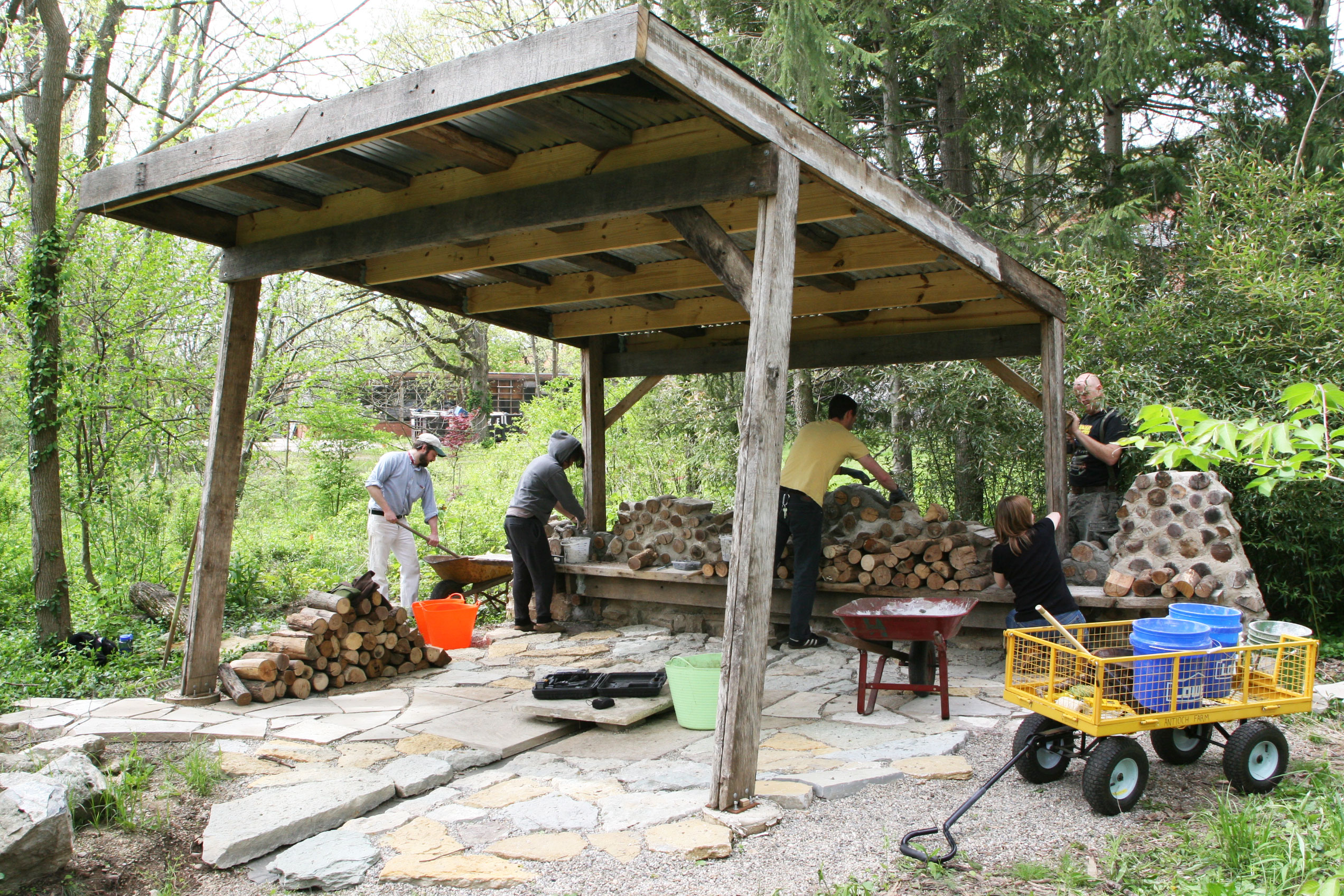
Construction of a tea pavilion began on the Antioch College campus last year. The project will continue on Saturday and Sunday, May 4 and 5, as volunteers work to complete a cordwood and mortar wall and realize the rain harvesting system.

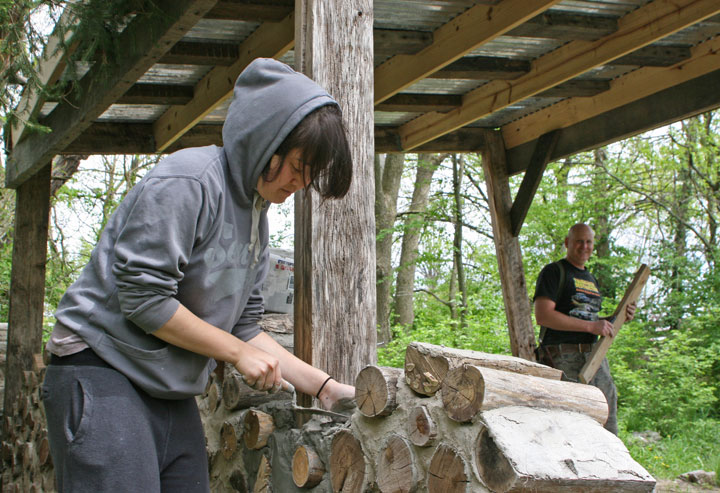
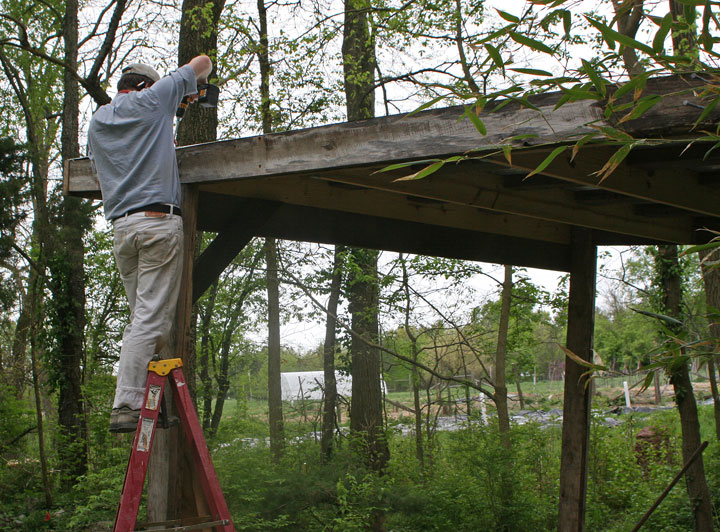
The process began last April with a design charrette, in which students developed an innovative design for the structure developed around the ritual process of building; the event of harvesting, steeping and drinking tea inspired by many cultures and the importance of water on the farm. Students and community members in Yellow Springs, along with the grounds crew at Antioch College, took down and salvaged material from an existing structure built in the 1970s, poured footings for the new structure, pulled up the concrete from the non-functioning pond, placed a stone “foot print” using stones harvested by hand from a nearby limestone quarry, constructed and roofed the renewed Tea Shelter structure and partially constructed a cordwood and mortar wall.

Volunteers are invited to join in from 9 a.m.–5 p.m. each day, with a one-hour lunch break. Those interested should RSVP to Sara Black at sblack {at} antiochcollege(.)org.

First Education Conference— AUM, college collaborate on kids

An upcoming educational conference at Antioch University Midwest and Antioch College seeks to address topics of concern to many local parents and educators: how technology affects children, and how best to create safe, healthy schools. The series of events features an international expert on school climate and an area expert on the effects of technology on children.

The “Safe School Climate: Making the Invisible Visible” education conference will take place May 8 and 9. Featured are author and educator Kim John Payne, the author of Simplicity Parenting and founder of the Center for Social Sustainability, along with Wittenberg educator Lowell Monke.
The conference includes several events, beginning with a pre-conference four-hour session with Payne on May 8, which takes place at Antioch College, and a free lecture by Payne that night. It continues on May 9 with a day-long session with Payne at Antioch Midwest. Cost for the workshop is $125 for both days, and $75 for only one, with student rates available.

A related event on the effects of technology on children, featuring Monke, will take place Thursday, April 18, at 7 p.m. at the AU Midwest PNC Auditorium. That event is free to the community.

“The topic of school climate is connecting parents, teachers, students, higher education faculty and nonprofits in organizing an event that offers something to everyone,” said AUM School of Education Director Marian Glancy in a press release.

Co-organizers of the conference are Sarah Wallis, the assessment coordinator for the School of Education at AUM, and Antioch College community liaison Jennifer Berman. As well as having a timely topic, the event is significant as a collaboration between Antioch College and Antioch University, the first since the college gained its independence from the university in 2009.
“People are excited about it both inside and outside the institutions,” Wallis said. “This is showing that it [collaboration] can be done and will be done. This is the first of many.”

It’s also noteworthy that Yellow Springs public schools are providing support, along with the Yellow Springs Community Foundation, Project Trust and Think Tank, Inc., according to Wallis.
“It’s a community event where we’ve all come together to do this,” she said.

The collaboration between Wallis and Berman began when Wallis volunteered to help the college train students in mediation techniques for resolving difficult situations.

“We’re trying to figure out a new way to deal with conflict,” Berman said.

Of interest to both Berman and Wallis is the strategy of “restorative justice,” in which the offender in a difficult situation is not banned from the community, as often happens in traditional strategies, but rather is included in the solution.

“The process is more inclusive, with an emphasis on keeping the person in the community, getting everyone involved in a dispute working together to figure out a way to make the community whole,” Berman said.

Payne, an educator for 27 years, is a leading advocate for restorative justice who has spoken on the school climate issue on television networks ABC, NBC and CBS, among other places. He also writes a blog for Huffington Post on issues related to parenting and school climate, and has been featured in Time magazine, the Chicago Tribune and the L.A.Times.

“I’m am thrilled to be a part of this conference. I feel the approach of connecting social inclusion of marginalized student populations to overall school climate is timely and essential to creating an effective learning and compassionate community,” Payne said in the press release.

The May 8 pre-conference sessions will include The Cost of Poverty and Other Issues of Diversity; Project Trust: Building Inclusive Communities and Breaking Down Barriers Between Student Cliques; and Overcoming Social Overwhelm: Building our Kids’ Resilience to Bullying, Teasing and Subtle Non-Inclusion.

Workshop topics on May 9 include Assessing School Climate; Signs and Symptoms of Student Mental Health Issues; School Climate Initiatives by the Ohio Department of Education; and student panels on topics such as GLBT issues and resources.

“I am extremely excited at the opportunity to host a conference that facilitates the exchange of skills and resources to create safe and inclusive environments for learning,” AUM School of Education Director Glancy said in the press statement.

And while how to address bullying is in the limelight in many school communities, the effects of technology on children is also high on parents’ lists of concerns, Berman said.

“Screen time is a huge source of conversation and strife” among local parents, according to Berman, the mother of two elementary-age children. “People feel these things are getting away from them, like we’re on a runaway train with all on board, but we’re not happy about the ride.”
Dr. Monke will address this topic on April 18 in his talk, “Unplugging Narcissus: Why a High Tech Society Needs a High Touch Childhood.”

Monke, who has focused his work on the effects of technology on children for the past 15 years, believes that some of  the concerns receiving publicity on the topic, such as “sexting,” may be focusing on the wrong issues.

“Those things may be important but don’t get at the fundamental problems,” he said in an interview last week.

Those fundamentals are how technology changes the way that children relate to the world.
“What we’ve seen in the last 60 years is a fundamental shift in the way that children engage in the world first hand,” he said. While until recent history most children’s experience of the world was first-hand, now “the vast majority of what children engage with are symbolic representations of the world rather than the real world,” he said.

It’s not clear what the effects of this shift are, but one may be that children care less about learning, since they don’t bring as much real-world experience to the table, Monke said. And he has also looked at how the average 7½ to 8 hours a day that children spend engaged with technology has affected their social skills.

“My students to a person admit that when they come to class they fake texting rather than talk to the strange person sitting beside them,” he said. “What does this mean about their capacity to have good social skills?”

At Antioch College, staff is aware of the challenges of communication issues among young people, according to Berman.

“At Antioch, we’re all about community, and the value of face-to-face conversations,” she said. Most Antioch College students grew up texting and on Facebook, and “We’re all figuring out how to talk to each other.”

And while many Antioch College students have excellent social skills, “this generation has new issues,” she said.

For more information on the Lowell Monke lecture, contact Berman at jberman {at} antiochcollege(.)org. To register for the Kim Payne events, go to http://midwest.antioch.edu/education-conference.
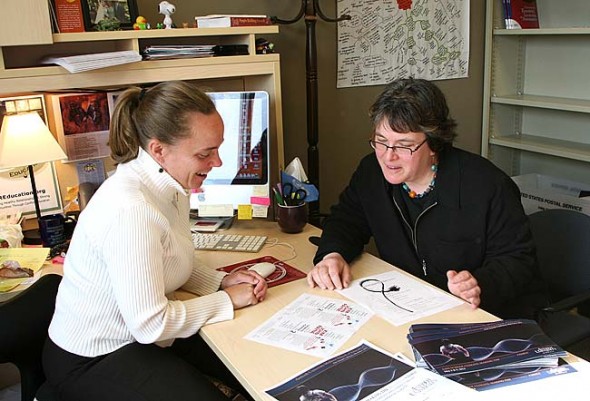
041113_MonkePayne01

AUM, Antioch College collaborate on education conference

An upcoming education conference at Antioch University MIdwest and Antioch College seeks to address topics of critical interest to local parents and educators. Klm John Payne, an international expert on school climate and Dr. Lowell Monke, a Wittenberg specialist on the effects of technology on children, will be featured.

The “Safe School Climate: Making the Invisible Visible” education conference will kick off Wednesday, May 8, with a half-day session at Antioch College featuring Payne, the author of Simplicity Parenting and founder of the Center for Social Sustainability. Payne has been featured as an expert on school climate on ABC, NBC and CBS, along with Time Magazine, the Chicago Tribune and the L.A. Times.

That evening, he will give a free talk to the community.

The conference continues with a daylong series of workshops with Payne on Thursday, May 9, to take place at Antioch University Midwest. Cost for the workshop is $125 for both days, and $75 for one day only. Interested persons may register by going online to http://midwest.antioch.edu/education-conference.

A related event is a free talk to the community by Dr. Lowell Monke of Wittenberg University, to take place Thursday, April 18, at 7 p.m. at Antioch University Midwest. Monke, who has focused on the effects of technology on children, will speak on “Unplugging Narcissus: Why a High Tech Society Needs a High-Touch Childhood.” The event will include a dialogue with audience members, who are encouraged to share their own stories and concerns.

The education conference is a collaboration between Antioch College and Antioch University.

Curl Gym next on college’s renovation list

Antioch College is unveiling this week a preliminary design for its new Health and Wellness Center on campus. The center will be located in Curl Gym, which is scheduled for major renovation beginning late spring. College leaders view the wellness center as much a resource for the Yellow Springs community as it will be for the campus, Project Lead Dorothy Roosevelt said this week.

“We’re really excited about it — I think it will be great for the community.”

The college will host a dinner to announce further updates on the plans for Curl Gym tonight. The seating for the event is full.

According to the facilities master plan, Curl gym is next on the list of campus buildings to be renovated, after North Hall was completed last summer and a portion of the science building laboratories were reopened in the fall. Along with the rehabbing of the wellness center, the college expects to start the construction of another geothermal heating and cooling system (second to the one that serves North Hall and the Vernet Ecological Center) that will serve the gym and the science building.

“Everything is being done in a sequenced, thoughtful way with environmental and economic sustainability in mind,” Roosevelt said.

Roosevelt, who is the wife of Antioch College President Mark Roosevelt, came on as Project Lead in February to research best practices and manage a local survey about the wellness needs on campus and in the wider community. Formerly a child development researcher at Harvard Project Zero, Roosevelt owned a yoga studio in Pittsburgh and taught rehabilitative yoga to those with cancer and heart disease. Her interest in the wellness center stems from her experience and connection to a village community she has heard clearly say that it would like a wellness/fitness/recreation facility in the village.

“In my conversations with people, everyone, the first thing they say is, ‘Is the pool going to be back?’” Roosevelt said.

The survey the college conducted reflected that sentiment. Since February, the college has received about 500 survey responses, including 135 from campus and over 350 from the community. Close to 95 percent said they were very likely or likely to join the center, which is expected to be competitive in fees to area YMCAs. Most said they wanted the cardio/strength building equipmement and fitness aspects of a gym. And many people said they wanted the pool back.

So the plan that architects MacLachlan, Cornelius and Filoni are creating for the college wellness center includes everything the community said it wanted. According to Roosevelt, the front doors will open into an open lounge area with comfortable chairs, where people can gather, have a juice and plan a bike ride or coordinate a club team.

To the left, will be east gym’s basketball court, and to the right will be west gym’s fitness center/weight room. The college plans to keep two of the racketball courts behind west gym and turn two more into multi-purpose studios for things like dance, tai chi or martial arts. South gym, which was in fairly good shape, will remain a multi-purpose room able to accommodate both a campus dinner as well as a sporting competition or dance performance, Roosevelt said.

And at the heart of the gym, the pool will be completely rebuilt, at official competition length of 25 yards. The current pool is seven inches short of that, which Roosevelt suspects may be related to Antioch Archivist Scott Sanders’ story that the pool was planned and built at least in part by former Antioch students.

In a future facilities renovation phase, the second floor could accommodate a partnership with a physical therapy rehabilitation/massage practice.

In all, the 44,000 square foot fitness building will maintain its current footprint but be better integrated on the inside and get all new HVAC, electrical and plumbing infrastructure, as well as roofing, concrete patching, windows and doors. The renovation is expected to be completed sometime in the fall.

For the total cost of the project, the College is currently working with a rough “conceptual estimate” of $8 million, according to Antioch College Finance Director Valerie Webster. The number can vary due to a variety of alternate scenarios being considered in the bidding, which is expected to be finalized in a few weeks, Webster said.

While the renovation of the gym is part of Antioch’s master plan budget, the college is still in need of funds for the current year’s capital projects, Roosevelt said. With the second class of students finishing their first year, and a new crop of students applying for the fall, all tuition-free, the college is still dependent on ongoing fundraising. But Antioch’s leaders are taking a carefully planned course toward remaking the school into one that is sustainable for the long-term, Roosevelt said.

“Going forward, we’re doing things well and right, without being extravagant,” she said. “A fitness center is a real need — all colleges have some kind of fitness center, and if we want to attract students down the road, it’s something we’ll need.”