Students take a global look at water

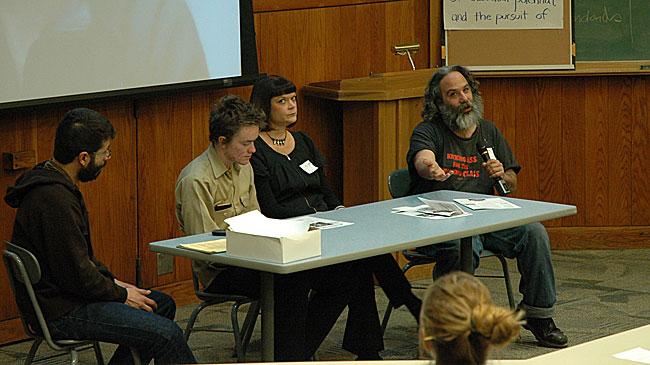
The entrance gallery at McGregor Hall was packed last Wednesday with students from Antioch College’s opening semester global seminar on the broad topic of water. Rachel Smith and Megan Miller stood beside their posterboard, gesturing with animation to explain their work to the Antioch community invited to view it. The seminar had inspired them to dig into the issue of hydraulic fracturing in the area, and they had used their findings to mount a public education campaign for the Clark and Greene County residents that are currently being asked to decide about fracking in their neighborhoods.

Right next to them, Antioch student Dustin Mapel spoke just as fervently about his idea to develop a new water usage plan for the college, including a rainwater catchment basin, a wastewater treatment process that fertilizes the campus garden and a cost estimate that wouldn’t nauseate the president. Students Ethan Kellaway and James Russell were also enthused about their recent chemical study of the Hebble Creek watershed that proved that the industrial pig farms in Greene County were not adversely affecting the watershed, which is currently within EPA pollutant limits.

Having approached the topic of water through the disciplines of art, science, history, literature, environmentalism and political science all in one semester, faculty members Lewis Trelawny-Cassidy and David Kammler, who led the college’s first global seminar, received a range of final projects that reflected their integrative model. In this contemporary incarnation of a liberal arts education, the global seminars are designed to help students understand the complexities and nuances that are involved in the decision-making that occurs in any system, Kammler said before the presentation last week. The aim is to encourage students to reflect on and integrate all of their learning, Trelawny-Cassidy said, and to help students become effective thinkers on major world issues, Kammler said. And ultimately, being able to perceive the interconnectedness of science, economics, psychology and politics regarding any issue will help students to be effective agents of change, he said.

“We wanted to help get them excited about [creating change], talk about how you go about practically doing it, and then how you let your passion drive you to get something done,” Kammler said. “It’s learning with a purpose, and it’s through a liberal arts education that students become effective citizens.”

Working with Green Environmental Coalition leader Vickie Hennessy this semester, Smith and Miller learned about the chemistry and mechanics of fracking and the process by which gas companies have attempted to lease private land to extract natural gas in Greene County over the past two years. They researched the degradation that fracking can cause to the rivers, streams and fresh water aquifers of an entire region, and realized that instead of a theoretical problem, fracking is a threat right now, right here in Yellow Springs.

“It was shocking — I was horrified,” Smith said of what she learned. “I knew it was important not to become emotionally attached to this issue, but it’s local, and personally we don’t want to do it and we don’t want people we know to do it.”

So they became attached, a little. They created educational packets to distribute to the residents in Fayette County, where fracking is currently a possibility. And they scheduled several screenings of the fracking film Gasland at both Cedarville University and the Xenia public library. They will continue to work on the project when they return to Antioch after the holidays, but they have intentionally limited their activism so that they can focus on their school work, they said.

According to Trelawny-Cassidy and Kammler, the seminar guided students to push for things they believe in and think about how to implement their own creative ideas. Many of the projects reflected a range of investigation students had to do to understand how hard facts would influence their ability to convince others of their beliefs. Cost estimates, for instance, were a big part of Mapel’s project because he knew that in order to convince the college of the need for a new water system, he would need to show them that they had enough money to do it.

“We talked a lot about when you’re trying to fight for whatever cause you’re in, you need to be able to learn fast and become an expert in that field quickly enough to make a convincing argument,” Trellawny-Cassidy said. “It takes a while to learn that skill.”

Other projects from the water seminar included Adam Abraham’s investigation of the conflicts the scarcity of water has created around the globe over the past decade. Since 2000, according to the United Nations, 20 percent of the world’s population in 30 countries faced water shortages, which has led to 60 wars/conflicts, especially around the Tigris, Euphrates and Nile rivers. Over the past 50 years the world has tripled its consumption of water, which is a finite resource, and Abraham concludes that in order to survive as a global community, nations will have to collaborate to manage water better and/or improve the technologies to treat water.

One group researched the potential for adopting composting toilets on campus, including a flush count for Birch Hall which found that the 35 students who live there account for 600 flushes per week. If even some of those toilets were exchanged for the Phoenix brand composter, the students calculated that a full campus of 1,000 students could reduce its yearly consumption of 2.5 million gallons of water.

Antioch students assess their year

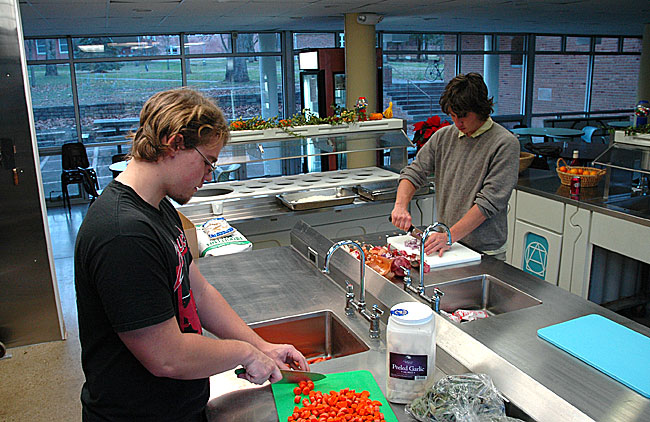
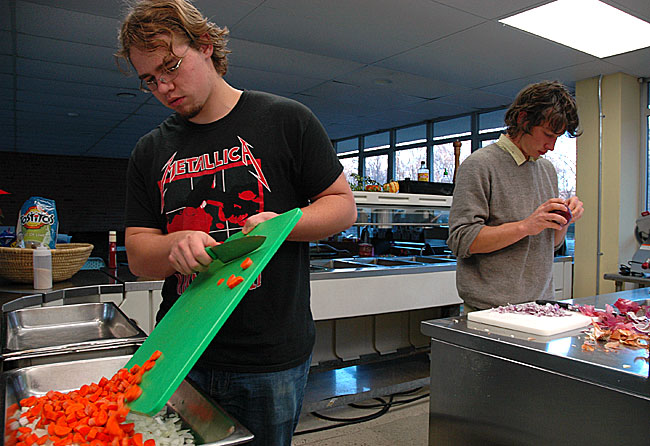
It’s Sunday night on the Antioch College campus and while some students are studying, others are cooking a meal they planned for fellow students. Chopping up onions and carrots for two shepherd’s pies — one with grass-fed beef and the other gluten-free and vegan — Ethan Kellaway shared his thoughts on the school year thus far.

“It’s worthwhile building the school back up … but it’s very busy balancing all of the jobs we have,” he said, repeating a common feeling among the first class of 34 students at the revived college. Not only are the students expected to go to class, do their homework, work on campus, cook for one another and govern themselves, they are also being leaned on to remake a college.

The exceptional group of students, undergoing an exceptional college experience, vacillate between stress and excitement, frustration and optimism, and feelings of isolation and connection as they work to get the school up-and-running. They have a lot of responsibility, and a lot of pressure on them, to revive the college, they said. In the words of student Adam Abraham,“we’re setting the stage for future generations of Antiochians.”

Louise Smith, dean of community life, said a lot is being asked of these students, but that they’re handling the pressure well.

“It’s like everyone’s watching,” she said.

All eyes are on the students, who received full tuition scholarships in exchange for the risk, and reward, of helping revive the college. Bringing back the historic liberal arts college is not without its birth pains, but students, staff and faculty are confident that the Antioch model is working and that the institution has a future.

“Everyone’s pretty committed and had to be pretty committed to come here,” said Katie Wiebke, a student. “There’s a lot of pride for the school. It will be exciting to see how it can grow, we’re just overwhelmed with the new experience.”

Demands of community

Hassan Rahmanian, vice president for academic affairs, estimates that the students spend between 68 and 70 hours per week in scheduled activities and class preparation. That leaves precious little time for socializing, reading, decompressing, personal time and helping the college succeed, students said.

“[The workload] is limiting our ability to get engaged and work on things, to have more input in student life and dive into the governance model,” student Eva Erickson said. “And we still need time to be human.”

Between the time commitments and the small student body, the experience can be intense, but also rewarding, students said. Among their responsibilities, the students work 10 hours on campus, or for a local non-profit, cook on the weekends and participate on various campus committees along with faculty and staff. Community governance has long been a facet of the Antioch experience, but some of the students said they haven’t felt ownership over the model that was handed to them.

“There was a grand plan in place before we got here and it feels like we’re only getting in the way,” said Eros, another student.

Smith helped create the new governance model, in which small groups propose concrete policies rather than deliberating in a large assembly. It is still a work-in-progress, she said.

Students will soon weigh in on faculty searches and hires and have already begun to impact the college, especially in dining service, she said.

To Rahmanian, strong community governance goes a long way to creating a valuable, and Antiochian, educational experience.

“Education becomes so purposeful because you’re so close to the mission of the institution,” he said.

Size is everything

In addition to the hectic pace of campus life and the heavy responsibilities to shoulder, the smallness of the school is perhaps its most distinctive feature so far. Reflecting on their Antioch experience as the first semester comes to a close, nearly all students commented on the college’s size, which affords a close knit group while limiting options for extracurricular activities.

“It’s really awesome because we’re a family, but you don’t get that flow of humanity,” said Wiebke. Fellow student Sam Senzek said it’s not uncommon to walk from one edge of the campus to the other without seeing another soul, which she finds disheartening.

Everything is small at the college, which has just six full-time faculty positions, but that means more interaction between students and faculty and also between students and the administration. Wiebke appreciates that staff are accessible and even participates in a small group committee meeting with “Mark,” or Mark Roosevelt, the college’s president.

Adam Abraham said that at a college leadership conference for students of color, he heard students lamenting the “great institutional hurdles” to impacting decisions at their colleges, while reflecting that “we don’t have those” at Antioch. Maisie Taibbi said there is less of a hierarchy at Antioch, which results in more discussion-oriented classes and active decision-making by students.

“I think there’s a collaboration between students and staff,” she said. “We haven’t separated ourselves from each other. There’s a conscious effort to find similarities.”

Antioch feels especially small because of its location within a small town, students added. Taibbi, from Pittsburgh, recently took a job at the Emporium so that she could meet more people in such a small place.

“The town is really part of campus if you make it that way,” Taibbi said. “Yellow Springs is really a special place with lots of possibilities.”

A rigorous education

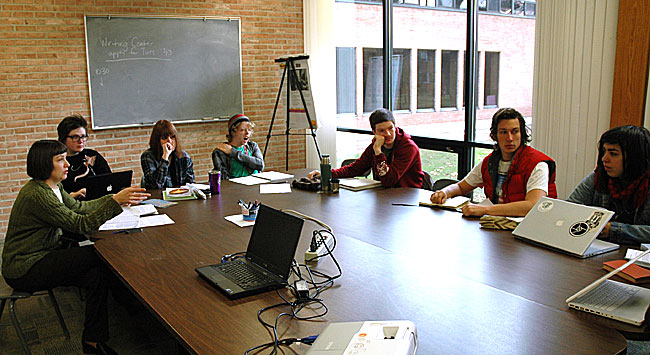
At a recent literature and science class, professor Geneva Gano asked student Eros if he had completed the assigned reading for the literature class, to which he responded:

“I rigorously skimmed it.”

The courses have been a highlight for many students, who find them engaging and as “rigorous” as President Roosevelt promised.

“Rigor is good for fundraising dollars, but not as much in the implementation,” said Elijah Blanton, who finds the block system too challenging, even though he’s able to get through the three-hour classes with a thermos of coffee. Next semester the load will get even greater as students find themselves adding a foundation course, Blanton said. Of course, he plans to emphasize this rigor himself as he takes a job for the college’s annual fund.

Especially strenuous has been the global seminar course on water, co-taught by the chemistry and philosophy professors, which students said seemed unorganized and too laborious for a two-credit hour course.

Other students appreciated the water seminar’s field trips and the student presentations they heard on the quality testing of a nearby river, composting toilets, and Antioch’s water system. In the literature and science class, taught by Geneva Gano, students said they’ve enjoyed creating almanacs with their own nature writing and ecological observation.

“The goal was to capture the attention of students who might not consider themselves literary-minded and bring them into the study of literature,” Gano said of the combined course.

Rahmanian said students gave overwhelmingly positive feedback on the first block courses and that changes will be made to how the global seminar is designed in the future. A draft syllabus for next semester’s food seminar has been posted for student feedback and the college chef and farmer have weighed in on the food seminar curriculum.

Some students said Antioch alumni were surprised to hear that the students were being given letter grades in addition to professor-written narrative assessments and self-evaluations they were required to complete. Letter grades were added so as not to jeopardize accreditation from the Ohio Board of Regents. Rahmanian said that, “adding letter grades doesn’t take away the importance of the qualitative feedback.”

Even though the revived college has only been open for two months and the students have yet to embark on their first co-op, they are glad for the experiential education model that is seminally Antiochian. All students are required to work 10 hours a week, either as a Miller Fellow at a local nonprofit or at a job on campus.

Abraham, who works for the Yellow Springs Tree Committee, said he never would have been interested in identifying trees until the committee chose him. Now he’s grateful for the knowledge.

Senzek, who works on the college farm, enjoys working outside, being directly involved in her own food production and using what she learns in the classroom in the real world.

“It’s not something I would’ve pursued on my own, so it’s great that it’s incorporated in our education,” Senzek said. “I like having theory and practice at the same time. Most college students have the theory and then wait four years to get the practice.”

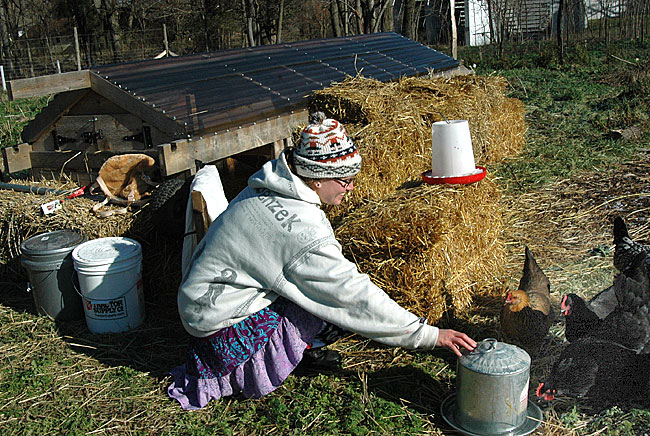
Senzek recently woke at 7:30 a.m. to load the broiler chickens she had been feeding into a truck to be taken to slaughter. Later that day, students and staff members dined on fresh, locally-raised chicken, which Senzek described as an amazing learning experience.

“It’s rewarding to know what’s being used rather than food from factory farms,” she said.

The chosen ones

Students joked that when they go downtown, villagers often approach them saying “So you’re one of the chosen ones!”

The group of students, who hail from 16 different states and are diverse in age and interest, share some common characteristics that may help them overcome the challenges. They are eager, curious, adventurous, idealistic, engaged, passionate, serious, committed, careful, thoughtful, and optimistic.

Having taught at UCLA and Stanford, Gano said she was impressed by Antioch students, who were more artistic than expected.

“I haven’t seen so many creative minds and students who are ready to jump into a challenge,” Gano said. She said that despite her own heavy workload, she came for the students, and she hasn’t been disappointed.

“These are the students I wanted to teach,” she said, adding that they are explorers who love to interact with the outside world, thoughtful to one another and highly talented.

Smith said each student is a “soulful individual” who came with his or her own struggles but has been “game” to help rebuild the college. Since it’s not accredited, the students are taking some risk in attending Antioch. But their commitment to and passion for Antioch continues to help the students survive a time-constrained and intense campus experience.

“I think everyone’s pretty committed because you had to be pretty committed to come here,” Wiebke said. “Sometimes it’s that selfish half of you that thinks, ‘why didn’t I come here in three years when everything’s ready?’”

“It’s definitely a risk,” added Taibbi. “But the college has a reputation, a past. I don’t think I’d be as confident without that.”

Most students are generally optimistic that the college will continue to attract new students and new funding. In fact, recruitment for next year’s class is going well, according to Cezar Mesquita, dean of admission and financial aid. The college has received 50 percent more inquiries than at the end of recruitment last year and already six students have applied.

“Right now things are looking promising,” Mesquita said, adding he is “cautiously optimistic” the college will meet its Fall 2012 admission goal of 75 students, including 15 on full tuition scholarships and 60 who receive a more traditional blend of need and merit-based scholarships. Federal financial aid assistance won’t become available until at least fall 2013.

“We were selling the dream,” Mesquita said. “The difference is now we can provide tangible evidence of what we’re doing.”

Mesquita said he will rely upon the current students to spread the word, host prospective students and be ambassadors of the institution. And as the students add these additional responsibilities, life on campus may become even more taxing. But Smith said she believes Antioch students have always been a special group willing to take on tough tasks.

“Many of our students come with a story and have overcome adversity,” Smith said. “They’re not doing what’s easy. They’ve looked for the difficult — they still do.”
 

Glimpses into Antioch student life

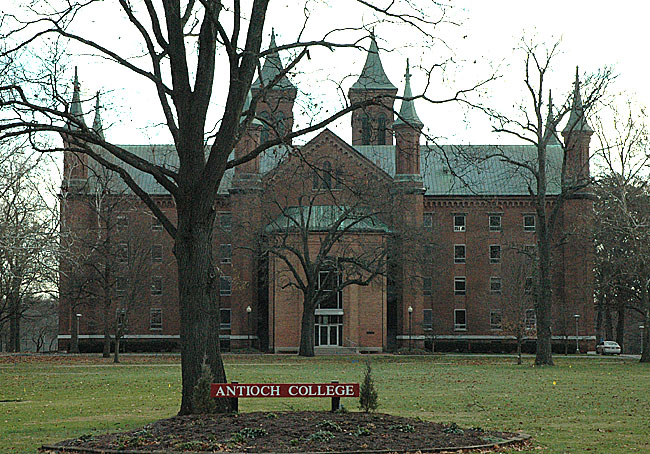
All eyes are on the first group of 34 Antioch College students, who received full tuition scholarships in exchange for the risk, and reward, of helping revive the college. Bringing back the historic liberal arts college is not without its birth pains, but students, staff and faculty are confident that the Antioch model is working and that the institution has a future.

“Everyone’s pretty committed and had to be pretty committed to come here,” said Katie Wiebke, a student. “There’s a lot of pride for the school. It will be exciting to see how it can grow, we’re just overwhelmed with the new experience.”

The exceptional group of students, undergoing an exceptional college experience, vacillate between stress and excitement, frustration and optimism, and feelings of isolation and connection as they work to get the school up-and-running. They have a lot of responsibility, and a lot of pressure on them, to revive the college, they said. In the words of student Adam Abraham,“we’re setting the stage for future generations of Antiochians.”

See the Dec. 15 edition of the YS News for the full story.

Antioch seeks local jobs for students

Antioch College leaders face huge challenges getting the college up and running at a time when many liberal arts colleges are struggling. And as leaders of a school that places work at the heart of its educational experience, they face an additional challenge. In this economic downturn, Antioch leaders aim to create local jobs for its first class of students.

Leading this effort is Susan Eklund-Leen, the college’s director of work, and Tom Haugsby, the former head of the college’s co-op department who has come out of retirement to help Antioch. They seek Yellow Springs community members who might either already have a job appropriate for an Antioch College student, have the ability to create one, or simply be interested in brainstorming about possibilities. They plan to hold a luncheon or workshop to address the topic, and invite villagers who would like to attend to contact Nancy Wilburn at 319-6065.

Creating co-op placements for Antioch College students in town offers a variety of benefits for all involved, according to Eklund-Leen, beginning with stronger ties between the Village and the college. Many in the Yellow Springs community link the vitality of the village to that of the college, and work collaborations helps to solidify that partnership.

There’s also a financial benefit to Yellow Springs.

“We’d love to get more tax dollars to the village,” Eklund-Leen said.

Specifically, the two co-op professionals seek placements in the village or area for Antioch College students for a three-month period beginning in April 2012. (Only 17 or 18 placements are needed.) Co-op leaders ask that the students work 30 to 40 hours a week, and be paid the entry-level wage, or about $10 hourly. While the initial co-op time commitment is only three months, they would be happy if the employer chose to offer the job again next spring or on a regular basis, according to Eklund-Leen.

Potential co-op employers might include those who want to make a difference in a young person’s life. As someone closely involved with co-op for over three decades, Haugsby emphasizes that an Antioch College student’s work experience can be critical to his or her learning.

“The central question most students are wrestling with is, ‘is there a place for me in the world?’ Haugsby said. “On a job they learn how to belong. It helps students learn how to be proactive, intentional, purposeful.”

Eklund-Leen and Haugsby are seeking a variety of jobs for the co-ops, but note that many of the students have an interest in sustainability and environmental issues, and there’s always an interest in social justice work, the arts and media. Some of the potential area jobs he’s pursuing include positions at the Mid Ohio Food Bank and the Ohio Farm Bureau, he said.

Haugsby encourages anyone interested in offering a position to not let the cost of hiring an employee eliminate the possibility. While the purpose of co-op is to have students enter into the work world on its own terms, it’s possible the college could help to subsidize a co-op job.

“I’ve raised money before to help offset the cost,” he said. “We want to do good work and be responsible partners and if that means having to step up and sometimes do extraordinary things, we do that.”

Created in 1921 by renowned Antioch College President Arthur Morgan, the school’s co-op program has now been in existence for 90 years. Antioch is the only liberal arts college in the country that requires off-campus co-op work programs of all students. During co-op, students have the opportunity to learn new skills, discover new passions or reinforce passions they already have, according to Eklund-Leen.

Overall, the first group of the revived college’s students are a mature bunch, according to Eklund-Leen, who noted that out of the first group of 35, about a third have already lived abroad, and 10 are over 21. Some came to Antioch as upperclassmen from other colleges, she said.

“They’re a very savvy group with a strong sense of community,” she said. “They’re very respectful and not afraid to express opinions, but they do so respectfully.”

Since they arrived on campus in September, the new students were required to work 10 hours a week. This new component of students’ experience reflects the college “taking seriously its responsibility to ready students for the next step,” Eklund-Leen said, by making sure they’ve had a work experience before they leap into a full-time co-op job. And with their jobs the students are also helping to fill in the gaps on a campus where everyone is working hard to help the college revival succeed. These campus jobs include positions on the Antioch Farm, in the advancement office, the new community dining room and the office of community life.

Ten of the new students have Miller Fellowships, grants funded by the bequest of longtime Antioch College professor Nolan Miller and his brother, Richard, to fund jobs in village nonprofits. Miller Fellowship students will continue at their current placement, only fulltime, during spring quarter.

It’s also new this year that new Antioch College students’ first co-op is located in the village or surrounding area, rather than anywhere in the country. The local placement is linked to the college’s admissions needs, as current students are needed nearby when prospective students visit in the spring, Eklund-Leen said. And the local placement is also due to the college wanting to give students a more supervised co-op experience before sending them out to different parts of the country.

As well as seeking the local positions, Eklund-Leen and Haugsby are also working to find jobs in designated metropolitan areas for the first quarter next fall, both by re-activating relationships with former co-op employers and creating new positions. College alumni have been extremely helpful in finding new co-op positions in the major areas of Washington, D.C. and San Francisco.

Haugsby and Eklund-Leen are undaunted by the challenges of creating new jobs in a troubled economy. Their hard work is worth it, they say, because with their more than 50 years of combined experience at Antioch’s co-op department, they know the value of putting work at the heart of the learning experience.

“Arthur Morgan thought higher education was valuable but not in isolation from the work world,” she said. “Having work experience allows students an opportunity to reflect on how what they learned in class applies to their jobs and vice versa. It’s a powerful way to be educated.”

Antioch organizes Occupy teach-in

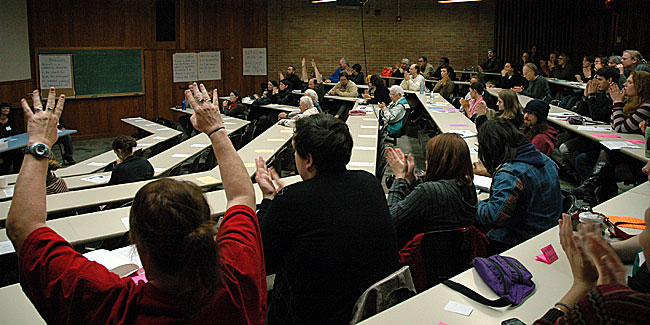
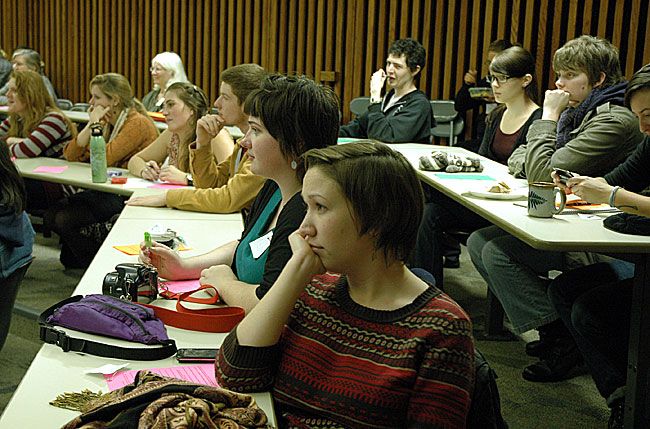
Antioch College has a long history of organizing teach-ins on social issues of the day, from the Vietnam War and the Antioch student strikes to the Persian Gulf War. The latest teach-in, held last Thursday, covered the Occupy Movement — it’s goals, it’s achievements and its challenges — and included sessions on the history of Occupy, media representation, Occupy Dayton, politics of Occupy and police confrontation.


Members of the public attended the event along with Antioch College students and staff. Here audience members show their support for a presenter comment with a method used at Occupy encampments.

Antioch College students listened to presentations.

Yellow Springs Police Chief John Grote talked to students about police tactics at Occupy protests.

From left, Panayiotis Manolakos (Occupy Wall Street), Liam Nilsen (Occupy Wall Street), Karen Abney Korn (Occupy Dayton) and Gerry Bello discuss Occupy strategies.

New college dines responsibly

Traditional cafeterias are designed to be about choice. But what’s the difference between institutional chicken fingers and institutional mac and cheese? Not much, according to the folks at Antioch College, who are out to create a campus dining model that exchanges the anonymous din of feeding from the trough for a more intimate and participatory, socially and environmentally responsible way of eating.

The college’s innovative approach to food was born partly of the need to recognize the ecological demands of food service and also to honor the experience of eating in community. According to Louise Smith, dean of community life at the college, “It’s how we live in community together — we break bread together, meditate together, cook together, in addition to doing governance together…it’s part of the larger coversation of what’s our responsibility to the planet? To the local community? To our bodies?”

The unusually small size of the current college community provided the other justification for a decentralized dining system. With 35 students living on campus and about that many faculty and staff there during the week days, economies of scale would have been difficult to realize in the kind of cafeteria setting the college formerly operated in the Union building, Smith said.

The plan drafted in August, when Smith started her job full-time, was to utilize the kitchen on the ground floor of Birch Hall, where all the students currently live. The college’s Renewal Commission had it remodeled for student use in 2005, and this year’s dining committee of Smith, Joyce Morrissey, Tom Brookey, Reggie Stratton and Nick Boutis believed it to be an inviting, well-proportioned space to upgrade, utilizing much of the good commercial equipment from the Union’s kitchen.

“It’s a beautiful space with lots of windows that we thought would foster a sense of belonging to a dorm and to the core community for first-year students,” said Smith, who had memories of baking cookies there to deliver to students one Christmas.

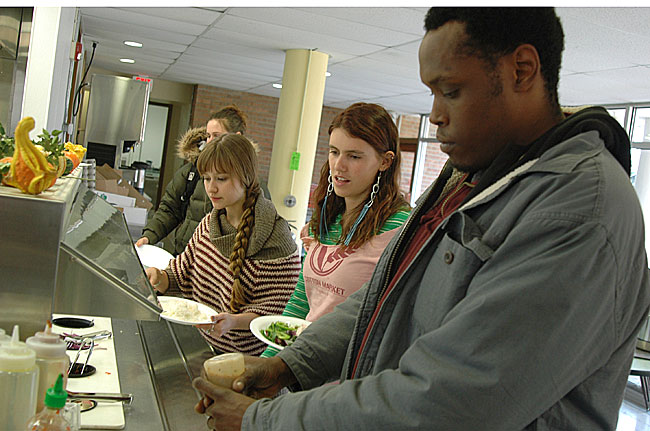
Although students have been on campus for almost two months, they only recently got the chance to eat in their own dining hall. After many frustrating weeks renovating the campus kitchen, the Greene County Health Department finally signed off on the new dining hall, and students had their first meal there on Wednesday, Nov. 9. On Tuesday this week, head chef Isaac DeLematre was serving split pea soup, black beans and rice, roasted root vegetables from area farms and braised greens from the college farm.

“I’m taking input from students and working with what we have coming from the farms,” DeLamatre said. “It’s going great.”

While the campus is well fed now, making the new dining plan operational was slower and more costly than college leaders had hoped, largely due to the complicated county health and building codes that regulate commercial kitchens. While the Union building kitchen satisfies many of the regulations, the building isn’t heated, it’s not ADA compliant, and aside from the cafeteria, the remainder of the large building would be vacant. But installing a new kitchen at Birch was complicated.

The county code is very fussy about the specifications of a commercial kitchen, which, it says, shall have cooking stations lit at 50 candles and dishwashing at 20 candles, stainless steel countertops, a separate sanitizing sink and a handwashing station not more or less than 18 feet from where food is being served. Fire safety, temperature control, food storage, plumbing and electric must all conform to code, which Smith has all but memorized by now.

So Stratton, the college facilities manager, had his crew upgrade the Birch kitchen by reusing the dish room, three refrigerators, two ovens and other cooking equipment from the Union kitchen and buying only a freezer, one dishwasher and a prep sink and countertop.

Students were scheduled to arrive on Sept. 24, before the renovation would be complete. In a survey, a large majority of them had already indicated interest in doing some amount of cooperative dining. So the college asked Current Cuisine to help cater some meals temporarily, believing that the students could take care of many of their own meals as well until the kitchen was up and running.

However, it turned out that Greene County not only prohibits the students from preparing meals together outside of an approved kitchen, it also required that the catering be done in a space with servers, sneeze guards, and both hot and cold service stations, Smith said.

So for the first six weeks, Current Cuisine served lunches and dinners at the Corretta Scott King Center during the week, and students started the cooperative system by helping to set up and clean up after their meals, with the help of community life student worker Sara Brooks and residence life manager Randle Charles. The college also held a weekly Wednesday potluck with the Yellow Springs community at the First Presbyterian Church. And several community members invited the student body to dine in their homes, Smith said. While the dining challenge was costly and stressful for both the college and the small local caterer, it also created unexpected opportunities for community building, according to Smith.

“The potlucks have been great, and there’s been a lot of support in town for us,” she said. “It’s been one of the ways we’ve taken lemons and made lemonade.”

The situation brightened significantly when Chef DeLamatre started work full-time last month. Most recently the sous chef at Sunrise Café, DeLamatre attended Antioch College in 2003–04 and then worked for several years on organic farms, including Orion Organics in Yellow Springs. He helped run a food co-op in Hillsboro, S.C., where he also started a CSA, before deciding to go to cooking school. He is thrilled to be connected to the college’s own farm, which welcomed its first eggs last week and is expecting to harvest its first chickens this fall.

“It’s like a dream come true for a chef — having such a close relationship to a farm,” he said. “Students can go to the farm and bring up whatever they want to eat. That’s as good as it gets.”

DeLamatre also supports the cooperative dining scene. He recalls being less than enthusiastic about his college dining experiece, and feels excited about being able to help students get the kind of organic, local, fresh food they want. He has met with them a few times already, and found them to be “conscientious about the food and food systems they support, and how it affects the world around them. They make dietary choices that reflect that,” he said.

“The students are excited, they kind of arrived that way,” he said. “They’re excited to be able to choose what they eat, which is something immediate [they] can do — establish their values and make it happen immediately — it’s gratifying and empowering.”

The cooperative model Antioch is establishing isn’t new. Boutis, who is part of the committee and also managing sustainability on campus, started out in a dining cooperative at Oberlin College in the 1980s. The group, part of the National Association of Student Cooperatives, had 90 members who were all involved in creating their menus, purchasing the food, cooking it and serving it themselves. Cooperatives can be less expensive than traditional dining plans, partly due to a reduction in waste on trays, which encourage people to take more than they can eat, Smith said. The co-op food plan at Oberlin, according to Boutis, cost about half as much as the traditional dining plan.

“Our ability to charge less for dining services will increase our ability to focus on our academic model,” Boutis said. “It plays in the context of making practical decisions with not just ecological sustainability but economic sustainability.”

Dining on campus has been one of the biggest challenges the community life group has faced, mostly because “food is so fundamental,” Smith said. But with the kitchen now fully operational, it won’t be long for students to be “serve-safe” trained to be an integral part of the community dining and food service program. Smith feels the ultimate plan is solid and responsible on many levels.

“It’s in keeping with our vision, and it will be a vital part of what makes community life here good,” Smith said. “And I’m confident that when we’re up and running, we’ll be cost effective.”