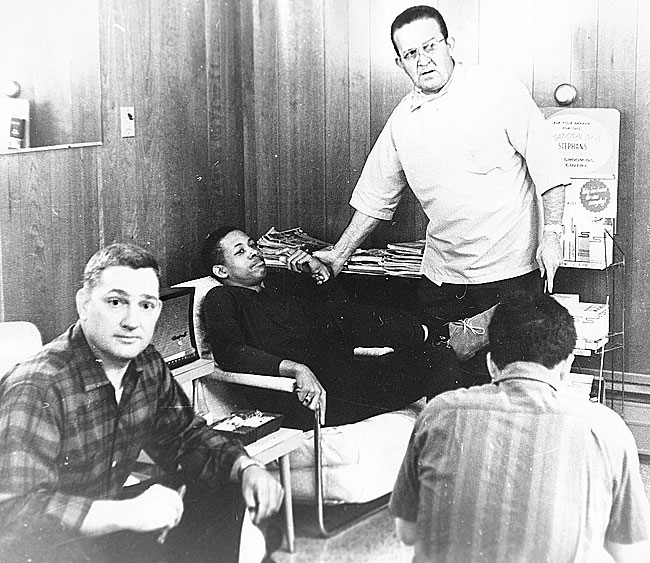
Gegner legacy strong after 50 years

Fifty years ago this month, African-American villager Paul Graham walked into Lewis Gegner’s barbershop on Xenia Avenue, sat down in his barber chair and asked for a haircut.

“I can’t cut your hair,” the white barbershop owner replied, according to Graham’s account. “I don’t know how. That’s all there is to it.”

That day Graham filed a complaint against Gegner’s discriminatory practices with the Ohio Civil Rights Commission in a case that reached the Ohio Supreme Court.

The historic moment was part of a 20-year effort to desegregate Yellow Springs, which escalated to the dramatic 1964 confrontation between police and protesters picketing Gegner’s shop  —  an event that landed 100 people in jail and thrust Yellow Springs into the national spotlight during the height of the civil rights movement.

Soon after the confrontation, Gegner sold his shop and moved out of town, and the Supreme Court refused to hear Graham’s case. Gegner had never consented to cut a black man’s hair when pressured.

Today, the villagers and Antioch College students who participated in the Gegner actions look back on the incident with a mixture of pride and disappointment, and draw lessons from a struggle which both defined and divided the community.

“It became apparent that Yellow Springs wasn’t the type of community we thought it was,” Graham said.

See the Nov. 24 issue of the YS News for the full story.


Hundreds of local and area students, residents and law enforcement officials jammed downtown Yellow Springs on Xenia Avenue during a chaotic demonstration against Gegner's Barber Shop on March 14, 1964. (Photo courtesy of Antiochiana)

From left, Arthur Morgan, Paul Graham, an unidentified man, Walter Anderson and Hardy Trolander (partially hidden) led a march through Yellow Springs in May 1963 to protest discrimination at Gegner's Barbershop. More than 550 people participated in the march. (Photo courtesy of Antiochiana)

Lewis Gegner, right, tried to remove Antioch student Jim Fearn from his shop in 1964. (Photo courtesy of Antiochiana)

Optimism at Antioch College, and hard work ahead

With its first class of new students now at Antioch College, and new faculty and staff on board, the mood is hopeful on campus, according to President Mark Roosevelt at a talk to the community Friday evening.

“It’s been a wonderful couple of months,” Roosevelt said. “Walking around campus, you can feel the optimism.”

Roosevelt gave an update on the college to an overflow crowd at Herndon Gallery. Before the talk, several hundred community members joined with students, faculty and staff for a potluck at the college art building. The event coincided with meetings of the college’s board of trustees and alumni board.

The number “35″ has special significance for the college, Roosevelt said, as there are 35 students in its initial class. And the college recently received a check for $35 million from the sale of the college’s YSI Incorporated stock after the global corporation ITT acquired YSI in the summer.

But the question of how to create an economically sustainable college remains Antioch’s most significant challenge, Roosevelt said, emphasizing that college leaders do not yet have clear answers.

“That is the big work ahead of us,” he said.

However, Roosevelt encouraged the college community to be undaunted by the size of the task, comparing the challenge to that of the Pittsburgh public schools, where he previously served as superintendent. When Roosevelt and other school leaders decided that Pittsburgh needed to launch an ambitious effort to guarantee college scholarships to all high school graduates, “We didn’t have a dime,” he said, yet in a year the schools had raised $150 million.

See the Oct. 27 Yellow Springs News for a more detailed story of Roosevelt’s talk.

Class of 2015 to arrive at Antioch

Megan Miller of the Yellow Springs area was a freshman at Earlham College last spring when she applied to join the first class of Antioch College. She decided to change schools because “even though Earlham is small, I didn’t feel involved in my education,” she said, though she was a 4.0 student. She also felt inspired by the revived college’s new emphasis on sustainability.

Zeb Reichert, a 2011 graduate of Yellow Springs High School, turned down a substantial scholarship at Ohio University because he saw coming to Antioch as a “way of making my own path.”

Miller and Reichert are among the 35 young people of Antioch’s first class who will arrive on campus this Saturday, Sept. 24. Their arrival, from across the country as well as near Yellow Springs, is the culmination of two years of planning and preparation by the college, which came back to life after being closed by Antioch University in fall 2009. Led initially by Interim President Matthew Derr and since January by President Mark Roosevelt, college staff and faculty have worked tirelessly to prepare for the day that students arrive.

“We’re ready for them,” Vice President for Academic Affairs Hassan Rahmanian said last week. “We’re excited.”

For Rahmanian, the wait has been even longer. A longtime member of the Antioch College faculty before the college closed, Rahmanian went on to become a leader of the Nonstop Institute, then took a job at Pacific Graduate Institute in California before he returned to the area last year. He joined Antioch as its academic leader last March, and has since been focused, along with the new faculty, in shaping and implementing the new curriculum.

The responsibility of helping to bring the historic college back to life can feel overwhelming as well as exhilarating, Rahmanian said.

“The joy and the feeling that we’re trusted” to launch the new Antioch “has its own pressure but also its own energy,” Rahmanian said. “I feel blessed that we have really good people working here.”

For Roosevelt, the arrival of students can’t come soon enough.

“It’s an awkward thing to be on a college campus with no students,” he said. Having the students arrive is a boost “for people’s morale, pleasure and ­inspiration.”

Community comes first

When students arrive with their parents on Saturday, Sept. 24, they’ll spend the day at a convocation and barbeque before the parents leave campus. Then the following morning, the new students are off to two-and-a-half days at the Outdoor Education Center in Glen Helen for a retreat on community-building.

“We’re starting with, how do we dialogue with each other?” said Dean of Community Life Louise Smith in an interview last week. “Because we’re so small and we have to do so much so fast, it seemed wise to practice together as we move forward, to have common grounding,” she said.

The idea for the retreat came from the college’s Task Force on Community and Community Governance — local members are Al Denman, Jennifer Berman, Jewel Graham, Wally Sikes and Levi Cowperthwaite — and “I embraced it as a good idea,” Smith said.

Antioch College alum Richard Maizell will facilitate the retreat, in which all six faculty members and some staff will also participate.

While the college has a long tradition of student empowerment through community governance, the revived college has a new opportunity to be “intentional and articulate” about community-building, including how to interact in constructive ways even during disagreements, said Smith, a longtime Antioch College faculty member.

“Sometimes previously as a community we didn’t have the opportunity to gain the skills to have vigorous debate without becoming destructive,” she said.

At the end of the retreat, the students and faculty will address campus policies on drug and alcohol use, “grappling with some real life stuff,” Smith said.

While governance will be one aspect of living and working together at Antioch College, leaders aim to weave community into other aspects of campus life. For instance, Smith said, students will regularly cook together, as well as have a weekly time to work on the Antioch Farm. The young people will also have the opportunity to take non-credit Community Life classes, including a class on mindfulness meditation led by villager Katie Egart.

When the students return from the retreat, they’ll live in single rooms in the newly renovated Birch Hall, where a residence life manager will also reside. The basement of Birch is currently waiting on health department permits to begin operation as a commercial kitchen (students will cook for themselves on weekends), and should be ready by the end of October. Until then, local eateries will cater some meals, and students will also attend some potlucks, according to Smith.

On Saturday, Oct. 1, students will spend a day in downtown Yellow Springs, attending the farmers markets, visiting local shops and attending a program at the Yellow Springs library.

Antioch’s emphasis on community shouldn’t stop at the border of campus, Smith said.

“What’s wonderful about community is that every interaction, including those with staff or in the village, can be a chance to practice,” Smith said.

The college will also sponsor potlucks for students and villagers, to be announced at a later time.

New approach to academics

After their community-building retreat, students will start focusing on academics. In the later part of their 10-day orientation, they will meet with faculty advisors, take placement tests and attend a faculty open house to hear descriptions of available classes, according to Rahmanian. Classes begin on Tuesday, Oct. 4.

According to Roosevelt, what most excites him about the revived college is the new Global Seminars, interdisciplinary classes which focus on issues of contemporary sustainability concerns, including water, air and energy. The first quarter’s Global Seminar, which all students will take, will focus on water, and will be taught by new faculty David Kammler, a chemist, and Lewis Trelawny-Cassity, a philosopher.

“I’ve watched the faculty wrestle with the complexity of putting together the first seminar on water,” Roosevelt said. Because traditional academic disciplines are necessarily artificial and limiting, approaching a topic such as water from a variety of disciplines offers an opportunity for creative thinking and new solutions, he said.

“It offers a chance to put into practice what we preach,” Roosevelt said.

Also new to Antioch College this year is a hybrid block system, in which each 10-week quarter is divided into two five-week blocks. In each block, students will choose a foundation course, a language (Spanish, French or Japanese) and a Global Seminar.

Foundation courses offered this fall are Introduction to Philosophy, Cultural Anthropology, Introduction to Environmental Science and a two-dimensional visual arts course, according to Rahmanian.

To supplement the college’s new faculty — aside from Trelawny-Cassity and ­Kammler, faculty members are Sara Black, in 3-D and performance art; Kristin Adler, cultural anthropology; Geneva Gano, literature; and Anneris Coria-Navia, Spanish — the college hired an adjunct instructor to teach environmental science, as well as adjuncts to teach French and Japanese, Rahmanian said. It will also hire adjuncts to teach psychology and contemporary media art for the winter quarter.

Black is working on developing an artist-in-residency program for both the fall and winter quarters, Rahmanian said, and the college also hopes to have one or two guest faculty for the winter quarter.

Work is central

In keeping with the importance of co-op to the tradition of Antioch College, each new student will work 10 hours a week, and will be paid this year from college revenue sources, since the college is not yet eligible for federal work study funds, according to Work Director Susan Eklund-Leen. Antioch could be eligible at the earliest for federal funding in June 2012, if it is accepted as a candidate for accreditation by the Higher Learning Commission, Eklund-Leen said.

First year students will each hold a job on campus or in the village. Twenty-five campus jobs are available, including ones on the Antioch Farm, in plant management, in the library, the office of community life and in various administrative offices, she said.

Ten jobs in Yellow Springs nonprofits, funded by the Miller Endowment, will include work at Home, Inc., the Yellow Springs Home Assistance Program, the Arts Council, the Tree Committee and Tecumseh Land Trust.

New students will continue to work 10 hours a week during the winter term, and spring term students will work full-time on their jobs. First-year students will stay in the community or area this year, and next year will have an opportunity to find jobs further away from Yellow Springs.

While the revived college’s curriculum, work program and community life segment have all resulted from intense planning, it’s important that they be approached with an attitude of flexibility, Roosevelt said.

“We’ll be a work in progress,” he said, ready to revise what doesn’t work and try something else.

The students will be critical in helping to shape the new Antioch College, he said.

“The students will tell us what they need and we’ll adjust,” he said. “I think we underestimate how much they will impact” the direction of the new school.

New students to arrive at Antioch College

The first class of the revived Antioch College will arrive on campus this Saturday, Sept. 24, for a 10-day orientation before classes begin Tuesday, Oct. 4. The class of 35 includes young people from all over the country, including several from the Yellow Springs area.

On Sunday, Sept. 25, the students will begin a two-day retreat on community-building at the Outdoor Education Center in Glen Helen with faculty and some college staff. Along with the traditional Antioch College practice of community governance, community will be integrated into various segments of campus life, including students cooking together and working together on the Antioch College farm, according to Dean of Community Life Louise Smith.

When classes begin Oct. 4, all students will take a Global Seminar, an interdisciplinary class with a sustainability focus. This quarter’s seminar will focus on water, and be taught by chemist David Kammler and philosopher Lewis Trelawny-Cassity. Students will also take a language and a foundation course, or three courses in all during the first quarter.

For a more detailed article about the arrival of Antioch College students on campus, see the Sept. 22 issue of the Yellow Springs News.

‘Whoo Cooks For You’ for the birds

You might call it avian welfare, Social Security for the birds, funding the feathered, even banking for the beaked. Like many people, the disabled birds at the Glen Helen Raptor Center are out of a job and need support. Some are grounded temporarily, while others are permanent wards of the Glen. And while the birds do put in several hours a week, with the help of Raptor Center Director Bet Ross, educating visitors and students across the region about the beauty and importance of raptors in the natural world, the income doesn’t cover what it costs to operate their home.

If raptors can eat near the top of the food chain, surely those who support them have some right to do the same. The five celebrated chefs designing the Glen’s second annual Whoo Cooks for You? will have diners eating from the canopy this year to raise money for the Raptor Center. The event, featuring a six-course meal for locovores and old timey music from the Corn Drinkers, takes place on Sunday, Sept. 11, at the Outdoor Education Center. Tickets for $150 are still available but are limited.

While this weekend’s omnivorous guests are nibbling on the region’s finest cuisine, the birds will be enjoying their daily dose of frozen mice and voles. The price of a ticket will take care of one of the Raptor Center’s 30 resident birds for a day, or several of its 150–200 yearly itinerants, who need food, shelter, sometimes medical attention and a safe place to regain their ability to fly and perhaps survive in the wild.

The world may be a cruel place for humans, but it’s even crueller for raptors, only 20 percent of which survive their first year of life, according to Ross. For the past 40 years the Raptor Center has helped to boost that percentage by taking in hundreds of sick and wounded birds each year, rehabilitating them, and releasing about half back into the wild. Ross has led the operation for most of the last 25 years, and this past year brought new birds with new stories.

This year the Raptor Center saw a clutch of full-grown kestrels who had failed to fledge and were starving. Ross was able to save two of the four. In the spring she saw a red-shouldered hawk that had suffered head trauma in a hail storm. It was a full week before he could be released. And in January someone brought a whole box of puffy white baby owls that had fallen out of their nest. The saddest story this year was the young eagle from Eastwood Lake that flew into a power line and crashed to the ground. The large raptor suffered a broken leg and breastbone and did not survive. But Ross focuses on the bright side of that story, as she is apt to do, which resulted in DP&L’s decision to secure all the poles and power lines around the lake for the birds.

While the rehabbed birds are mostly caged in the woods away from people, the resident birds serve an educational purpose, allowing visitors to observe them up close next to informational signs about their habitat and behavior. This year’s Whoo Cook’s for You?, named after the call of the barred owl, will help build new caging to replace all of the center’s signage. The vision, according to Glen project manager Ann Simonson, is to eventually communicate the information through a smart phone application with the sound of the bird calls and links to other Web sites and other nature centers in the region.

It is one of the Glen’s goals to become more tech-savvy to increasing outreach on a tighter budget. Technology is the way to reach the younger generations, who already connect to the world through digital media every day. Simonson hopes that the digital tools will help kids dig into their interest in the Glen, and link to related sites on the Internet as well as each other to deepen their knowledge and awareness of the natural world.

“Kids want that kind of interaction, and if their experience at the Raptor Center is good, people will donate and pass on the connection to their kids and their friends,” Simonson said.

Sunday’s experience should be a memorable, and flavorful one. The meal will start with appetizers prepared by the Winds Café chefs Mary Kay Smith and Kim Korkan, a plated first course of Peruvian fish tapas by Sidebar chef Margo Blondet, and a dessert of Grand Marnier sabayon from Doug McGregor of Seasons Bistro. The Meadowlark’s Elizabeth Wiley is preparing the main course of succulent braised turkey thighs with succotash and spicy tomato salsa. Vegetarian options are available upon request. Additional courses will be prepared by Carrie Walters of Dorothy Lane Market. The event is made possible by these chefs, the Ruth B. & Thomas Mackey Charitable Trust at Schwab Charitable Fund, and Orion Organics.

The event will begin with a special tour of the Raptor Center and presentation by the center’s staff, followed by the Corn Drinkers and a drawing for a chance to win a gift certificate to each of the restaurants. To R.S.V.P., call 937-903-1762 ext. 101 or e-mail asimonson {at} glenhelen(.)org .

Farming food, reaping knowledge

Preparing the ground for incoming students took on new meaning last week at Antioch College, as the revived college launched the Antioch College Farm, its first major sustainability project. Located steps from the classroom, the farm is envisioned by organizers as a significant aspect of campus life, where students not only produce food and compost scraps, but also incorporate their learning about environmental sustainability into classes ranging from chemistry to philosophy.

On Friday the college announced that Glen Helen Director Nick Boutis will also serve as the coordinator of the college’s sustainability projects, including the farm. In an interview Friday, Boutis said that the college’s unique position as newly regenerated after having been closed actually offers an advantage over other schools that have incorporated farms into their operation.

“Most colleges can’t integrate the farm into their campus from the get-go, but we can,” said Boutis. “If we do this wisely, we can figure out how the farm interacts with the facilities, the curriculum and the community. I think it’s incredibly exciting and one of the things that Antioch intends to do moving forward.”

The college took a significant step toward getting the farm up and running with the recent hiring of local organic farmer Kat Christen, who will help to design and implement the first phase of the farm project. As well as running Smaller Footprint Farms with her husband, Christen brings to the job five years experience with environmental education. She worked as an urban naturalist for the Five Rivers MetroParks in Dayton, and also has a bachelors in life science education and a minor in plant biology from Ohio University.

“It’s an exciting project, an opportunity to make something great happen for the college and the community,” Christen said in an interview this week.

Because “growing food is one of the most basic ways we connect with the earth,” growing healthy food with sustainable practices is one of the most meaningful ways that people learn the value of environmental sustainability, she believes.

Sustainability was identified as a major focus of the revived college in President Mark Roosevelt’s June State of the College address. In an interview this week, Roosevelt said that focus has evolved from a variety of factors, including the interest of the college board, and specifically board member David Goodman, and Roosevelt’s own experience in the college’s admissions process last spring, as he learned about prospective students.

“I was affected hugely by seeing how the students are already driven by this issue, and how they see its connection to social justice,” he said.

Identifying himself as still learning about the topic, Roosevelt said he’s become increasingly passionate about sustainability concerns in the six months since he began his presidency.

“I’ve had my own education. It’s been dramatic,” Roosevelt said.

Other colleges, such as Middlebury and Sewanee, offer a sustainability focus, and college leaders are still determining what Antioch’s specific niche will be, Roosevelt said, stating that because Antioch is located in the Midwest, that niche will likely be food production.

Along with Boutis and Christen, a new farm committee composed of faculty and staff has begun meeting regularly to identify ways to incorporate the farm into campus operations.

“Students should be able to pull a vegetable out of the ground, cook with it, take the compost back to the garden and then study the results in chemistry class,” Boutis said of some of the ways the college will integrate the farm experience into campus life.

The farm committee is composed of assistant professors David Kammler (chemistry) and Lewis Trelawny-Cassity (philosophy); Dean of Community Life Louise Smith; facilities representative Ronnie Hampton; adminstrative representative Joyce Morrisey; and Boutis, Brooke Bryan and Ann Simonson of Glen Helen.

Located on the 35-acre former “golf course” on campus, the farm will be a “working laboratory that provides the opportunity for active participation in learning, experimenting and applying best management practices in organic and ecological agriculture methods,” according to a college press release. Lessons learned in the fields will likely become fodder for the college’s new Global Seminars that offer students interdisciplinary approaches to the study of issues around food, water, governance, health and energy.

While the first quarter Global Seminar will focus on water, food will likely be emphasized in winter or spring, according to Trelawny-Cassity. Questions regarding how citizens should spend their time, how food should be produced and distributed are “inherently philosophical” and go back to Plato, he said.

“The farm is an interesting experiment in community and local food production. These are issues of political economy,” he said.

Along with its ability to incorporate the farm into many segments of campus life, Antioch has other advantages compared to some colleges regarding integration of the farm as an educational experience, according to Boutis. First, it will be located on campus, rather than several miles away. And while some schools struggle with aligning their students’ calendar years with a farm’s growing season, Antioch’s first class of students will have a spring campus-based co-op, when farm needs are high, and will also be on campus during their first summer.

“We have some options other schools don’t have regarding the growing season,” Boutis said.

In the first weeks of her job designing the new farm project, Christen is focusing on tilling areas in the former golf course where fall crops — including swiss chard, onions, carrots and beets — will be planted, and planting those areas with the cover crops of buckwheat and red clover that will enrich the soil when they break down.

She’s also building no-till beds in the former Antioch College garden area that, because it’s been untended for several years, is very overgrown. That area will be part of a “food forest” of food-producing trees and shrubs, including wild plums, pecans and pawpaws, Christen said.

Other steps getting the farm up and running include the building of “chicken tractors” for containing the chickens that will be used for eggs, meat and manure, along with fences built from the locust trees that have grown in the area.

The farm will likely include animals other than chickens eventually, and the second species may well be bees, Boutis said. Toward that end, Gunter Hauk of Virginia, a leading biodynamic farmer and beekeeper, will visit campus the end of August for two days of residency with faculty and staff. His visit will also include the screening of a film shown at the Little Art on Aug. 30 and a public talk on Aug. 31.