‘Marcellus Shale’ play coming to Antioch College

During Antioch College’s winter quarter in 2016, the performance program will host a unique project in civic engagement and collaborative techniques in theater and performance. “Marcellus Shale,” a play written by Talking Band members Paul Zimet and Ellen Maddow, will be hosted at the college, with performances and an exhibition and panel discussion March 10–13.

“Marcellus Shale” was inspired by firsthand experience Zimet and Maddow had with the impact of fracking on their upstate New York community in 2013. The play moves beyond talking points and into the underlying questions all people face when struggling with life-altering (and possibly life-threatening) decisions: What really matters to you? What would be the last thing that you would give up? What do you consider a good life? Have you lived one? Are you living one now?

Critic and activist Andy Horowitz writes of the play:

“The play offers a nuanced and thoughtful exploration of this divisive and contentious issue. The opposing views of a spectrum of characters – a veteran with PTSD, local farmers who sold their rights, and those who refused, women ‘Prayer Warriors’ from the local church, spectral ‘Men In Suits’, Occupy Wall Street-style radicals – all are given equal weight and complexity. The story is told in such a way that each character has respect and dignity; they struggle to maintain their human connections even as they hold ideologically irreconcilable positions.”

Antioch undergraduate students in Associate Professor of Performance Louise Smith’s devised theater class, as well as students in Associate Professor of Biology and Environmental Science Dr. Kim Landsbergen’s ecology class, will take part in public showings as well as panel presentations on the issues and themes of the play. Talking Band members Maddow and Zimet will be in residence at Antioch College Feb. 12–16, offering an open studio on Friday, Febr. 12 and a devised theater workshop open to the public on Saturday, Feb. 13.

For additional information on the upcoming events, or to find out how to participate as an individual or an organization, contact Louise Smith at lsmith@antiochcollege.org.

Antioch College to host “Living as Form” symposium

Antioch College and the Herndon Gallery will be hosting a series of events, May 9–11, in connection to its current exhibition, “Living as Form (The Nomadic Version).” Originally produced in 2011 for Creative Time in New York City under the curation of Nato Thompson, “Living as Form” seeks to draw a through-line between the “critical mass” of activism that emerged in the 21st century with the concurrent turn toward the social in contemporary art. 

On Friday, May 9, at 7 p.m., the Herndon Gallery will host a performance by Micha Cárdenas, a Los Angeles-based artist and scholar. Her work seeks to “create community, autonomy, and reduce violence against women, LGBTQI people, people of color, and other groups who continue to combat violence on a daily basis.” Cárdenas works with overlapping realms of performance, activism, and technology to organize for change.

On Saturday, May 10, the Compass Group, a collective of artists and activists who have been working in what they describe as the geographic and political area of the Midwest Radical Cultural Corridor, will present the fourth iteration of the People’s Trial on Monsanto, a participatory public hearing on Monsanto’s public record, and the impact of their products and policies on life—in this community, nation and biosphere.  The hearing has been organized under the collaborative leadership of Sarah Lewison (Carbondale, Ohio), Sarah Kanouse (Iowa City, Iowa) and Claire Pentecost (Chicago, Illinois), and will be staged at the Clifton Lodge in Clifton, Ohio, from 10 a.m. to 4 p.m.  

Local farmers, conservation managers, seed cleaners, agricultural workers, scientists, and naturalists have been recruited to testify as to the significance of genetic modification and associated technologies, as well as the role of government in regulating (or not regulating) these technologies. The trials have previously been held in Carbondale, Illinois; St. Louis, Missouri; and Iowa City, Iowa. The public is invited to attend this free public performative “trial.”

The symposium will conclude on Sunday, May 11, with a roundtable discussion in the Herndon Gallery on the Antioch College campus beginning at 10 a.m. The discussion will include independent scholar and cultural critic Brian Holmes; artist and scholar Micha Cárdenas; artist collaborative ESCAPE GROUP; and Sara Black, assistant professor of visual art at Antioch College, as moderator. Following the discussion, ESCAPE GROUP, in collaboration with Sara Black, will present a performance that explores the recipe as form and content. 

All events during the symposium are free and open to the public.

Activism and art at Antioch

When is activism also art?

For example, Women on Waves, a ship that performs medical abortions outside of the territorial waters of countries where it is illegal, or Project Row Houses, a low-income housing development in Houston where the houses are sometimes canvases for artistic expression. When aesthetics or theatrics are used in everyday social activism, is it also a kind of visual or performance art?

At Antioch College, which has staked out a legacy in both activism and art, that question will be explored in a new exhibit at the Herndon Gallery in South Hall that runs April 18 through May 16.

“Living as Form (The Nomadic Version)” is an international exhibit of socially engaged art featuring archived documentation from 22 projects that could be considered both activism and art.

Originally presented by Creative Time in New York City in 2012, “Living as Form” challenges traditional notions about art’s boundaries, contributing to a new category of contemporary art sometimes referred to as “social practice,” according to co-curator Sara Black, assistant professor of visual art at Antioch.

“It’s so contemporary that it is still finding its feet in the art historical cannons, and there’s so much debate about what to call it,” Black said. “It’s testing the boundaries of what we comfortably call art.”

The exhibit is a collaboration of Black with Antioch artists-in-residency Jillian Soto and Anthony Romero, Chicago-based performance artists who arrived on campus last week to teach, create and curate for three months. To Romero, a performer and writer native to Texas, the exhibit looks at how art can be used for social change.

“The exhibition is a question about how activists are able to use artists’ strategies and tactics to organize communities and make change,” Romero said.

The “Living as Form” projects (which include Women on Waves and Project Row Houses) are organized by theme and will be presented in three sections. Weekly conversations with Antioch art faculty and residents showcasing work on each theme will begin at 7:30 p.m. Wednesday, April 23, with a discussion of “Occupation and Convening.”

Explained Soto of the first theme: “Many of the projects involve people occupying territories they aren’t supposed to or convening in public places you wouldn’t normally convene to perform an action or sing.” Other conversations will be on “Borders and Access” on April 30 and “Difference” on May 7.

In addition, two new performance art works were commissioned for exhibit and will be shown on the weekend of May 9–11. Performing is Micha Cárdenas, a transgender artist from California whose work focuses on ending violence against queer and trans people, people of color, indigenous people, youth and sex workers, according to her website. The Compass Group of the Midwest Radical Cultural Corridor will also present a day-long “people’s hearing” on Monsanto, which has been previously held in St. Louis, Mo., Iowa City, Ia., and Carbondale, Ill. Those works will ultimately become part of the archive of projects as it continues to travel around the country.

Herndon Gallery is one of 15 venues to exhibit “Living as Form” since 2012 with other exhibitions as far-flung as Israel, Taiwan, Russia, Western Sahara and Mexico and as close as Youngstown, Ohio, according to the project’s website. Curator Nato Thompson, who has also written a book on the 100 socially engaged projects he collected, created the exhibit to respond to what he saw was a historically unique trend in art.

The atypical show won’t simply feature artwork on the walls, since “the work happened out in the world,” according to Black. The exhibition arrives as a hard drive of saved images, photos and videos documenting the actions, putting the daunting task of presenting material that is “ephemeral in nature” on the co-curators, Black said. The goal is to turn a hard drive in a “box the size of my hand” to something that is engaging to the community, she said.

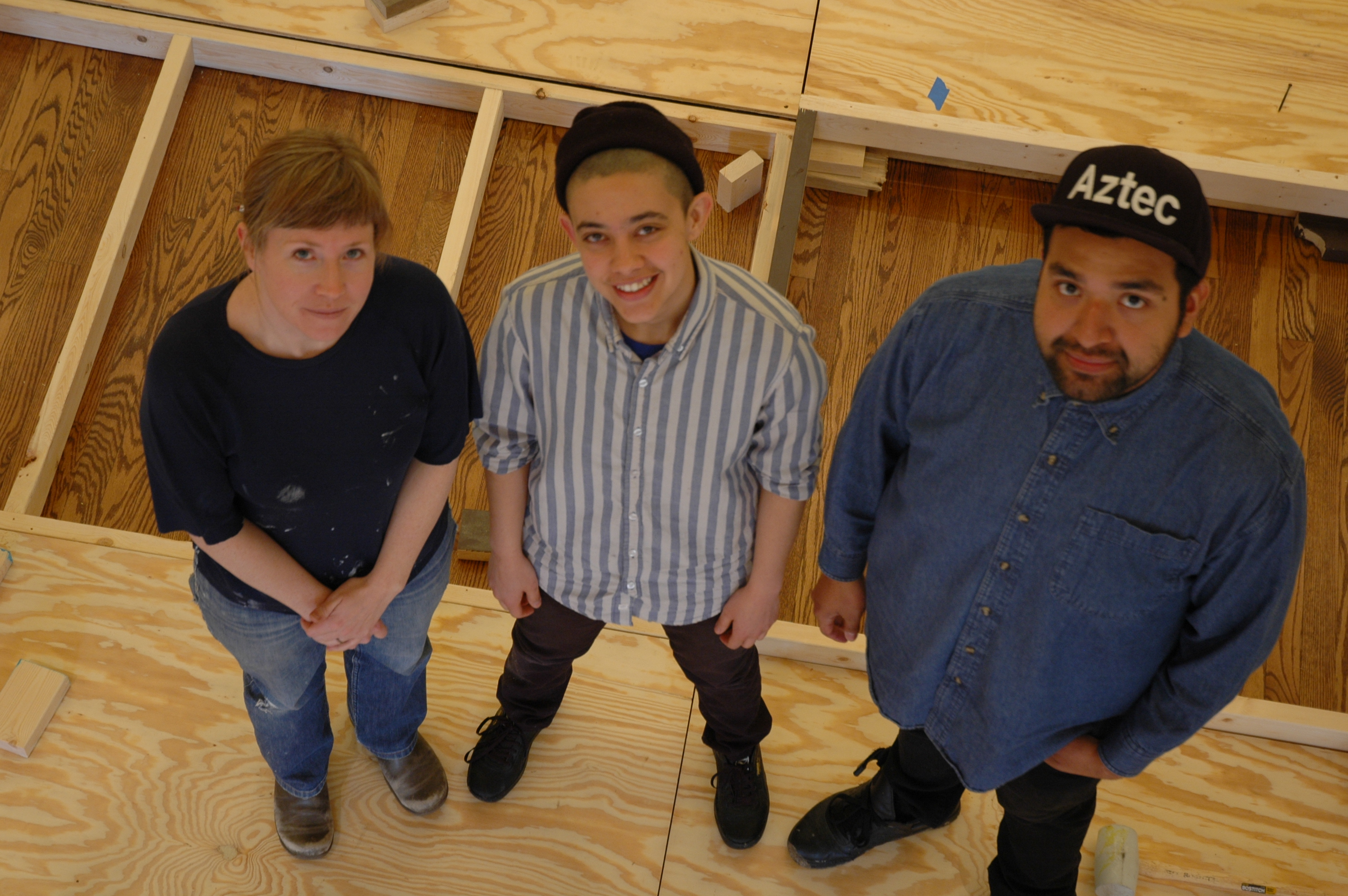
But Black, with her background in sculpture, installation art and performance, and the experienced performance artists Romero and Soto are well equipped to craft a meaningful show from the documentation, since performers often have to explore how people experience work outside of its live context, Black said. Recently, the trio began by building a platform in the center of the Herndon, but the audience will have to wait until the exhibit opens to see how the work will ultimately be presented.

The “Living as Form” exhibit is an extension of the artist in residency program at Antioch, which is designed to expose students to new voices and ideas in art since Antioch is so small, with only one instructor in each artistic discipline, Black said. In addition to co-curating the exhibit this quarter, Romero and Soto will open their studio time to students and teach courses in the performance curriculum while associate professor of performance Gabrielle Civil is doing research. Three artists in residence per year live and work on campus.

Soto and Romero are graduates of the Art Institute of Chicago who have collaborated with Black as ESCAPE GROUP, a platform in Chicago that Soto and Romero created to work with other artists.

Performance has recently become a focus of the young art program at the revived Antioch College as an art form that is “on the rise” and which helps students feel more comfortable in their bodies and their selves, Black said. Instead of separating traditional performance forms like dance and theater from performance art, Antioch in its interdisciplinary curriculum has combined them by focusing on “presence,” Black said.

Romero sees performance as about learning how one’s body is “occupying space,” which can be valuable for everyone from an aspiring lawyer to a professor, while Soto says that performance can be used to explore art or life:

“Performing is a kind of skill set and lens to look at art. Once you are aware of what it is to perform, that we are always performing at life.”
Conversations on activism and art at Antioch

When aesthetics or theatrics are used in everyday social activism, is it also a kind of visual or performance art?

At Antioch College, which has staked out a legacy in both activism and art, that question will be explored in a new exhibit at the Herndon Gallery in South Hall that runs April 18 through May 16. The first of three weekly conversations on the exhibit is 7:30 p.m. Wednesday, April 23, at the Herndon.

“Living as Form (The Nomadic Version)” is an international exhibit of socially engaged art featuring archived documentation from 22 projects. Originally presented by Creative Time in New York City in 2012, “Living as Form” challenges traditional notions about art’s boundaries, contributing to a new category of contemporary art sometimes referred to as “social practice,” according to co-curator Sara Black, assistant professor of visual art at Antioch.

“It’s so contemporary that it is still finding its feet in the art historical cannons, and there’s so much debate about what to call it,” Black said. “It’s testing the boundaries of what we comfortably call art.”

The exhibit is a collaboration of Black with Antioch artists-in-residency Jillian Soto and Anthony Romero, Chicago-based performance artists who arrived on campus last week to teach, create and curate for three months.

herndon_blacksotoromero

from left, Sara Black, Jillian Soto, Anthony Romero


The “Living as Form” projects are organized by theme and will be presented in three sections. Weekly conversations with Antioch art faculty and residents showcasing work on each theme will begin at 7:30 p.m. Wednesday, April 23, with a discussion of “Occupation and Convening.”

Explained Soto of the first theme: “Many of the projects involve people occupying territories they aren’t supposed to or convening in public places you wouldn’t normally convene to perform an action or sing.” Other conversations will be on “Borders and Access” on April 30 and “Difference” on May 7.

In addition, two new performance art works were commissioned for exhibit and will be shown on the weekend of May 9–11. Performing is Micha Cárdenas, a transgender artist from California whose work focuses on ending violence against queer and trans people, people of color, indigenous people, youth and sex workers, according to her website. The Compass Group of the Midwest Radical Cultural Corridor will also present a day-long “people’s hearing” on Monsanto, which has been previously held in St. Louis, Mo., Iowa City, Ia., and Carbondale, Ill. Those works will ultimately become part of the archive of projects as it continues to travel around the country.

Read the April 17 issue of the News for the full story.

Antioch College to host photographer Anne Noble

Antioch College will host New Zealand photographer, educator and researcher Anne Noble during the week of April 14.  Noble is currently working at Columbia College in Chicago as a Fulbright Scholar on a series of projects that explore the symbiotic relationship between people and bees.  She will give a free, public presentation on Wednesday, April 16, at 7:30 p.m. in McGregor Hall, room 113 on the Antioch College campus. She will present “From Antarctica to the Honey Bee:  In Search of An Ecological Sublime.”

In her presentation, Noble will show photographic work made in Antarctica, discuss the development of an environmentalist art practice that is underpinned by an ethic of attention to the natural world, and talk about her recent collaborations with scientists to create images and installations that incorporate the perspectives of both art and science within their aesthetic framework.

During her time at Antioch, Noble will meet with area beekeepers and bee inspectors.  Regarding her concern with the relationship between humans and bees, Noble writes, “While represented historically as a symbol of immortality and regeneration and used as a metaphor to model an idea of the perfect human community, the honey bee is urgently in need of new images and metaphors that provide an imaginative frame through which to engage audiences in considering the fragility of the world’s natural biological systems and our part in their rapid transformation.”

Anne Noble is distinguished professor of Fine Arts at Massey University, Wellington.  She is one of New Zealand’s leading photographers, producing comprehensive series of work, spanning landscape, documentary and installation incorporating still and moving image.  Since 2001 she has been researching and photographing Antarctica, an extension of her interests in how photography shapes our understanding of the places we know and inhabit.  She has made three visits to Antarctica the most recent in 2008 as a U.S. National Science Foundation Polar Arts Fellow. 

In 2011 and 2014 Clouds Publishing published Ice Blink, and The Last Road the first two volumes of a trilogy devoted to her photographic investigations of Antarctica. In 2009 she received a New Zealand Arts Foundation Laureate award in recognition of her contribution to the visual arts in New Zealand.  She is in the United States this year as a Fulbright Senior Scholar based at Colombia College as their 2014 International Artist in Residence.  While in the U.S. she is developing a new series of projects related to the decline of the honey bee.

For more information, contact Dennie Eagleson, creative director of the Herndon Gallery, at deagleson {at} antiochcollege(.)org or call 937-768-6462.

Artwork explores the American ‘Appetite’

The suburban home and garden that just went up inside the Herndon Gallery this week speaks of many things about the American culture. Its manicured lawn, the white pitched-roof house, and the square rooms with the things its inhabitants desire are all part of our appetite for consumption. What started out as the American Dream, according to curator Michael Casselli, has morphed since the post-war 1950s into an outsize need to consume everything from food to knowledge. And instead of an American pastime, consumption has become a global norm.

“Appetite: An American Pastime,” a new multi-media exhibit that opens at the Herndon Gallery at Antioch College’s South Hall this weekend. An opening reception will be held on Saturday, March 16, 7–9 p.m. On Sunday, March 17, at 1 p.m., the Herndon Gallery will host Lunch on the Lawn, a conversation and lunch event with participating artist Stefanie Koseff.

“Appetite” is the invention of Casselli, Antioch College adjunct faculty in media arts. It is a curatorial collaboration between Brooklyn artists Stefanie Koseff, Eric Dyer, Maggie Hoffman, and Raul Vincent Enriquez and local political/cultural theorist Kurt Miyazaki. The Herndon was transformed by the two miles of wax paper it took to build the roof and the inner and outer walls of the house. Then each artist was asked to respond to the concept of “appetite” within one of four rooms of the house. The result is a multi-sensory interpretation of what, how and why people desire and some of the consequences of our human appetites.

The exhibition continues through May 24.

Gallery hours are Tuesday through Saturday, from 1 to 4 p.m. For more information, please contact Dennie Eagleson, creative director of the Herndon Gallery at deagleson {at} antiochcollege(.)org or 937-768-6462.

More on this story will appear in this week’s Yellow Springs News.

Rotating food images appear on the platters from a project above the table.

Rotating food images appear on the platters from a projector above the table.