Conversations on activism and art at Antioch

When aesthetics or theatrics are used in everyday social activism, is it also a kind of visual or performance art?

At Antioch College, which has staked out a legacy in both activism and art, that question will be explored in a new exhibit at the Herndon Gallery in South Hall that runs April 18 through May 16. The first of three weekly conversations on the exhibit is 7:30 p.m. Wednesday, April 23, at the Herndon.

“Living as Form (The Nomadic Version)” is an international exhibit of socially engaged art featuring archived documentation from 22 projects. Originally presented by Creative Time in New York City in 2012, “Living as Form” challenges traditional notions about art’s boundaries, contributing to a new category of contemporary art sometimes referred to as “social practice,” according to co-curator Sara Black, assistant professor of visual art at Antioch.

“It’s so contemporary that it is still finding its feet in the art historical cannons, and there’s so much debate about what to call it,” Black said. “It’s testing the boundaries of what we comfortably call art.”

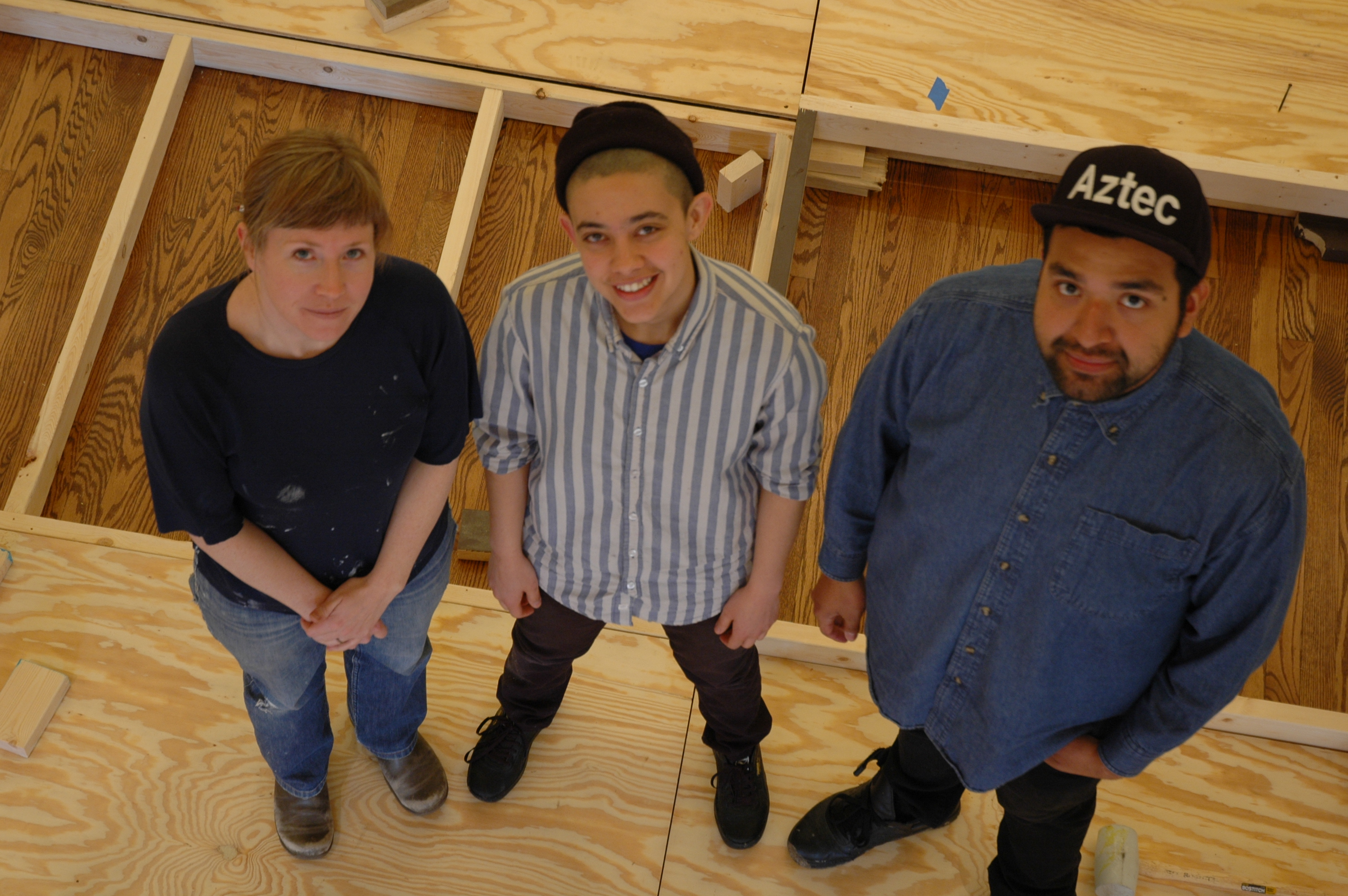
The exhibit is a collaboration of Black with Antioch artists-in-residency Jillian Soto and Anthony Romero, Chicago-based performance artists who arrived on campus last week to teach, create and curate for three months.

herndon_blacksotoromero

from left, Sara Black, Jillian Soto, Anthony Romero


The “Living as Form” projects are organized by theme and will be presented in three sections. Weekly conversations with Antioch art faculty and residents showcasing work on each theme will begin at 7:30 p.m. Wednesday, April 23, with a discussion of “Occupation and Convening.”

Explained Soto of the first theme: “Many of the projects involve people occupying territories they aren’t supposed to or convening in public places you wouldn’t normally convene to perform an action or sing.” Other conversations will be on “Borders and Access” on April 30 and “Difference” on May 7.

In addition, two new performance art works were commissioned for exhibit and will be shown on the weekend of May 9–11. Performing is Micha Cárdenas, a transgender artist from California whose work focuses on ending violence against queer and trans people, people of color, indigenous people, youth and sex workers, according to her website. The Compass Group of the Midwest Radical Cultural Corridor will also present a day-long “people’s hearing” on Monsanto, which has been previously held in St. Louis, Mo., Iowa City, Ia., and Carbondale, Ill. Those works will ultimately become part of the archive of projects as it continues to travel around the country.

Read the April 17 issue of the News for the full story.

Antioch College to host photographer Anne Noble

Antioch College will host New Zealand photographer, educator and researcher Anne Noble during the week of April 14.  Noble is currently working at Columbia College in Chicago as a Fulbright Scholar on a series of projects that explore the symbiotic relationship between people and bees.  She will give a free, public presentation on Wednesday, April 16, at 7:30 p.m. in McGregor Hall, room 113 on the Antioch College campus. She will present “From Antarctica to the Honey Bee:  In Search of An Ecological Sublime.”

In her presentation, Noble will show photographic work made in Antarctica, discuss the development of an environmentalist art practice that is underpinned by an ethic of attention to the natural world, and talk about her recent collaborations with scientists to create images and installations that incorporate the perspectives of both art and science within their aesthetic framework.

During her time at Antioch, Noble will meet with area beekeepers and bee inspectors.  Regarding her concern with the relationship between humans and bees, Noble writes, “While represented historically as a symbol of immortality and regeneration and used as a metaphor to model an idea of the perfect human community, the honey bee is urgently in need of new images and metaphors that provide an imaginative frame through which to engage audiences in considering the fragility of the world’s natural biological systems and our part in their rapid transformation.”

Anne Noble is distinguished professor of Fine Arts at Massey University, Wellington.  She is one of New Zealand’s leading photographers, producing comprehensive series of work, spanning landscape, documentary and installation incorporating still and moving image.  Since 2001 she has been researching and photographing Antarctica, an extension of her interests in how photography shapes our understanding of the places we know and inhabit.  She has made three visits to Antarctica the most recent in 2008 as a U.S. National Science Foundation Polar Arts Fellow. 

In 2011 and 2014 Clouds Publishing published Ice Blink, and The Last Road the first two volumes of a trilogy devoted to her photographic investigations of Antarctica. In 2009 she received a New Zealand Arts Foundation Laureate award in recognition of her contribution to the visual arts in New Zealand.  She is in the United States this year as a Fulbright Senior Scholar based at Colombia College as their 2014 International Artist in Residence.  While in the U.S. she is developing a new series of projects related to the decline of the honey bee.

For more information, contact Dennie Eagleson, creative director of the Herndon Gallery, at deagleson {at} antiochcollege(.)org or call 937-768-6462.

Leading the college to wellness

For the past six months there’s been a gaping hole at the back of Antioch College Curl Gym, where the pool used to be. But the renovation of the 85-year old building is closing in on a completion date sometime in July. And newly hired Wellness Center director Becky Harrison is keen to get the gym in its new digs operational. What the wellness center will become after that is open to everyone’s imagination, Harrison said in an interview earlier this month.

“Everything is possible — that’s why I love this project,” she said. “As I get into the personality of the facility and its users, it will grow — I’m open for it to change as the college grows.”

On a recent tour of the facility, still deep in rubble and dust, Harrison whirled about, chatting and joking with the construction crew and wending her way through the building like it was home already. Her excitement about creating what she sees as a place of wellness for the whole person was contagious.

“These types of facilities are so much more than just a gym … they’re almost like mini community centers,” Harrison said. “The possibilities are fascinatingly endless … when I get goose bumps, it’s a good day!”

She believes that everyone is on a personal journey to wellness of mind, body and spirit. The path includes taking care of the physical body, but also the social and emotional aspects of the individual.

“This center can talk to all those areas, including possibly massage and physical therapists and nurse consultants,” she said.

In overall terms, plans for the 44,000-square-foot Wellness Center have not changed significantly since the idea of a shared community-college fitness center was introduced more than a year ago. The official 25-yard pool (with ultraviolet disinfection system) and 10-person, handicapped accessible therapy pool with a patio extension are coming along. The basketball and racquetball courts are under way, as is “West Gym,” where the fitness and weight room with a track around the perimeter will be located. The central locker rooms will be completely refurbished, as will the restrooms and the warming kitchen in South Gym, a multipurpose performance space that can be turned into a theater or banquet hall. Two additional group fitness spaces are currently under construction, including a smaller room on the first floor for yoga or pilates, and a 3,500-square-foot room upstairs for larger activities, such as kickboxing, zumba or indoor soccer. An adjacent room on the second floor could be used for yoga, meditation or possibly as a child watch center. And still a third-floor loft that looks over the second floor could be used as a lounge and storage area.

But Harrison is keeping open as many options as possible to ensure that the Wellness Center develops organically as an extension of both the college and the Yellow Springs community members who will be using it.

“Nothing is set in stone yet — we’re examining the budget and asking what is this facility capable of? What activities will be happening in each room? … It’s going to come from our members, students, faculty, and the community.”

Harrison comes to the college with 15 years of experience as the assistant director of the recreation and wellness center at Vanderbilt University, her alma mater. After studying recreation and education at Ohio State University, she received a master’s in health promotion at Vanderbilt and went right to work helping to promote student wellness, and group fitness and running a personal training program at the school with 12,000 undergraduate and graduate students in Nashville, Tenn.

Though Antioch is leagues smaller than where she came from, Harrison was attracted to the opportunity to start something new and help design it from the ground up, she said.

“What really excites me about this job and the new facility is I get the chance to build and grow a program and make it sustainable,” she said.

And her return to Ohio mirrors somewhat the college’s own rebirth. Harrison grew up in Zanesville, left the state after college, and is now returning to her Midwest roots, newly married in October and currently living in Beavercreek.

“The welcome I’ve gotten at the college and in the community has been wonderful,” she said.

According to Dorothy Roosevelt, who assumed responsibility for the initial phase of design and construction for the Wellness Center, the $8 million project is still on budget and expected to achieve LEED certification. Roosevelt expects to step back once construction is completed to let Harrison take the lead.

“Dorothy has done a fantastic job — I want to say thank you to her,” Harrison said.

Harrison hopes to be able to hire either one full-time or two part-time staff members, as well as a host of part-time class instructors, a pool manager and guards, and welcome desk and janitorial personnel. A membership structure for the Wellness Center has yet to be decided, but Harrison said the goal is to get membership fees within range of area YMCAs. Community input is appreciated, and Harrison invites people to seek her out by emailing, calling or visiting her in her temporary office in South Hall. She also invites community members to check the college website in May for publicity about pricing and virtual tours of the new space. Public tours and open houses will be scheduled once the facility receives its occupancy permit, and Harrison moves to her office at the front of the new building. She is excited for a strong beginning, but wants to ensure its longevity.

“I believe in the concept of health at every size and health at every age, and we’re doing our best to make this facility long-term stable and fiscally responsible.”
Yellow Springs author Deanna Newsom to read at Antioch College

In the second installment of its Local Writer Series, Antioch College will present Deanna Newsom on Wednesday, March 12, 7 p.m., in the Coretta Scott King Center on the college campus. Villager Newsom is the author of the young adult novel “The Tunnel Jumpers,” which follows a pair of brothers travel around the world as they work to solve the mystery of what happened to their parents. When not writing, Newsom works in the Rainforest Alliance’s Evaluation and Research program. The Local Writers Series was conceived as a way to showcase local talent in Yellow Springs and surrounding counties of the Miami Valley.

SIDEBAR: Arts book fundraiser


Return to the main article, “Antioch College’s Miller Fellows boost local nonprofits”

Yellow Springs Arts Council has represented artists in the village for many decades. But who exactly are these artists and how many of them are there? That’s the mission of Antioch College Miller Fellow Alexandra Scott, who joined the organization this winter to create the first official directory of the village artists.

“The purpose is to help uphold the reputation of Yellow Springs as an arts community, for publicity for the artists and to help connect them to buyers,” Scott said last week.

The Arts Council is distributing surveys this week asking local artists to submit information about themselves and their work. The questionaires are due back to Arts Council by the end of February, for inclusion in this year’s book.
To raise funds to produce the directory, the Arts Council will host an Arts Alive fundraiser on Saturday, Feb. 8, 6:30–9:30 p.m. The event at the YSAC gallery on Corry Street will feature live folk music by Cedar Waxwing (Ben Hemmendinger and Perin Elsworth-Heller) as well as a raffle with artsy prizes. Admission is a suggested donation of $5.

Questionaires are also available at the Chamber of Commerce or online at ysarts council.com.

A new face to tell the Antioch College story

When a Dayton Daily News videographer focused his camera last week on Todd Sanders, an Antioch College student, Sanders spoke eloquently about a college drive organized to send potable water to West Virginians whose drinking water was recently contaminated by a chemical spill.

“This is very much in the spirit of why I came here,” said Sanders, a first-year student.

Meanwhile, new Antioch Director of Communications Dan Doron was beaming. In his first few weeks on the job, Doron has been impressed with the quality of students at Antioch, whom he plans to help with media training. Sanders, however, didn’t need much help that day.

“I’ve been here less than two weeks and I think this place is fantastic,” Doron said. “The students are self-motivated, they want to make the world a better place and I just want to help them.”

Earlier this month, Doron replaced Mark Blackmon as the head of the Antioch communications department, who was only on the job for a few months. Former communications director Gariot Louima, who came to Antioch soon after its 2009 revival, left over the summer.

Doron said he sees his role as helping students, faculty and the administration to get the word out about what they’re doing.

“They want to accomplish things and I want to help them,” Doron said. Doron helped coach Sanders to face the camera and also assisted recently when a faculty member invited a Dayton psychologist to give a talk on “The New Neuroscience of Mind Control.”

Doron also plans to create a central channel for sharing information about campus events and he looks forward to reaching prospective students and their parents with the benefits of an Antioch education.

“This school does things that no one else does,” Doron said. “The real difference is, for parents, you want your child to get a good education and while you want them to become a better person and to change the world, you also want to justify the money you spend on college — you want them to have the skills to get a job.”

Doron is a Columbus native who still resides there with his wife, Jennifer, and their two young children, though he lives on the Antioch campus during the week. But Doron, 41, also has lived all over the country, and he comes to Antioch with an eclectic background in writing and media.

Doron, who got his bachelor’s degree in English writing from Otterbein College outside Columbus, has been a reporter and editor at Columbus Suburban News Publications, the New Haven (Conn.) Register and the San Francisco Independent. He worked in the Yale University development office, an Internet startup that bought and sold textbooks to college students, a financial publishing company, and the Cleveland Clinic public and media relations department. He was also a speechwriter for the City of Chicago and had his own communications consulting firm.

Though Doron has worked for for-profit companies, he gets the most satisfaction in helping nonprofits and educational and healthcare institutions to fulfill their missions, he said. He applied for the position at Antioch because he said he “loves a challenge,” and bringing the college back from closure sounded like a big one. But amidst the challenges, the college has a unique opportunity to leverage its history while changing to meet the needs of the 21st century, Doron said.

“If you’re starting anew you can see what was great about it and make it work for today,” Doron said. “Some of these kids on campus are phenomenal and they might not have come here in 2006.”

Better communication with the Yellow Springs community and the college’s neighbors is also a Doron goal. As a member of the newly formed Golf Course Advisory Committee, Doron pledged to local neighbors at a recent meeting that the college will do a better job of communicating its plans and listening to neighbor concerns.

“It sounds like there were communication issues and that the majority of [the problem] was coming from the college,” Doron said. He also feels strongly that Yellow Springs has a stake in Antioch’s success.

“We are neighbors and community members together; we have to start working together,” Doron said. “Antioch is here, they’re not going anywhere. Let’s work together to make them both as prosperous as possible. … A financially stable and successful Antioch College is only good for Yellow Springs.”