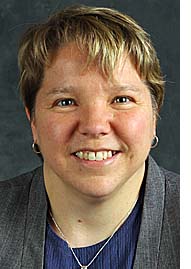
Sidebar: Monica Hasek At Antioch College Wellness Center

FEATURE: Interim Wellness Center Director Monica Hasek (submitted photo)Local yoga studio owner Monica Hasek has been named the new director of the Antioch College Wellness Center, the college announced on Tuesday.

“We feel lucky that we found someone in the village whose passion and expertise seem to fit with the wellness center,” Antioch College President Mark Roosevelt said. “I think that this tightens the village/college connection.”

Hasek, who with her husband, Robert, has run Yoga Springs on Dayton Street for the past 10 years, could start her new position as early as next week. She replaces Becky Harrison, who was hired in February but left the job last week.

A more detailed story about Hasek will be in next week’s News.
 

Return to main article: Leadership shifts at Antioch College


Leadership shifts at Antioch College


SIDEBAR: Monica Hasek hire as interim Wellness Center director.

Recent shifts in Antioch College leadership aim to build on the college’s strengths and distinctiveness, as well as pivot to a new stage of growth, according to College President Mark Roosevelt in recent interviews. The changes include a new focus on global studies, the hiring of a new academic leader, the loss of a key fundraiser and a re-arrangement at the top levels of college leadership.

“The real effort is to integrate what we have, to put together the strengths we have in a way that’s compelling,” Roosevelt said this week.

For instance, since its reopening, the college has offered individual pieces of a global studies program, but until now the pieces have not cohered into a whole, Roosevelt said. Recently, former vice president for academic affairs Hassan Rahmanian began bringing these pieces together in his new role as leader of the college’s global learning initiatives.

Several factors led to the emphasis on global studies, Roosevelt said, including intense student interest and the success of the college’s language acquisition courses. And the reborn college found itself with a faculty that is rich in global experience. Currently, the college has 35 faculty members, and a significant number either came from, or have lived in such countries as Argentina, Brazil, Greece, Japan, Mexico, Belgium, Indonesia and Jamaica, among others.

“For a small faculty, we have an important reservoir of languages and cultures here,” Rahmanian said, stating that this particular strength of the college is underutilized. “It’s a great resource.”

And Rahmanian, who came to this country from Iran as a graduate student, has a lifelong passion for helping students engage with the wider world.

“I love it. This change brings me new energy,” Rahmanian said.

A member of the Antioch College faculty from 1986 until the college closed in 2008, Rahmanian was named vice president of academic affairs after the college re-opened, and as such oversaw the development of the new college’s curriculum. But the need for that initial push has passed, according to Rahmanian, and since he’s never felt fully comfortable as an administrator, he’s ready to pursue his passion for global studies.

“This opens up an ocean of new possibilities,” Rahmanian said.

Among the possibilities are developing a major in global studies in which a student would spend semesters at universities in two different countries, along with beefing up the “global” part of the college’s global learning seminars. Rahmanian also plans to work closely with a new consortium of 16 international liberal arts colleges, through the Great Lakes College Association, or GLCA, to develop collaborative courses.

New academic leader

Antioch College this week announced that Lori Collins-Hall is the new vice-president of academic affairs. She plans to start her job in July. (Submitted photo)

Antioch College this week announced that Lori Collins-Hall is the new vice-president of academic affairs. She plans to start her job in July. (Submitted photo)

Taking Rahmanian’s place as vice president for academic affairs will be Lori Collins-Hall, currently professor of sociology and the chair of the sociology department at Hartwick College in Oneonta, N.Y., Roosevelt announced this week.

Collins-Hall brings with her a “trifecta of skill sets” that is uniquely suited to what the college needs at this stage in its growth, according to Roosevelt. Those skill sets include significant experience with student assessment, especially assessment of experiential learning; expertise in the accreditation process; and a deep connection with experiential learning, Roosevelt said.

The college also seeks an academic leader who can ease the administrative burden currently borne by faculty, who are “tired and overworked,” Roosevelt said, but not overworked by their teaching. Rather, due to the college’s start-up nature, faculty members have been called on to develop policies and procedures, a sometimes overwhelming job on top of a teaching load.

“Our hope is that Lori can help the faculty organize around these administrative tasks that have been burdensome to them,” Roosevelt said.

All in all, he is impressed with Collins-Hall’s level of energy and willingness to take the challenge, Roosevelt said.

In an interview this week, Collins-Hall said she’s excited to start her new job.

“I think Antioch and I are a really good match,” she said, describing herself as, “passionate about liberal arts colleges and passionate about experiential learning. It was a key criterion for me to feel that I have something substantial to contribute on day one.”

Collins-Hall said her new job begins on July 21 and she plans to live in Yellow Springs.

Good fits

Finding the right people to work at the college isn’t a simple thing, according to Roosevelt, responding to the recent loss of several key staff members. Because the college doesn’t have the time or financial resources to use consultants, he personally conducts the searches for key positions, often relying on help from Rick Detweiler, the head of the GLCA.

“This isn’t the easiest place to work. It’s very demanding. I’m demanding,” Roosevelt said.

In the past several weeks, two recently-hired college leaders have left Antioch. In both cases, according to Roosevelt, the people hired “were not a good fit and we reached mutually acceptable resolution.”

Dan Doron, former director of communications, left last week, as did Becky Harrison, the director of the Wellness Center. (See sidebar on new director).

In a recent press release, the college announed that Vice-President for Advancement Brian Williams, who has been on the job less than a year, will leave Antioch mid-May to join the Associated Colleges of the Midwest, where he will be vice president and director of faculty development and grant programs.

“That job is our toughest job,” Roosevelt of the advancement position, stating that it requires both traditional and nontraditional fundraising strategies.

While the press release describes the loss of Williams as “disappointing,” it states that the change allows the college to streamline its fundraising and communication efforts. A new position which includes all these responsibilites, the vice president for external relations, will be filled by Jennifer Jolls, the current director of institutional effectiveness. While Jolls will oversee the overall fundraising efforts, a new advancement professional will be hired to head the fundraising team, Roosevelt said.

With the college since 2011, Jolls came to Antioch as assistant director of communications. Since then, her responsibilities have increased to include overseeing the college’s efforts to regain accreditation. An accreditation team from the North Central Association, the accrediting agency, visited the college last fall to determine if Antioch will be approved as an official candidate for accreditation, the next step in the multi-year process. While Roosevelt received an initial report from the accreditation team last winter, he is not allowed to discuss it, although he said, “We have no reason to be discouraged.”

The college will hear whether it is approved for candidacy in early summer.

Jolls’ efforts toward the accreditation work shined a light on her impressive work ethic and strengths in organization and strategic thinking.

“She’s a superstar,” Roosevelt said. “She’s done an awesome job. And at Antioch, that means you get a bigger challenge.”

Antioch College to host “Living as Form” symposium

Antioch College and the Herndon Gallery will be hosting a series of events, May 9–11, in connection to its current exhibition, “Living as Form (The Nomadic Version).” Originally produced in 2011 for Creative Time in New York City under the curation of Nato Thompson, “Living as Form” seeks to draw a through-line between the “critical mass” of activism that emerged in the 21st century with the concurrent turn toward the social in contemporary art. 

On Friday, May 9, at 7 p.m., the Herndon Gallery will host a performance by Micha Cárdenas, a Los Angeles-based artist and scholar. Her work seeks to “create community, autonomy, and reduce violence against women, LGBTQI people, people of color, and other groups who continue to combat violence on a daily basis.” Cárdenas works with overlapping realms of performance, activism, and technology to organize for change.

On Saturday, May 10, the Compass Group, a collective of artists and activists who have been working in what they describe as the geographic and political area of the Midwest Radical Cultural Corridor, will present the fourth iteration of the People’s Trial on Monsanto, a participatory public hearing on Monsanto’s public record, and the impact of their products and policies on life—in this community, nation and biosphere.  The hearing has been organized under the collaborative leadership of Sarah Lewison (Carbondale, Ohio), Sarah Kanouse (Iowa City, Iowa) and Claire Pentecost (Chicago, Illinois), and will be staged at the Clifton Lodge in Clifton, Ohio, from 10 a.m. to 4 p.m.  

Local farmers, conservation managers, seed cleaners, agricultural workers, scientists, and naturalists have been recruited to testify as to the significance of genetic modification and associated technologies, as well as the role of government in regulating (or not regulating) these technologies. The trials have previously been held in Carbondale, Illinois; St. Louis, Missouri; and Iowa City, Iowa. The public is invited to attend this free public performative “trial.”

The symposium will conclude on Sunday, May 11, with a roundtable discussion in the Herndon Gallery on the Antioch College campus beginning at 10 a.m. The discussion will include independent scholar and cultural critic Brian Holmes; artist and scholar Micha Cárdenas; artist collaborative ESCAPE GROUP; and Sara Black, assistant professor of visual art at Antioch College, as moderator. Following the discussion, ESCAPE GROUP, in collaboration with Sara Black, will present a performance that explores the recipe as form and content. 

All events during the symposium are free and open to the public.

Antioch College to present farm vision


View a larger image of the Antioch Farm plan.

 
Antioch College will lay out its long-term vision for a 36-acre property on the south end of campus known as the “golf course” at a public meeting next week.

In what Antioch leaders called a project central to the college’s mission to demonstrate sustainable ways of living, the college plans to use the land this year for growing vegetables, grazing meat animals, planting a food forest and constructing a five-acre solar photovoltaic array.

Within five years Antioch hopes to dig a second geothermal well field, pasture more —and larger—animals and designate public paths through and around the property, which will be largely fenced off.

Antioch presents its South Campus Master Plan at 7 p.m. Wednesday, May 7, in the John Bryan Community Center gymnasium.

According to Andi Adkins, Antioch’s vice president of administration and finance, the college organized the community meeting so it could share its plans with both concerned neighbors and supporters of its sustainability initiatives.

“There are people who don’t understand our plan and have misgivings, so we want to answer those questions,” Adkins said. “But we also want to celebrate with our supporters — those who are into sustainable farming and teaching kids how to farm and feed the world sustainably.”

Since the college first made public its plans to expand its farm at a Village Council meeting last August, a group of about 35 to 40 villagers, mostly the farm’s immediate neighbors, have organized in opposition, saying that the “golf course” has been valuable open space since 1930.

Specifically, the group, Yellow Springs Open Space Coalition, disapproves of the college’s plan to fence off most of the property, making it inaccessible to villagers, site an “industrial-looking” solar array there and pasture large ruminants like cows and pigs, according to Mike Kelly of the coalition. Neighbors also contend that the college has not changed its plans to accommodate their concerns, even though they are now part of an Antioch Golf Course Committee.

“People won’t be able to walk their dogs through the golf course, fly kites, throw a Frisbee, camp or continue all the uses that we have had there for more than 80 years,” Kelly said, adding, “I don’t think the college is listening. I don’t think there’s give-and-take.”

Kelly said deed restrictions that limit zoning changes on the “golf course” property demonstrate a long-held Village desire that the land be kept as community open space. When Antioch University sold the “golf course” to the Village in 1981 while under some financial stress, the Village agreed to keep the land as open space. Later, when Antioch repurchased the property in 1991, Antioch agreed to comply with the current provisions of E-1 educational zoning and to not seek a zoning change that would allow commercial or private residential uses on the site.

“What we take from those deeds is that they represent the history of the golf course as community open space, and a philosophy held by the Village and college,” Kelly said.

But Antioch leaders defended their plan for the property this week, saying that they are not violating deed restrictions since they don’t plan to seek a zoning change from E-1 education. Moreover, both a sustainable farm and solar array are a vital part of the college’s mission to find “new and better ways” of living and will help Antioch reach its stated goal of a zero carbon footprint.

Antioch Trustee David Goodman said in a phone interview that Antioch has an opportunity to use the property to lead in the development of ways humanity can live “without destroying the very resources we need to live, like food, water and energy.”

“The Antioch farm is not just a nice, cute way to say we’re green,” he said. “We need to figure out a way to have a physical place on the campus where we can create a model that works economically, practically, socially, spiritually and environmentally.”

Goodman argued that the farm will remain “open space” because it will still be partially accessible to the public but will additionally generate food, sequester carbon in its soil and be more ecologically healthy than mowed grassland.

Becoming a leader in sustainability will also help attract students, make Antioch distinctive among liberal arts colleges, and helps “operationalize” its vision of connecting practical work with academic learning, according to Glen Helen Ecology Institute director Nick Boutis.

“There’s a broad sense that what we’re doing is distinctive,” Boutis said. “The farm is the most significant realization of how we marry classroom experience and work to build an enriched learning environment for students in the context of a significant global issue.”

In addition to Boutis, the following Antioch representatives are expected to speak at the May 7 meeting: President Mark Roosevelt, Facilities Manager Reggie Stratton, Farm Manager Kat Christen, Food Service Coordinator Isaac DeLamatre, Dean of Admissions Micah Canal, Associate Professor of Environmental Science Linda Fuselier, Visiting Assistant Professor of Visual Arts Raewyn Martyn and others. Brett Henderson of Miamisburg’s Solar, Power & Light, which is developing the solar array, will also make a presentation.

More animals planned for farm

The initial phase of the Antioch Farm, which was started in 2011, has included a half acre for annual vegetables, a half-acre food forest of fruit and nut trees and native plants and movable grazing pens covering about one acre for 50 chickens and ducks and six ewes (female sheep). Those uses received Village administrative approval and then were grandfathered in in August by Village Council during an overhaul of the zoning code.

However, Council, in response to neighbors’ concerns, also decided at that meeting that in the new zoning code sustainable farming would be a conditional rather than permitted use in the E-1 education district, meaning that Antioch would have to seek Planning Commission approval for any changes to its farm operation such as adding more animals or barns.

According to farm manager Kat Christen, Antioch doesn’t plan to make any changes to its animal operation this year, but they are hoping to introduce about two cows, five pigs, 50 ewes and 30 goats in the coming years to help manage the grassland more sustainably while simultaneously producing meat for students.

While raising animals has become the most controversial aspect of Antioch’s “golf course” plan, Christen defended the use of animals, saying animals are critical for a sustainable farm because their manure fertilizes the land while the animals keep the grass and weeds down. And since students are now eating meat, raising animals is a way to provide a more healthy and local product for students, she said.

“Grazing animals allows us to distribute fertility and build the soil and enhance the ecological function of that area, managing that land without the use of fossil-fueled mowers,” Christen said.

Antioch will use the accepted sustainable practice of rotational grazing, so animals will only have access to 30 percent of the property at any given time, Christen said. Multiple kinds of animals are important because they eat different plants, she added.

Neighbors, however, still have questions about how many animals the Village will ultimately allow on the property, according to Kelly, citing concerns that animals will smell, pollute the land with manure and attract predators like coyotes and foxes. Antioch initially proposed that the upper limits for animals as a permitted use in the zoning code be up to 1,400 pounds per acre, with additional per-acre limits of two pigs, or 1.4 cows, or 17 sheep, or 35 chickens. However, when Council decided to make farming a conditional use instead of a permitted one, per-acre animal limits were not included in the code.

Antioch does plan to expand its planting areas this year. The South Campus site plan drawings for 2014 show an expansion of the annual garden just south of the Antioch Science Building to 1.67 acres and the planting of a 1- to 1.5-acre food forest along Allen Street near the Antioch School. The plan also shows two rotational grazing pens, of 1.74 acres and 2.15 acres, located south of the garden along the west side of the property.

There are also currently compost piles on the property that recycle campus food and organic waste. Long term plans additionally show a walking path circumnavigating the property and another cutting through between Herman Street and Corry Street, a reserved Antioch School play area just west of the school and protected woods at the corner of Corry and Allen Streets.

Solar request before Planning

Construction could begin on a solar array on the “golf course” later this summer if the Village Planning Commission grants Antioch a conditional use permit to produce solar energy there. College leaders hope to seek approval from the Planning Commission in May or June to construct a 1.25-megawatt solar photovoltaic array on five acres on the eastern side of the golf course along Corry Street. If the Planning Commission approves the plan, more than 3,300 panels measuring around six feet by three feet will be erected inside a permanent chain link fence there. By fall, the array could produce about 50 percent of the college’s electricity.

The Village has been in discussions with Antioch for two years about a large solar array on campus, according to Stratton, Antioch facility’s manager, since the college’s solar array would be connected to the Village grid and because Antioch is currently the village’s largest consumer of electricity.

An onsite solar array is essential to reaching the zero carbon footprint goal set by the college and so the college can “walk the talk” about the threat of climate change, Stratton said.

“We’re not going to depend on the large utility companies to do what’s right because they will extract and burn fossil fuels as long as possible,” Stratton said. “Research shows onsite renewable generation is the way going forward.”

The need to produce solar power on campus was heightened when Antioch moved recently from natural gas heating to a geothermal heating and cooling system, which increased its electricity load dramatically, Stratton said. Even though the village is projected to purchase about 85 percent of its electricity from renewable sources by next year, Antioch wants to go further, since the electric grid still carries electricity generated from fossil fuels.

“The Village is supporting the renewable industry, but what we’re getting across our grid is still coal and natural gas-based,” Stratton said. “This way we know we’re getting clean energy directly to our campus.”

Neighbors, however, see a potential community eyesore in the solar array. They have also expressed concern about Antioch cutting trees down to accommodate the panels and the impact on Village finances of losing such a significant electricity customer.

“We love solar energy, we just don’t think planting five acres of industrial-looking ugly concrete, steel and glass panels instead of open space is a good idea,” Kelly said of the coalition. “I don’t want my bill to go up so I can have solar panels out my window.”

Stratton responded that because of neighbor concerns, Antioch moved the planned solar array slightly west to save a stand of old sycamore trees growing along Corry Street, and that they plan on erecting a gallery of student and community art projects along the fence to make it look more attractive. Furthermore, the village won’t be harmed financially because of flexibility in the town’s electricity portfolio and because Antioch will continue to pay peak demand charges on its electricity use.

Kelly and other members of the Yellow Springs Open Space Coalition look forward to attending the May 7 meeting to ask more questions of Antioch leaders, but they remain skeptical that the college will respond to their concerns. Instead, the group plans on pressuring the Planning Commission to not grant Antioch conditional use permits for the solar farm and later, for large animals.

“Our initial position was we wanted the golf course to stay the same and then we thought they would listen,” Kelly said. “At this point we realize our only position is to speak out at the Planning Commission.”

Glen’s Trailside raises baby chicks for Antioch College farm

Naturalists at Glen Helen are hatching and raising about two dozen chicks at Trailside Museum. Among the current batch are chicks that are one, three and four weeks old. At seven weeks, the chicks will be moved across the street to live their adult lives at the Antioch College farm.

Last week Antioch College student and Trailside assistant Joshua Lucca and Trailside volunteer Emory Schweitzer talked to visitors stopping by for a peek. Noah and Gabriel Winkler came from Middletown to hike in the Glen and stopped at Trailside for a visit with the chicks. Noah, below, was at least as excited about the pile of 20 rocks and fossils he found in the Glen as he was about the chicks.  

Noah Winkler came from Middletown with his family for a hike in the Glen last week.

Noah Winkler came from Middletown with his family for a hike in the Glen last week.


Activism and art at Antioch

When is activism also art?

For example, Women on Waves, a ship that performs medical abortions outside of the territorial waters of countries where it is illegal, or Project Row Houses, a low-income housing development in Houston where the houses are sometimes canvases for artistic expression. When aesthetics or theatrics are used in everyday social activism, is it also a kind of visual or performance art?

At Antioch College, which has staked out a legacy in both activism and art, that question will be explored in a new exhibit at the Herndon Gallery in South Hall that runs April 18 through May 16.

“Living as Form (The Nomadic Version)” is an international exhibit of socially engaged art featuring archived documentation from 22 projects that could be considered both activism and art.

Originally presented by Creative Time in New York City in 2012, “Living as Form” challenges traditional notions about art’s boundaries, contributing to a new category of contemporary art sometimes referred to as “social practice,” according to co-curator Sara Black, assistant professor of visual art at Antioch.

“It’s so contemporary that it is still finding its feet in the art historical cannons, and there’s so much debate about what to call it,” Black said. “It’s testing the boundaries of what we comfortably call art.”

The exhibit is a collaboration of Black with Antioch artists-in-residency Jillian Soto and Anthony Romero, Chicago-based performance artists who arrived on campus last week to teach, create and curate for three months. To Romero, a performer and writer native to Texas, the exhibit looks at how art can be used for social change.

“The exhibition is a question about how activists are able to use artists’ strategies and tactics to organize communities and make change,” Romero said.

The “Living as Form” projects (which include Women on Waves and Project Row Houses) are organized by theme and will be presented in three sections. Weekly conversations with Antioch art faculty and residents showcasing work on each theme will begin at 7:30 p.m. Wednesday, April 23, with a discussion of “Occupation and Convening.”

Explained Soto of the first theme: “Many of the projects involve people occupying territories they aren’t supposed to or convening in public places you wouldn’t normally convene to perform an action or sing.” Other conversations will be on “Borders and Access” on April 30 and “Difference” on May 7.

In addition, two new performance art works were commissioned for exhibit and will be shown on the weekend of May 9–11. Performing is Micha Cárdenas, a transgender artist from California whose work focuses on ending violence against queer and trans people, people of color, indigenous people, youth and sex workers, according to her website. The Compass Group of the Midwest Radical Cultural Corridor will also present a day-long “people’s hearing” on Monsanto, which has been previously held in St. Louis, Mo., Iowa City, Ia., and Carbondale, Ill. Those works will ultimately become part of the archive of projects as it continues to travel around the country.

Herndon Gallery is one of 15 venues to exhibit “Living as Form” since 2012 with other exhibitions as far-flung as Israel, Taiwan, Russia, Western Sahara and Mexico and as close as Youngstown, Ohio, according to the project’s website. Curator Nato Thompson, who has also written a book on the 100 socially engaged projects he collected, created the exhibit to respond to what he saw was a historically unique trend in art.

The atypical show won’t simply feature artwork on the walls, since “the work happened out in the world,” according to Black. The exhibition arrives as a hard drive of saved images, photos and videos documenting the actions, putting the daunting task of presenting material that is “ephemeral in nature” on the co-curators, Black said. The goal is to turn a hard drive in a “box the size of my hand” to something that is engaging to the community, she said.

But Black, with her background in sculpture, installation art and performance, and the experienced performance artists Romero and Soto are well equipped to craft a meaningful show from the documentation, since performers often have to explore how people experience work outside of its live context, Black said. Recently, the trio began by building a platform in the center of the Herndon, but the audience will have to wait until the exhibit opens to see how the work will ultimately be presented.

The “Living as Form” exhibit is an extension of the artist in residency program at Antioch, which is designed to expose students to new voices and ideas in art since Antioch is so small, with only one instructor in each artistic discipline, Black said. In addition to co-curating the exhibit this quarter, Romero and Soto will open their studio time to students and teach courses in the performance curriculum while associate professor of performance Gabrielle Civil is doing research. Three artists in residence per year live and work on campus.

Soto and Romero are graduates of the Art Institute of Chicago who have collaborated with Black as ESCAPE GROUP, a platform in Chicago that Soto and Romero created to work with other artists.

Performance has recently become a focus of the young art program at the revived Antioch College as an art form that is “on the rise” and which helps students feel more comfortable in their bodies and their selves, Black said. Instead of separating traditional performance forms like dance and theater from performance art, Antioch in its interdisciplinary curriculum has combined them by focusing on “presence,” Black said.

Romero sees performance as about learning how one’s body is “occupying space,” which can be valuable for everyone from an aspiring lawyer to a professor, while Soto says that performance can be used to explore art or life:

“Performing is a kind of skill set and lens to look at art. Once you are aware of what it is to perform, that we are always performing at life.”